Aplicación de aprendizaje profundo en la detección fitosanitaria del cacao usando visión por computadora
DOI:
https://doi.org/10.51252/rcsi.v6i1.1385Palabras clave:
aprendizaje profundo, diagnóstico automatizado, modelos de clasificación, sanidad vegetal, visión artificialResumen
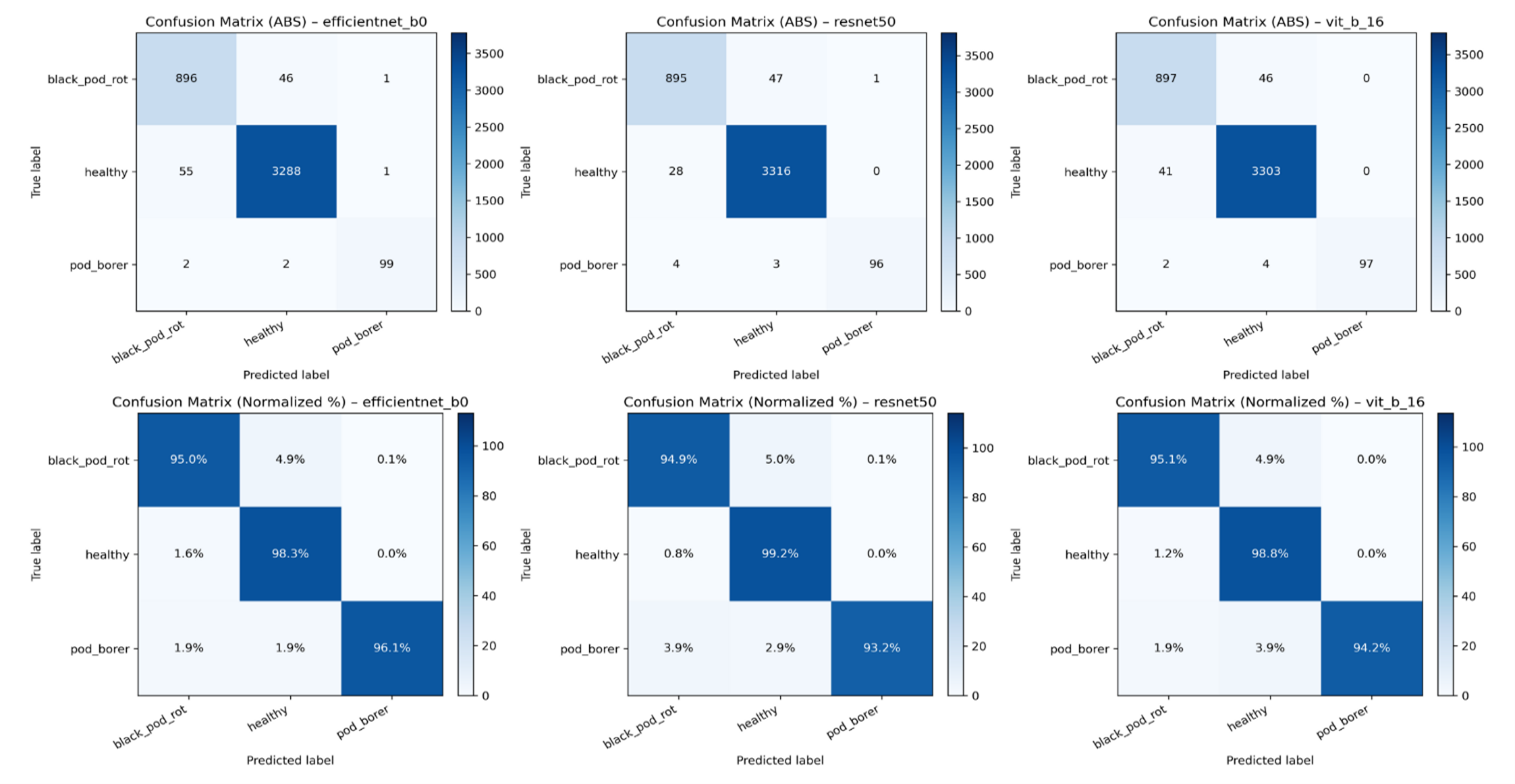
Este estudio analizó la aplicación del aprendizaje profundo en la detección fitosanitaria automatizada del cacao mediante visión por computadora, comparando el desempeño de tres arquitecturas: ResNet50, EfficientNet-B0 y Vision Transformer (ViT-B/16). Se implementó un pipeline reproducible que integró preprocesamiento de imágenes, validación cruzada estratificada de cinco pliegues y análisis estadístico inferencial mediante ANOVA de medidas repetidas. El conjunto de datos estuvo conformado por 4 390 imágenes RGB de frutos de cacao, distribuidas en tres clases desbalanceadas: Healthy, Black Pod Rot y Pod Borer. Todos los modelos fueron ajustados mediante fine-tuning completo y entrenados con el optimizador AdamW, parada temprana y programación dinámica de la tasa de aprendizaje. Los resultados mostraron valores medios de F1 macro superiores a 0.96 en las tres arquitecturas, sin diferencias estadísticamente significativas entre modelos (F = 0.278, p = 0.7645). Las curvas de entrenamiento evidenciaron convergencia estable y baja variabilidad inter-fold, sin indicios de sobreajuste. Los hallazgos indican que el rendimiento depende principalmente de la calidad del pipeline experimental y del manejo del desbalance de clases, más que del tipo de arquitectura empleada.
Descargas
Citas
Anjali, Jena, A., Bamola, A., Mishra, S., Jain, I., Pathak, N., Sharma, N., Joshi, N., Pandey, R., Kaparwal, S., Yadav, V., Gupta, A. K., Jha, A. K., Bhatt, S., Kumar, V., Naik, B., Rustagi, S., Preet, M. S., & Akhtar, S. (2024). State-of-the-art non-destructive approaches for maturity index determination in fruits and vegetables: principles, applications, and future directions. Food Production, Processing and Nutrition, 6(1), 56. https://doi.org/10.1186/s43014-023-00205-5
Bono, A., Guaragnella, C., & D’Orazio, T. (2026). A perspective analysis of imaging-based monitoring systems in precision viticulture: Technologies, intelligent data analyses and research challenges. Artificial Intelligence in Agriculture, 16(1), 62–84. https://doi.org/10.1016/j.aiia.2025.08.001
Charry, A., Perea, C., Ramírez, K., Zambrano, G., Yovera, F., Santos, A., Jiménez, T., Romero, M., Lundy, M., Quintero, M., & Pulleman, M. (2025). The bittersweet economics of different cacao production systems in Colombia, Ecuador and Peru. Agricultural Systems, 224, 104235. https://doi.org/10.1016/j.agsy.2024.104235
Cilas, C., & Bastide, P. (2020). Challenges to Cocoa Production in the Face of Climate Change and the Spread of Pests and Diseases. Agronomy, 10(9), 1232. https://doi.org/10.3390/agronomy10091232
Deepa, R., Varun, P., Shoba, L. K., Swathy, R., & Prabhu, B. (2025). Advanced Image Processing Techniques for Precision Agriculture. In Innovations and Developments in Unmanned Aerial Vehicles (pp. 227–244). IGI Global Scientific Publishing. https://doi.org/10.4018/979-8-3693-8462-6.ch010
Delgado-Ospina, J., Molina-Hernández, J. B., Chaves-López, C., Romanazzi, G., & Paparella, A. (2021). The Role of Fungi in the Cocoa Production Chain and the Challenge of Climate Change. Journal of Fungi, 7(3), 202. https://doi.org/10.3390/jof7030202
He, K., Zhang, X., Ren, S., & Sun, J. (2015). Deep Residual Learning for Image Recognition. In Cornell University. https://doi.org/https://doi.org/1512.03385
Injante, R., Rios-Trigoso, G., Ramírez-Shupingahua, S., & Tejada Shupingahua, K. (2025). Procesamiento de imágenes para la detección de la madurez del fruto: una revisión sistemática. Revista Peruana de Ingeniería, Arquitectura y Medio Ambiente, 2(1). https://doi.org/10.37711/repiama.2025.2.1.3
Kingma, J., & Ba, D. P. (2014). Adam: A Method for Stochastic Optimization. Cornell University. https://doi.org/https://doi.org/10.48550/arXiv.1412.6980
Lebrini, Y., & Ayerdi Gotor, A. (2024). Crops Disease Detection, from Leaves to Field: What We Can Expect from Artificial Intelligence. Agronomy, 14(11), 2719. https://doi.org/10.3390/agronomy14112719
Magfirah, N., Sartiami, D., Niogret, J., & Ekayanti, A. (2025). Biological parameter of cocoa pod borer Conopomorpha cramerella (Lepidoptera: Gracillariidae) under laboratory conditions. IOP Conference Series: Earth and Environmental Science, 1494(1), 012020. https://doi.org/10.1088/1755-1315/1494/1/012020
Mall, P. K., Singh, P. K., Srivastav, S., Narayan, V., Paprzycki, M., Jaworska, T., & Ganzha, M. (2023). A comprehensive review of deep neural networks for medical image processing: Recent developments and future opportunities. Healthcare Analytics, 4, 100216. https://doi.org/10.1016/j.health.2023.100216
Miyittah, M. K., Kosivi, R. K., Tulashie, S. K., Addi, M. N., & Tawiah, J. Y. (2022). The need for alternative pest management methods to mitigate risks among cocoa farmers in the Volta region, Ghana. Heliyon, 8(12), e12591. https://doi.org/10.1016/j.heliyon.2022.e12591
Paparella, A., Schirone, M., & López, C. C. (2025). The Health Impact of Cocoa from Cultivation to the Formation of Biogenic Amines: An Updated Review. Foods, 14(2), 255. https://doi.org/10.3390/foods14020255
Polania Bello, V. (2023). Diagnosis of the agronomic and phytosanitary management practices of cocoa producers in San José del Fragua: the case of the Cerafín Garcia property. Environmental Research and Ecotoxicity, 2, 55. https://doi.org/10.56294/ere202355
Puig, A. S., Irish, B., Ayala-Silva, T., Wurzel, S., & Gutierrez, O. (2022). Effect of Cacao Black Pod Rot Screening Method on Disease Reaction Determination. The 1st International Online Conference on Agriculture—Advances in Agricultural Science and Technology, 71. https://doi.org/10.3390/IOCAG2022-12215
Quintero, I., Ceccaldi, A., Martínez, H., Santander, M., Rodríguez, J., & Escobar, S. (2025). Dry cacao pulp in chocolate bars: A sustainable, nutrient-rich sweetener with enhanced sensory quality through refractance windows drying. Applied Food Research, 5(1), 100700. https://doi.org/10.1016/j.afres.2025.100700
Raj, M., & Prahadeeswaran, M. (2025). Revolutionizing agriculture: a review of smart farming technologies for a sustainable future. Discover Applied Sciences, 7(9), 937. https://doi.org/10.1007/s42452-025-07561-6
Ray, R. K., Chakravarty, S., Dash, S., Ghosh, A., Mohanty, S. N., Reddy Chirra, V. R., Ayouni, S., & Khan, M. I. (2025). Precision pest management in agriculture using Inception V3 and EfficientNet B4: A deep learning approach for crop protection. Information Processing in Agriculture. https://doi.org/10.1016/j.inpa.2025.09.005
Schmidt, J. E., Puig, A. S., DuVal, A. E., & Pfeufer, E. E. (2023). Phyllosphere microbial diversity and specific taxa mediate within-cultivar resistance to Phytophthora palmivora in cacao. MSphere, 8(5). https://doi.org/10.1128/msphere.00013-23
Shafay, M., Hassan, T., Owais, M., Hussain, I., Khawaja, S. G., Seneviratne, L., & Werghi, N. (2025). Recent advances in plant disease detection: challenges and opportunities. Plant Methods, 21(1), 140. https://doi.org/10.1186/s13007-025-01450-0
Song, X., Yan, L., Liu, S., Gao, T., Han, L., Jiang, X., Jin, H., & Zhu, Y. (2025). Agricultural Image Processing: Challenges, Advances, and Future Trends. Applied Sciences, 15(16), 9206. https://doi.org/10.3390/app15169206
Taha, M. F., Mao, H., Zhang, Z., Elmasry, G., Awad, M. A., Abdalla, A., Mousa, S., Elwakeel, A. E., & Elsherbiny, O. (2025). Emerging Technologies for Precision Crop Management Towards Agriculture 5.0: A Comprehensive Overview. Agriculture, 15(6), 582. https://doi.org/10.3390/agriculture15060582
Tan, M., & Le, Q. V. (2020). EfficientNet: Rethinking Model Scaling for Convolutional Neural Networks. Cornell University. https://doi.org/https://doi.org/10.48550/arXiv.1905.11946
Villalobos-Culqui, C., Valles-Coral, M. A., García-Rivas-Plata, C., & Tuesta-Hidalgo, O. A. (2025). Modelo de visión artificial basada en redes neuronales convolucionales para identificación de mazorca negra en plantaciones de cacao. Revista Científica de Sistemas e Informática, 5(1), e678. https://doi.org/10.51252/rcsi.v5i1.678
Vinci, G., Ruggeri, M., Gobbi, L., & Savastano, M. (2024). Social Life Cycle Assessment of Cocoa Production: Evidence from Ivory Coast and Ghana. Resources, 13(10), 141. https://doi.org/10.3390/resources13100141
Wang, Y., Deng, Y., Zheng, Y., Chattopadhyay, P., & Wang, L. (2025). Vision Transformers for Image Classification: A Comparative Survey. Technologies, 13(1), 32. https://doi.org/10.3390/technologies13010032
Waqas, M., Naseem, A., Humphries, U. W., Hlaing, P. T., Dechpichai, P., & Wangwongchai, A. (2025). Applications of machine learning and deep learning in agriculture: A comprehensive review. Green Technologies and Sustainability, 3(3), 100199. https://doi.org/10.1016/j.grets.2025.100199
Wu, K., Ji, Z., Wang, H., Shao, X., Li, H., Zhang, W., Kong, W., Xia, J., & Bao, X. (2025). A Comprehensive Review of AI Methods in Agri-Food Engineering: Applications, Challenges, and Future Directions. Electronics, 14(20), 3994. https://doi.org/10.3390/electronics14203994
Zahlul Ikhsan, Muhammad Al-Ikhlas, Yaherwandi, Hasmiandy Hamid, Aulia Oktavia, & Dandy Ahamefula Osibe. (2024). Level of Pest Infestation on Cocoa (Theobroma cacao L.) Variety BL-50 in Tanah Datar Regency, West Sumatera Province, Indonesia. Andalasian International Journal of Entomology, 2(1), 38–47. https://doi.org/10.25077/aijent.2.1.38-47.2024
Descargas
Publicado
Cómo citar
Número
Sección
Licencia
Derechos de autor 2026 Jorge Raul Navarro-Cabrera, José Guillermo Beraún-Barrantes, Ángel Cárdenas-García, Carlos Mauricio Lozano-Carranza

Esta obra está bajo una licencia internacional Creative Commons Atribución 4.0.
Los autores retienen sus derechos:
a. Los autores retienen sus derechos de marca y patente, y tambien sobre cualquier proceso o procedimiento descrito en el artículo.
b. Los autores retienen el derecho de compartir, copiar, distribuir, ejecutar y comunicar públicamente el articulo publicado en la Revista Científica de Sistemas e Informática (RCSI) (por ejemplo, colocarlo en un repositorio institucional o publicarlo en un libro), con un reconocimiento de su publicación inicial en la RCSI.
c. Los autores retienen el derecho a hacer una posterior publicación de su trabajo, de utilizar el artículo o cualquier parte de aquel (por ejemplo: una compilación de sus trabajos, notas para conferencias, tesis, o para un libro), siempre que indiquen la fuente de publicación (autores del trabajo, revista, volumen, número y fecha).