Análisis y modelado predictivo del rendimiento académico mediante técnicas de aprendizaje automático en una institución de educación secundaria
DOI:
https://doi.org/10.51252/rcsi.v6i1.1212Palabras clave:
aprendizaje automático, ciencia de datos, educación secundaria, pythonResumen
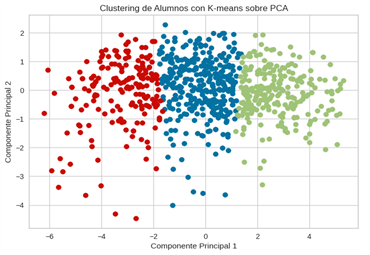
El rendimiento académico es un indicador clave para evaluar la calidad educativa y detectar áreas de mejora en los procesos de enseñanza y aprendizaje. En este trabajo se analizó un conjunto de datos de estudiantes de primer año del ciclo básico de una institución secundaria de la provincia de Salta, Argentina, con el objetivo de identificar variables que influyen en el desempeño estudiantil y apoyar la toma de decisiones orientadas a reducir el bajo rendimiento académico. Siguiendo la metodología CRISP-DM, se realizó un análisis exploratorio para identificar patrones relevantes en las calificaciones, se aplicaron modelos de aprendizaje no supervisado para detectar perfiles de estudiantes y, finalmente, modelos supervisados para predecir la aprobación del año a partir de las calificaciones del segundo trimestre. El mejor modelo alcanzó un F1-Score de 0,80 en la clase minoritaria y un accuracy del 89%. Los resultados permiten anticipar situaciones de riesgo académico y segmentar perfiles estudiantiles, aportando información útil para intervenciones pedagógicas más efectivas.
Descargas
Citas
Amalia, N. L. R., Supianto, A. A., Setiawan, N. Y., Zilvan, V., Yuliani, A. R., & Ramdan, A. (2021). Student Academic Mark Clustering Analysis and Usability Scoring on Dashboard Development Using K-Means Algorithm and System Usability Scale. Jurnal Ilmu Komputer Dan Informasi, 14(2), 137–143. https://doi.org/10.21609/jiki.v14i2.980
Belete, D. M., & Huchaiah, M. D. (2022). Grid search in hyperparameter optimization of machine learning models for prediction of HIV/AIDS test results. International Journal of Computers and Applications, 44(9), 875–886. https://doi.org/10.1080/1206212X.2021.1974663
Bellaj, M., Ben Dahmane, A., Boudra, S., & Lamarti Sefian, M. (2024). Educational Data Mining: Employing Machine Learning Techniques and Hyperparameter Optimization to Improve Students’ Academic Performance. International Journal of Online and Biomedical Engineering (IJOE), 20(03), 55–74. https://doi.org/10.3991/ijoe.v20i03.46287
Breiman, L. (2001). Random Forests. Machine Learning, 45(1), 5–32. https://doi.org/10.1023/A:1010933404324
Calinski, T., & Harabasz, J. (1974). A dendrite method for cluster analysis. Communications in Statistics - Theory and Methods, 3(1), 1–27. https://doi.org/10.1080/03610927408827101
Chapman, P. (2000). Chapman, P. (2000). CRISP-DM 1.0: Step-by-step data mining guide. https://www.semanticscholar.org/paper/CRISP-DM-1.0%3A-Step-by-step-data-mining-guide-Chapman/54bad20bbc7938991bf34f86dde0babfbd2d5a72
Chen, T., & Guestrin, C. (2016). XGBoost. Proceedings of the 22nd ACM SIGKDD International Conference on Knowledge Discovery and Data Mining, 785–794. https://doi.org/10.1145/2939672.2939785
García, A. M. (2014). Rendimiento académico y abandono universitario modelos, resultados y alcances de la producción académica en la Argentina. Revista Argentina de Educación Superior. http://hdl.handle.net/11336/35674
Ghahramani, Z. (2003). Unsupervised Learning. ML Summer Schools. https://doi.org/https://doi.org/10.1007/978-3-540-28650-9_5
Guanin-Fajardo, J. H., Guaña-Moya, J., & Casillas, J. (2024). Predicting Academic Success of College Students Using Machine Learning Techniques. Data, 9(4), 60. https://doi.org/10.3390/data9040060
Huang, G.-B., Zhu, Q.-Y., & Siew, C.-K. (2006). Extreme learning machine: Theory and applications. Neurocomputing, 70(1–3), 489–501. https://doi.org/10.1016/j.neucom.2005.12.126
Ibarra, C. S. (2020). TÉCNICAS DE DATA MINING APLICADAS A LA DESERCIÓN DE LOS ESTUDIANTES DE LA FACULTAD DE CIENCIAS EXACTAS [Universidad del Norte Santo Tomás de Aquino]. https://doi.org/https://doi.org/10.13140/RG.2.2.29986.66244
Kohavi, R. (2001). A Study of Cross-Validation and Bootstrap for Accuracy Estimation and Model Selection. Proceedings of the 14th International Joint Conference on Artificial Intelligence, 2, 1137–1143. https://www.researchgate.net/publication/2352264_A_Study_of_Cross-Validation_and_Bootstrap_for_Accuracy_Estimation_and_Model_Selection
Leng, Q., Guo, J., Tao, J., Meng, X., & Wang, C. (2024). OBMI: oversampling borderline minority instances by a two-stage Tomek link-finding procedure for class imbalance problem. Complex & Intelligent Systems, 10(4), 4775–4792. https://doi.org/10.1007/s40747-024-01399-y
MacQueen, J. (1967). Some methods for classification and analysis of multivariate observations. In Berkeley Symp. on Math. Statist. and Prob. University of California, Los Angeles.
Martínez, C. A., Hohl, D. M., Gutiérrez, M. de los A., Palmal, S., Faux, P., Adhikari, K., Gonzalez-Jose, R., Bortolini, M. C., Acuña-Alonzo, V., Gallo, C., Linares, A. R., Rothhammer, F., Catanesi, C. I., & Barrientos, R. J. (2025). DNA-based prediction of eye color in Latin American population applying Machine Learning models. Computers in Biology and Medicine, 194, 110404. https://doi.org/10.1016/j.compbiomed.2025.110404
Menacho Chiok, C. H. (2017). Predicción del rendimiento académico aplicando técnicas de minería de datos. Anales Científicos, 78(1), 26. https://doi.org/10.21704/ac.v78i1.811
Mohamed Nafuri, A. F., Sani, N. S., Zainudin, N. F. A., Rahman, A. H. A., & Aliff, M. (2022). Clustering Analysis for Classifying Student Academic Performance in Higher Education. Applied Sciences, 12(19), 9467. https://doi.org/10.3390/app12199467
Ogunsanya, M., Isichei, J., & Desai, S. (2023). Grid search hyperparameter tuning in additive manufacturing processes. SME North American Manufacturing Research Conference. https://doi.org/https://doi.org/10.1016/j.mfglet.2023.08.056
Plathottam, S. J., Rzonca, A., Lakhnori, R., & Iloeje, C. O. (2023). A review of artificial intelligence applications in manufacturing operations. Journal of Advanced Manufacturing and Processing, 5(3). https://doi.org/10.1002/amp2.10159
Rainio, O., Teuho, J., & Klén, R. (2024). Evaluation metrics and statistical tests for machine learning. Scientific Reports, 14(1), 6086. https://doi.org/10.1038/s41598-024-56706-x
Romero, C., & Ventura, S. (2020). Educational data mining and learning analytics: An updated survey. WIREs Wiley Interdisciplinary Reviews, 10(3). https://doi.org/https://doi.org/10.1002/widm.1355
Ros, F., Riad, R., & Guillaume, S. (2023). PDBI: A partitioning Davies-Bouldin index for clustering evaluation. Neurocomputing, 528, 178–199. https://doi.org/10.1016/j.neucom.2023.01.043
Rousseeuw, P. J. (1987). Silhouettes: A graphical aid to the interpretation and validation of cluster analysis. Journal of Computational and Applied Mathematics, 20, 53–65. https://doi.org/10.1016/0377-0427(87)90125-7
Saltos-Mero, J., & Cruz-Felipe, M. (2024). Análisis del rendimiento académico de estudiantes de las carreras Economía y Turismo con Power BI en los periodos (2021). 593 Digital Publisher CEIT, 9(1), 762–772. https://doi.org/10.33386/593dp.2024.1.2162
Shobha, G., & Rangaswamy, S. (2018). Machine Learning (pp. 197–228). https://doi.org/10.1016/bs.host.2018.07.004
Snoek, J., Larochelle, H., & Adams, R. P. (2012). Practical Bayesian Optimization of Machine Learning Algorithms. Cornell University. https://doi.org/https://doi.org/10.48550/arXiv.1206.2944
Syakur, M. A., Khotimah, B. K., Rochman, E. M. S., & Satoto, B. D. (2018). Integration K-Means Clustering Method and Elbow Method For Identification of The Best Customer Profile Cluster. IOP Conference Series: Materials Science and Engineering, 336, 012017. https://doi.org/10.1088/1757-899X/336/1/012017
Thorndike, R. L. (1953). Who Belongs in the Family? Psychometrika, 18(4), 267–276. https://doi.org/10.1007/BF02289263
Tukey, J. W. (1977). Exploratory Data Analysis, Volumen 2 (18th ed.). Addison-Wesley Publishing Company.
Wang, J., Lu, S., Wang, S.-H., & Zhang, Y.-D. (2022). A review on extreme learning machine. Multimedia Tools and Applications, 81(29), 41611–41660. https://doi.org/10.1007/s11042-021-11007-7
Yang, S. J. H., Lu, O. H. T., Huang, A. Y. Q., Huang, J. C. H., & Hiroaki Ogata, A. J. Q. L. (2018). Predicting Students’ Academic Performance Using Multiple Linear Regression and Principal Component Analysis. J-Stage, 26, 170–176. https://doi.org/https://doi.org/10.2197/ipsjjip.26.170
Zhang, T., Ramakrishnan, R., & Livny, M. (1996). BIRCH. ACM SIGMOD Record, 25(2), 103–114. https://doi.org/10.1145/235968.233324
Descargas
Publicado
Cómo citar
Número
Sección
Licencia
Derechos de autor 2026 Alejandro Miguel Zalasar, Ramón Aramayo, Cristian Alejandro Martínez

Esta obra está bajo una licencia internacional Creative Commons Atribución 4.0.
Los autores retienen sus derechos:
a. Los autores retienen sus derechos de marca y patente, y tambien sobre cualquier proceso o procedimiento descrito en el artículo.
b. Los autores retienen el derecho de compartir, copiar, distribuir, ejecutar y comunicar públicamente el articulo publicado en la Revista Científica de Sistemas e Informática (RCSI) (por ejemplo, colocarlo en un repositorio institucional o publicarlo en un libro), con un reconocimiento de su publicación inicial en la RCSI.
c. Los autores retienen el derecho a hacer una posterior publicación de su trabajo, de utilizar el artículo o cualquier parte de aquel (por ejemplo: una compilación de sus trabajos, notas para conferencias, tesis, o para un libro), siempre que indiquen la fuente de publicación (autores del trabajo, revista, volumen, número y fecha).