VEGA-RAD: Hybrid physical-statistical model for the daily prediction of solar radiation in the Amazon
DOI:
https://doi.org/10.51252/rcsi.v6i1.1454Keywords:
machine learning, climate uncertainty, hybrid model, daily solar radiationAbstract
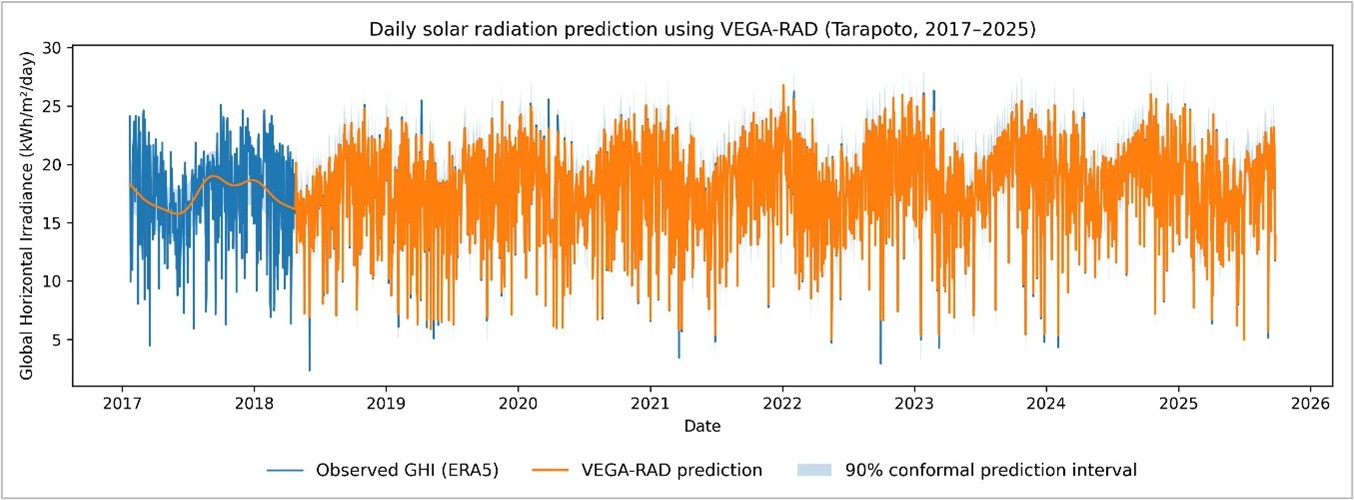
Daily solar radiation forecasting in the Peruvian Amazon represents a relevant challenge due to the high atmospheric variability that characterizes the region. In this study, VEGA-RAD (Vega Radiative Adaptive Dynamics) is formulated and evaluated as a hybrid physical–statistical model for daily solar radiation prediction in tropical environments. The model integrates an interpretable physical–astronomical proxy, stochastic temporal memory, and an adaptive statistical correction based on machine learning to capture residual nonlinearities. The analysis is conducted using daily ERA5 reanalysis data for the period 2017–2025, obtained through the Open-Meteo API. The results show a reduction in mean absolute error (MAE) from 1.699 to 0.477 kWh/m²/d and an increase in the coefficient of determination (R²) from 0.635 to 0.854. These improvements are supported by paired inferential analysis (Wilcoxon) and non-parametric bootstrap resampling. In addition, conformal prediction intervals achieve coverage levels consistent with the nominal 90 % and 95 % levels, with a temporally stable average width, indicating a conservative and reliable quantification of predictive uncertainty. The proposed VEGA-RAD model is presented as a reproducible, interpretable, and robust tool for energy applications in Amazonian contexts.
Downloads
References
Abad-Alcaraz, V., Castilla, M., Carballo, J. A., Bonilla, J., & Álvarez, J. D. (2025). Multimodal deep learning for solar radiation forecasting. Applied Energy, 393, 126061. https://doi.org/10.1016/j.apenergy.2025.126061
Aladwani, S. M., Almutairi, A., Alolayan, M. A., Abdullah, H., & Abraham, L. M. (2025). Prediction of solar radiation as a function of particulate matter pollution and meteorological data using machine learning models. Journal of Engineering Research, 13(4), 2818–2825. https://doi.org/10.1016/j.jer.2024.11.005
Alves, P. V., Bourscheidt, V., Fabrício dos Santos, L. O., & Humbelino de Melo, P. R. (2025). Seasonal variations and trends in solar UV spectral irradiances based on data from the Ozone Monitoring Instrument at solar noon in Southern Amazonas, Brazil. Remote Sensing Applications: Society and Environment, 37, 101423. https://doi.org/10.1016/j.rsase.2024.101423
Amorim, A. C. B., de Almeida Dantas, V., dos Reis, J. S., de Assis Bose, N., Emiliavaca, S. de A. S., Cruz Bezerra, L. A., de Matos, M. de F. A., de Mello Nobre, M. T. C., Oliveira, L. de L., & de Medeiros, A. M. (2024). Analysis of WRF-solar in the estimation of global horizontal irradiation in Amapá, northern Brazil. Renewable Energy, 235, 121361. https://doi.org/10.1016/j.renene.2024.121361
Arseven, B., & Çınar, S. M. (2025). A novel hybrid solar radiation forecasting algorithm based on discrete wavelet transform and multivariate machine learning models integrated with clearness index clusters. Journal of Atmospheric and Solar-Terrestrial Physics, 267, 106417. https://doi.org/10.1016/j.jastp.2025.106417
Bakır, H. (2024). Prediction of daily global solar radiation in different climatic conditions using metaheuristic search algorithms: a case study from Türkiye. Environmental Science and Pollution Research, 31(30), 43211–43237. https://doi.org/10.1007/s11356-024-33785-x
Celik, A. N., Sarman, B., & Polat, K. (2025). Horizontal-to-tilted conversion of solar radiation data using machine learning algorithms. Engineering Applications of Artificial Intelligence, 153, 110951. https://doi.org/10.1016/j.engappai.2025.110951
Chen, Y., & Gao, Y. (2022). Comparative analysis of digital trade development strategies and governance approaches. Journal of Digital Economy, 1(3), 227–238. https://doi.org/10.1016/j.jdec.2023.02.001
Cui, X., Yin, S., Chen, H., & Niu, D. (2025). A temporal–image parallel hybrid solar radiation–wind speed–green hydrogen production potential prediction model based on federated learning and rolling real-time decomposition. Energy, 337, 138516. https://doi.org/10.1016/j.energy.2025.138516
Demir, V. (2025). Evaluation of Solar Radiation Prediction Models Using AI: A Performance Comparison in the High-Potential Region of Konya, Türkiye. Atmosphere, 16(4), 398. https://doi.org/10.3390/atmos16040398
Ghareeb, N., Alanazi, A., Sedaghat, A., Farhat, M. H., Mehdizadeh, A., Salem, H., Nazififard, M., & Mostafaeipour, A. (2025). Integrating experimental and theoretical approaches for enhanced machine learning modeling of solar radiation. Engineering Science and Technology, an International Journal, 70, 102156. https://doi.org/10.1016/j.jestch.2025.102156
Ghimire, S., Bhandari, B., Casillas-Pérez, D., Deo, R. C., & Salcedo-Sanz, S. (2022). Hybrid deep CNN-SVR algorithm for solar radiation prediction problems in Queensland, Australia. Engineering Applications of Artificial Intelligence, 112, 104860. https://doi.org/10.1016/j.engappai.2022.104860
Hamdaouy, H., Benghoulam, E. M., Chaibi, M., Berrada, M., & Hmaidi, A. El. (2025). Estimating daily global solar radiation using deep learning. Results in Engineering, 27, 106132. https://doi.org/10.1016/j.rineng.2025.106132
Hersbach, H., Bell, B., Berrisford, P., Hirahara, S., Horányi, A., Muñoz‐Sabater, J., Nicolas, J., Peubey, C., Radu, R., Schepers, D., Simmons, A., Soci, C., Abdalla, S., Abellan, X., Balsamo, G., Bechtold, P., Biavati, G., Bidlot, J., Bonavita, M., … Thépaut, J. (2020). The ERA5 global reanalysis. Quarterly Journal of the Royal Meteorological Society, 146(730), 1999–2049. https://doi.org/10.1002/qj.3803
Hou, X., Fountoulakis, I., Blanc, P., Aebi, C., & Kazadzis, S. (2025). Intrahour solar radiation forecasting based on sun visibility for different cloud types. Solar Energy, 294, 113477. https://doi.org/10.1016/j.solener.2025.113477
Hu, Z., Wan, Z., Wang, Z., Zhang, H., Liu, S., Fan, X., & Zheng, W. (2025). Machine learning modeling of indoor thermal sensation under solar radiation considering skin temperatures. Building and Environment, 275, 112822. https://doi.org/10.1016/j.buildenv.2025.112822
Huang, L., Kang, J., Wan, M., Fang, L., Zhang, C., & Zeng, Z. (2021). Solar Radiation Prediction Using Different Machine Learning Algorithms and Implications for Extreme Climate Events. Frontiers in Earth Science, 9. https://doi.org/10.3389/feart.2021.596860
Jadhav, A. V., & Bhawar, R. L. (2025). Future changes in surface solar radiation over India: A bias-corrected and downscaled assessment of CMIP6 projections for renewable energy planning. Energy and Climate Change, 6, 100213. https://doi.org/10.1016/j.egycc.2025.100213
Krishnan, N., & Ravi Kumar, K. (2025). Impact of shortwave radiation parameterization schemes in predicting global horizontal irradiance for various climatic zones by WRF-Solar: A case study in India. Journal of Atmospheric and Solar-Terrestrial Physics, 274, 106590. https://doi.org/10.1016/j.jastp.2025.106590
Open-Meteo. (2025). Open-Meteo Historical Weather API (ERA5 Reanalysis Data). https://open-meteo.com/en/docs/historicalweather-api
Rajput, J., Kushwaha, N. L., Srivastava, A., Vishwakarma, D. K., Mishra, A. K., Sahoo, P. K., Suna, T., Rana, L., Jatav, M. S., Kumar, J., Dimple, Shaloo, Bisht, H., Rai, A., Zerouali, B., Pande, C. B., & Elbeltagi, A. (2025). Developing machine learning models for predicting daily relative humidity and solar radiation using lagged time series data inputs in a semi-arid climate. Journal of Atmospheric and Solar-Terrestrial Physics, 276, 106619. https://doi.org/10.1016/j.jastp.2025.106619
Raju, V. A. G., Nayak, J., Dash, P. B., & Mishra, M. (2025). Short-term solar irradiance forecasting model based on hyper-parameter tuned LSTM via chaotic particle swarm optimization algorithm. Case Studies in Thermal Engineering, 69, 105999. https://doi.org/10.1016/j.csite.2025.105999
Ruan, G., Chen, X., Li, Y., Lim, E. G., Fang, L., Jiang, L., Du, Y., & Wang, F. (2026). SkyNet: A Deep Learning Architecture for Intra-hour Multimodal Solar Forecasting with Ground-based Sky Images. Renewable Energy, 256, 124354. https://doi.org/10.1016/j.renene.2025.124354
Shringi, S., Saini, L. M., & Aggarwal, S. K. (2025). A review of data-driven deep learning models for solar and wind energy forecasting. Renewable Energy Focus, 55, 100739. https://doi.org/10.1016/j.ref.2025.100739
Solano, E. S., & Affonso, C. M. (2023). Solar Irradiation Forecasting Using Ensemble Voting Based on Machine Learning Algorithms. Sustainability, 15(10), 7943. https://doi.org/10.3390/su15107943
Tandon, A., Awasthi, A., Pattnayak, K. C., Tandon, A., Choudhury, T., & Kotecha, K. (2025). Machine learning-driven solar irradiance prediction: advancing renewable energy in Rajasthan. Discover Applied Sciences, 7(2), 107. https://doi.org/10.1007/s42452-025-06490-8
Vignesh Kumar, V., Madhesh, K., Sanjay, K., Guru Prasath, P., Pavish Karthik, A., & Praveen Kumar, G. (2025). A novel ensemble machine learning approach for optimizing sustainability and green hydrogen production in hybrid renewable-based organic Rankine cycle-operated proton exchange membrane electrolyser system. Renewable Energy, 242, 122369. https://doi.org/10.1016/j.renene.2025.122369
Wu, H., Zhang, C., Xue, J., Niu, X., Zhao, B., Pei, G., & Liu, C. (2025). Machine learning forecasts of short wave radiation from geostationary satellite measurements to optimize solar photovoltaic and concentrated solar power systems. Solar Energy, 299, 113718. https://doi.org/10.1016/j.solener.2025.113718
Y.H., H., S.Y., T., & J.Q., G. (2024). Machine Learning-Based Solar Irradiance Forecasting Model Using GPS. Journal of Telecommunication, Electronic and Computer Engineering (JTEC), 16(4), 31–36. https://doi.org/10.54554/jtec.2024.16.04.005
Yadav, A. K., Kumar, R., Wang, M., Fekete, G., & Singh, T. (2025). Comparative analysis of daily global solar radiation prediction using deep learning models inputted with stochastic variables. Scientific Reports, 15(1), 10786. https://doi.org/10.1038/s41598-025-95281-7
Yan, Z., Lu, X., Wu, L., Zhang, H., Liu, F., Wang, X., Xu, W., & Liu, W. (2025). Enhancing short-term solar radiation forecasting with hybrid VMD and GraphCast-based machine learning models. Expert Systems with Applications, 285, 128042. https://doi.org/10.1016/j.eswa.2025.128042
Zerouali, B., Bailek, N., Qaysi, S., Difi, S., Alarifi, N., Elbeltagi, A., Santos, C. A. G., He, K., & Youssef, Y. M. (2025). Hybrid machine learning optimization for solar radiation forecasting. Physics and Chemistry of the Earth, Parts A/B/C, 140, 104052. https://doi.org/10.1016/j.pce.2025.104052
Zhu, L., Huang, X., Zhang, Z., Li, C., & Tai, Y. (2025). A novel U-LSTM-AFT model for hourly solar irradiance forecasting. Renewable Energy, 238, 121955. https://doi.org/10.1016/j.renene.2024.121955
Downloads
Published
How to Cite
Issue
Section
License
Copyright (c) 2026 Juan Francisco Agreda-Vega, Evergisto Sare-Lara, Jimmy Aurelio Rosales-Huamani

This work is licensed under a Creative Commons Attribution 4.0 International License.
The authors retain their rights:
a. The authors retain their trademark and patent rights, as well as any process or procedure described in the article.
b. The authors retain the right to share, copy, distribute, execute and publicly communicate the article published in the Revista Científica de Sistemas e Informática (RCSI) (for example, place it in an institutional repository or publish it in a book), with an acknowledgment of its initial publication in the RCSI.
c. Authors retain the right to make a subsequent publication of their work, to use the article or any part of it (for example: a compilation of their works, notes for conferences, thesis, or for a book), provided that they indicate the source of publication (authors of the work, journal, volume, number and date).