Culturally conditioned misunderstanding in crimes of rape of minors in native communities
DOI:
https://doi.org/10.51252/rcri.v6i2.1523Keywords:
Native communities, customary, customs, anthropological report, cultural interactionAbstract
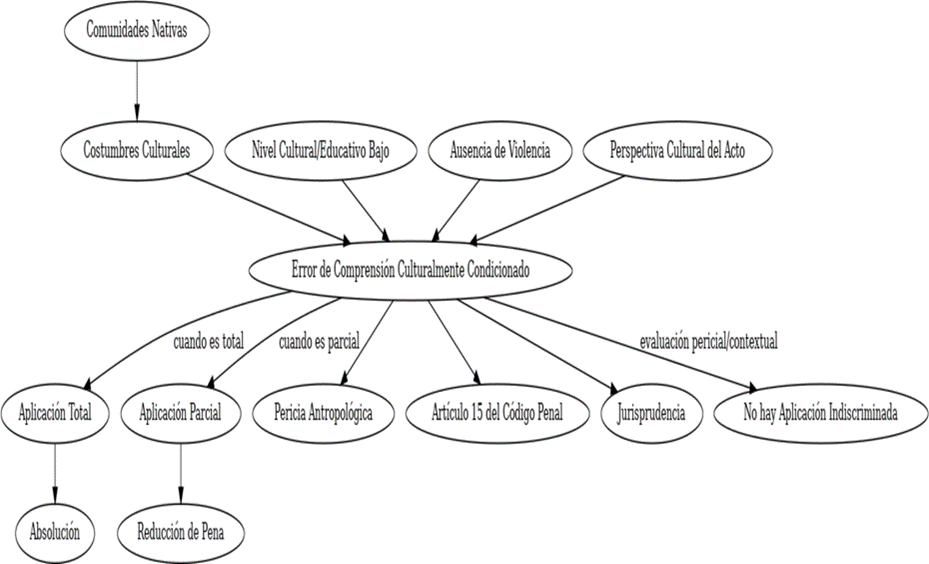
Its general objective is to analyze the application of the culturally conditioned error of understanding in crimes of sexual violation of minors, Collegiate Criminal Court 2019-2022. It was developed under a qualitative, basic approach and with a non-experimental design. The sample was eleven experts, including prosecutors, judges, lawyers and anthropologists. The interview guide was used in the collection of information, and the processing, organization and synthesis of the answers was carried out using the Atlas.ti software. The results show that culturally conditioned misunderstanding is applied exceptionally and, on a case, -by-case basis, mainly in native or rural contexts. Likewise, it was identified that anthropological expertise constitutes the main means of proof for its application; however, its judicial assessment is not uniform and depends on its technical quality, the fieldwork carried out and the articulation with other means of evidence. In conclusion, it is determined that, although the recognition of cultural diversity is a relevant element in criminal justice, it cannot justify the violation of the sexual indemnity of minors, and the principle of the best interests of the child and a rigorous and intercultural assessment of the evidence must prevail.
Downloads
References
Aranibar, E. R., Zanabria, L. C., & Díaz, F. M. (2023). La triple identidad: Error de comprensión culturalmente condicionado, pluriculturalidad y territorialidad. Temas De Nuestra América Revista De Estudios Latinoaméricanos, 39 (73), 1-24. https://doi.org/10.15359/tdna.39-73.5
Benítez, N. M. (2022). El error de prohibición culturalmente condicionado. Análisis dogmático, normativo y jurisprudencial. [Tesis de Pregrado, Universidad Nacional de La Plata]. http://sedici.unlp.edu.ar/handle/10915/143949
Casación N° 29-36-2021- Selva Central, fundamento 8 (Corte Suprema - Sala Penal Permanente 16 de diciembre de 2023).
Casación N° 337-20219 - Cajamarca (Corte Suprema - Sala Penal Permanente 21 de junio de 2017).
Código de los Procedimientos Penales. (1940).
Corte Suprema de Justicia de la República, Acuerdo Plenario N° 01-2015-CIJ-116. (2 de Octubre de 2015).
Flores, A. C., & Valverde, G. F. (2019). Importancia de la pericia antropológica en la determinación del error de tipo en el delito de violación sexual de menor de edad, Arequipa 2018. [Tesis de Pregrado, Universidad Tecnológica del Perú]. https://hdl.handle.net/20.500.12867/2166
Guevara, S. (2020). Violencia sexual y justicia comunal en pueblos indígenas Awajún – Wampis, región Amazonas. SCIÉNDO INGENIUM, 16 (3), 111-123. https://revistas.unitru.edu.pe/index.php/PGM/article/view/3018
Hernández, R., & Mendoza, C. (2018). Metodología de la Investigación. Las rutas cuantitativa, cualitativa y mixta. México: McGraw-Hill INTERAMERICANA EDITORES.
Huete, H. M. (2022). Costumbre del inicio sexual de las niñas y adolescentes en las Comunidades Nativas desde el Análisis cultural del Derecho e indemnidad sexual. [Tesis de Doctorado, Universidad César Vallejo]. https://hdl.handle.net/20.500.12692/78240
Jacinto, D. E. (2021). La violación sexual en los pueblos indígenas del Perú. [Tesis de Doctorado, Universidad Nacional Federico Villarreal]. https://hdl.handle.net/20.500.13084/5155
Le Bonniec, F., Maldonado, K., & Lilo, R. (2023). De la Defensa Cultural al Uso de las Pericias Antropológicas: Avances y Límites del Reconocimiento de la Diversidad Sociocultural en los Tribunales Penales de la Macrorregión Sur de Chile. Chungara. Revista de antropología Chilena, 55 (4), 1-16.
Mantilla, J. (2020). Diálogos posibles en la investigación de la violencia sexual: Estándares interamericanos y el caso peruano. IUS ET VERITAS(59), 18-27. https://doi.org/10.18800/iusetveritas.201902.001%20%20
Mendieta, L., & Maridueña, M. (2023). Uso del Atlas.ti en la construcción de la teoría fundamentada de los relatos de vida de los docentes de la Universidad de Guayaquil en el año 2023. Ciencia y Desarrollo, 26 (3). https://doi.org/10.21503/cyd.v26i3.2489
Ñaupas, H., Mejía, E., Trujillo, I. R., Romero, H. E., Medina, W., & Novoa, E. (2023). Metodología de la Investigación Total. Cuantitativa - Cualitativa y Redacción de la tesis (Quinta ed.). Bogotá: Ediciones de la U.
Palacios, O. A. (2021). La teoría fundamentada: origen, supuestos y perspectivas. Intersticios Sociales(22), 47-70. https://doi.org/10.55555/IS.22.332
Palacios, Y., Maturana, J., & Valoyes, J. K. (2023). Peritaje antropológico y elementos probatorios en el caso de las comunidades afrodescendientes desplazadas de la cuenca del río Cacarica. Antípoda. Revista de Antropología y Arqueología, 1(50), 117-142. https://doi.org/10.7440/antipoda50.2023.06
Piña, L. S. (2023). El enfoque cualitativo: Una alternativa compleja dentro del mundo de la investigación. Revista Arbitrada Interdisciplinaria Koinonía, 8(15), 1-3. https://doi.org/10.35381/r.k.v8i15.2440
Romero, S. (2024). La defensa cultural y la exclusión de la responsabilidad penal por el error culturalmente condicionado. Revista IUS, 18(53), 65-82. https://doi.org/10.35487/rius.v18i53.2024.905
Tapia, C. D. (2024). Peritaje antropológico en materia de derechos humanos ¿utopía o prolegómeno de la justicia? Contribuciones Desde Coatepec, 40, 89-108. https://revistacoatepec.uaemex.mx/article/view/22531
Villanueva, R. (2014). Constitucionalismo, pluralismo jurídico y derechos de las mujeres indígenas. Derecho Público, 32, https://dialnet.unirioja.es/servlet/articulo?codigo=4759787
Downloads
Published
How to Cite
Issue
Section
License
Copyright (c) 2026 Adriana Carolaei Tacilla-Paredes

This work is licensed under a Creative Commons Attribution 4.0 International License.
The authors retain their rights:
a. The authors retain their trademark and patent rights, as well as any process or procedure described in the article.
b. The authors retain the right to share, copy, distribute, execute and publicly communicate the article published in the Ratio Iure Scientific Journal (RCRI) (for example, place it in an institutional repository or publish it in a book), with an acknowledgment of its initial publication in the RCRI.
c. Authors retain the right to make a subsequent publication of their work, to use the article or any part of it (for example: a compilation of their works, notes for conferences, thesis, or for a book), provided that they indicate the source of publication (authors of the work, journal, volume, number and date).