Comparison of two types of inocules in the production of silage from fish viscera
DOI:
https://doi.org/10.51252/raa.v6i2.1721Keywords:
Proximate analysis, protein concentrate, organic waste, biological silage, added value.Abstract
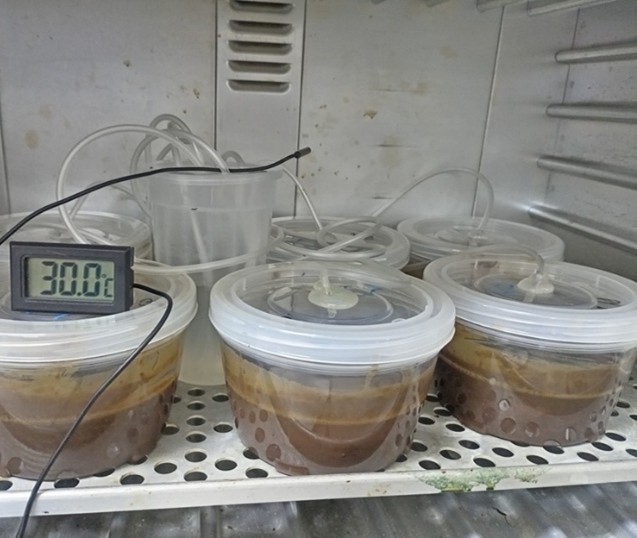
The fish processing industry, for direct human consumption, is an activity that generates significant foreign exchange for the country. It also produces large volumes of waste organic material, which lacks adequate treatment to obtain a value-added product. This study evaluated the use of different inoculants (Lyofast® and Probiotech®) for obtaining fish viscera-based silage as an alternative to promote a circular economy and a protein concentrate for various purposes, maintained at a constant temperature of 30±1°C. A one-factor statistical method was applied (1 factor x 2 treatments and 4 replicates each). The results showed no significant differences (p>0.05) in terms of upH, moisture, protein, and ash content in any of the silages produced. These results demonstrate that it is possible to use Probiotech® for producing fish waste silage with acceptable values for various applications. Although it is formulated for the maintenance and remediation of water quality in fish farming, Probiotech® can also be used as another potential inoculum for microbiological processes that promote a circular economy.
Downloads
References
Abun, A., Rusmana, D., Haetami, K., & Widjastuti, T. (2025). Evaluation of the nutritional value of fermented pangasius fish waste and its potential as a poultry feed supplement. Veterinary World, 18(2), 355–366. https://doi.org/10.14202/vetworld.2025.355-366
Ahuja, I., Dauksas, E., Remme, J. F., Richardsen, R., & Løes, A. K. (2020). Fish and fish waste-based fertilizers in organic farming – With status in Norway: A review. Waste Management, 115, 95–112. https://doi.org/10.1016/j.wasman.2020.07.025
Alfio, V. G., Manzo, C., & Micillo, R. (2021). From fishwaste to value: An overview of the sustainable recovery of omega-3 for food supplements. Molecules, 26(4). https://doi.org/10.3390/molecules26041002
AOAC International. (n.d.). Official Methods of Analysis of AOAC Internacional (OMA). AOAC International. Retrieved https://academic.oup.com/officialmethodsofanalysis-aoac
Arevalo Aguirre, Y. J., Querevalú Ortiz, J., Ochoa Mogollón, G. M., & Sánchez Suárez, H. (2023). Influencia de cepas bacterianas y condiciones de incubación en la viabilidad y calidad de ensilados biológicos para su uso en la producción animal. Manglar, 20(3), 221–231. https://doi.org/10.57188/manglar.2023.025
Caicedo Cadavid, S., & Velásquez Vélez, R. A. (2024). Effect of tilapia (Oreochromis sp) waste silage on the productive performance of rabbits (Oryctolagus cuniculus). Revista de Investigaciones Veterinarias Del Peru, 35(5). https://doi.org/10.15381/rivep.v35i5.29253
Coronado Guerrero, R. G., & Márquez Sandoval, C. A. (2025). Revaluation of aquaculture waste and by-products under a circular economy approach: systematic literature review. Proceedings of the LACCEI International Multi-Conference for Engineering, Education and Technology. https://doi.org/10.18687/LEIRD2025.1.1.505
Díaz Flores, N., Muro Lozada, P. F. M., Vara Valverde, C. A., Moreno Ríos, C. E., Bustillos Aponte, G. V., Davila Ruiz, B., Rivadeneyra Sánchez, N. L., Maslucan Canayo, O. A., & Amaringo Cortegano, C. A. (2023). Características nutricionales comparativas del ensilado biológico de pescado utilizando yogurt natural y suero de queso. Revista de Innovación y Transferencia Productiva -RITP, 4(1). https://doi.org/10.54353/ritp.v4i1.e001
Erasmus, V. N., Kadhila, T., Gabriel, N. N., Thyberg, K. L., Ilungu, S., & Machado, T. (2021). Assessment and quantification of Namibian seafood waste production. Ocean and Coastal Management, 199. https://doi.org/10.1016/j.ocecoaman.2020.105402
Fernández Herrero, A. (2021). Ensilados químicos y biológicos. Una alternativa de aprovechamiento integral y sustentable de los residuos pesqueros en la Argentina. Marine and Fishery Sciences, 34(2), 235–262. https://doi.org/10.47193/mafis.3422021010603
Gaviria Gaviria, Y. S., Camaño Echavarría, J. A., & Zapata Montoya, J. E. (2021). Evaluation of the environmental impact of dry chemical silage obtained from the viscera of red tilapia (Oreochromis spp.) using ecological footprint methodology. Heliyon, 7(6), e07337. https://doi.org/10.1016/j.heliyon.2021.e07337
Instituto Tecnológico Pesquero del Perú. (n.d.). Investigación y desarrollo de productos pesqueros - Fichas Técnicas. Instituto Tecnológico Pesquero del Perú (ITP). Retrieved https://es.scribd.com/document/476409141/FICHAS-TECNICAS-pdf
Khajuria, S., Kumar, S., Natt, S. K., Uniyal, S., Surasani, V. K. R., & Singh, A. (2026). Biological valorization of Pangas fish processing waste into nutrient-rich fish silage using molasses-assisted Lactobacillus plantarum: fermentation dynamics, nutritional quality, and economic feasibility. Frontiers in Aquaculture, 5. https://doi.org/10.3389/faquc.2026.1813678
Lima, J. L., Gomes, F. A., Barreto, L. V., Rosa, B. L., Souza, L. P., Ferreira, J. B., & Freitas, H. J. (2020). Silagem ácida e biológica de resíduos de peixes produzidos na Amazônia ocidental – Acre. Brazilian Journal of Development, 6(6), 36677–36693. https://doi.org/10.34117/bjdv6n6-271
Ochoa Mogollón, G., Ordinola-Zapata, A., Sanchez-Ochoa, G., Vieyra-Peña, E., Palacios-Pinto, G., & Sánchez-Suárez, H. (2025). Effect of biological silage from Litopenaeus vannamei heads on the gut microbial composition and health of laying hens. Revista Cientifica de La Facultad de Veterinaria, 35(1), 1–7. https://doi.org/10.52973/rcfcv-e35549
Peña García, P., Querevalú Ortiz, J., Ochoa Mogollón, G., & Sánchez Suárez, H. (2020). Ensilado biológico de residuos de langostino fermentado con bacterias ácido-lácticas: Uso como biofertilizante en cultivo de pasto y como alimento para cerdos de traspatio. Scientia Agropecuaria, 11(4), 459–471. https://doi.org/10.17268/SCI.AGROPECU.2020.04.01
Ramírez-Ramírez José, Loya-Olguín José, Ulloa José, Rosas-Ulloa Petra, Gutiérrez-Leyva Ranferi, & Silva-Carrillo Yessica. (2020). Aprovechamiento de desechos de pescado y cáscara de piña para producir ensilado biológico. Abanico Veterinario, 10, 1–12. https://doi.org/10.21929/abavet2020.29
Salazar-Sánchez, M. del R., Hernández-Martínez, I. Y., Cuello-Marín, R. R., Martínez Quintero, I. K., & Vilardy-Naranjo, J. (2023). Obtención de ensilaje biológico a partir de fermentación láctica de residuos pesqueros. Revista de La Facultad de Ciencias Básicas, 21(2).
Shaw, C., Knopf, K., & Kloas, W. (2022). Fish Feeds in Aquaponics and Beyond: A Novel Concept to Evaluate Protein Sources in Diets for Circular Multitrophic Food Production Systems. Sustainability (Switzerland), 14(7). https://doi.org/10.3390/su14074064
Toppe, J., & Olsen, R. L. (2024). Fish silage production by fermentation - A manual on how microbial fermentation can turn fish waste into a valuable feed ingredient or fertilizer. In Fish silage production by fermentation. FAO. https://doi.org/10.4060/cd0799en
Vidotti, R. M., Macedo Viegas, E. M., & Carneiro, D. J. (2003). Amino acid composition of processed fish silage using different raw materials. Animal Feed Science and Technology, 105, 199–204. https://doi.org/10.1016/S0377-8401(03)00056-7
Yucra Quispe, M. A. (2022). Alimentación de truchas Oncorhynchus mykiss con dietas de ensilado biológico de vísceras de truchas. Revista de Investigaciones, 11(2), 94–107. https://doi.org/10.26788/ri.v11i2.3131
Zapata-Guerra, J., Ochoa Mogollón, G., Ordinola-Zapata, A., Querevalu-Ortiz, J., Sanchez-Ochoa, G., & Sánchez-Suárez, H. (2025). Utilization of biological silage from shrimp processing waste as a sustainable practice in productive performance of broiler chickens. Revista Cientifica de La Facultad de Veterinaria, 35(1), 1–7. https://doi.org/10.52973/rcfcv-e361762
Downloads
Published
How to Cite
Issue
Section
License
Copyright (c) 2026 Elizabeth Norka LLasaca-Calizaya , Freddy Walter Delgado-Cabrera, Humberto Arbildo-Ortiz, Felix Johnny Tuesta-Ramos, Ehrlich Yam Llasaca-Calizaya

This work is licensed under a Creative Commons Attribution 4.0 International License.
The authors retain their rights:
a. The authors retain their trademark and patent rights, as well as any process or procedure described in the article.
b. The authors retain the right to share, copy, distribute, execute and publicly communicate the article published in the Revista Agrotecnológica Amazónica (RAA) (for example, place it in an institutional repository or publish it in a book), with an acknowledgment of its initial publication in the RAA.
c. Authors retain the right to make a subsequent publication of their work, to use the article or any part of it (for example: a compilation of their works, notes for conferences, thesis, or for a book), provided that they indicate the source of publication (authors of the work, journal, volume, number and date).