Application of Geographic Information Systems (GIS) for mapping and monitoring of zoonoses important to public health
DOI:
https://doi.org/10.51252/revza.v6i2.1616Keywords:
brucellosis, chlamydiosis, interpolation, rabies, public health, GIS, zoonosesAbstract
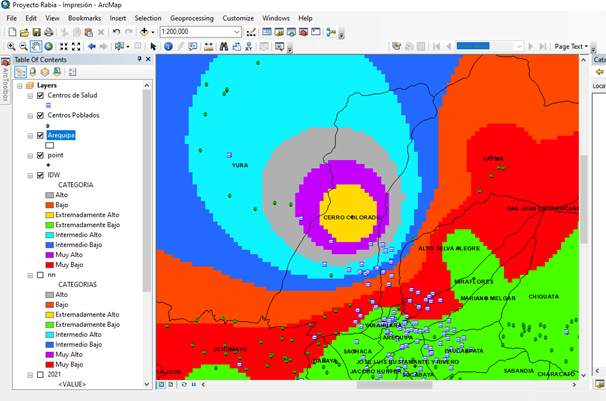
The general objective is to apply Geographic Information Systems (GIS) for the mapping and monitoring of significant zoonoses in public health. Three high-impact diseases are analyzed: rabies (Arequipa), brucellosis (Callao), and chlamydiosis (Ayacucho). Using ArcGIS software, monitoring maps were developed employing Inverse Distance Weighting (IDW) and Nearest Neighbor (NN) interpolation methods. The results demonstrate that the IDW method allows for the visualization of a larger area of influence, identifying more health centers at risk, while the NN method offers a more concentrated view of infectious foci. It is concluded that the integration of GIS tools is vital for transforming traditional epidemiological surveillance into a multisectoral and georeferenced strategy.
Downloads
References
Asante J, Noreddin A, El Zowalaty M. Systematic Review of Important Bacterial Zoonoses in Africa in the Last Decade in Light of the ‘One Health’ Concept. Pathogens [Internet]. 2019 Apr 16;8(2):50. Available from: https://www.mdpi.com/2076-0817/8/2/50
Grace D, Gilbert J, Randolph T, Kang’ethe E. The multiple burdens of zoonotic disease and an ecohealth approach to their assessment. Trop Anim Health Prod [Internet]. 2012 Sep 12;44(S1):67–73. Available from: http://link.springer.com/10.1007/s11250-012-0209-y
Grace D, Mutua FK, Ochungo P, Kruska RL, Jones K, Brierley L, et al. Mapping of poverty and likely zoonoses hotspots [Internet]. Zoonoses Project 4. Nairobi, Kenya: ILRI: Report to the UK Department for International Development; 2012. Available from: https://hdl.handle.net/10568/21161
Jones KE, Patel NG, Levy MA, Storeygard A, Balk D, Gittleman JL, et al. Global trends in emerging infectious diseases. Nature [Internet]. 2008 Feb;451(7181):990–3. Available from: https://www.nature.com/articles/nature06536
Allen T, Murray KA, Zambrana-Torrelio C, Morse SS, Rondinini C, Di Marco M, et al. Global hotspots and correlates of emerging zoonotic diseases. Nat Commun [Internet]. 2017 Oct 24;8(1):1124. Available from: https://www.nature.com/articles/s41467-017-00923-8
Gibb R, Redding DW, Chin KQ, Donnelly CA, Blackburn TM, Newbold T, et al. Zoonotic host diversity increases in human-dominated ecosystems. Nature [Internet]. 2020 Aug 20;584(7821):398–402. Available from: https://www.nature.com/articles/s41586-020-2562-8
Grace D, Lindahl J, Wanyoike F, Bett B, Randolph T, Rich KM. Poor livestock keepers: ecosystem–poverty–health interactions. Philos Trans R Soc B Biol Sci [Internet]. 2017 Jul 19;372(1725):20160166. Available from: http://royalsocietypublishing.org/rstb/article/23261
MESLIN FX, STORH K, HEYMANN D. Public health implications of emerging zoonoses. Rev Sci Tech l’OIE [Internet]. 2000 Apr 1;19(1):310–7. Available from: https://doc.oie.int/dyn/portal/index.xhtml?page=alo&aloId=29623
Naquira C. Las zoonosis parasitarias: problema de salud pública en el Perú. Rev Peru Med Exp Salud Publica [Internet]. 2010;27(4). Available from: http://www.scielo.org.pe/scielo.php?script=sci_arttext&pid=S1726-46342010000400001
Centro Nacional de Epidemiología P y C de E. Vigilancia epidemiológica de enfermedades zoonóticas: rabia [Internet]. 2023. Available from: https://www.saludarequipa.gob.pe/epidemiologia/Alertas/2024/ALERTA_202302 RABIA HUMANA URB.pdf
Escobedo M. L, Falcón P. N. Características epidemiológicas y clínicas de infecciones por Brucella melitensis en pacientes del Hospital Nacional “Daniel A. Carrión”, Callao, Perú (2007-2014). Rev Investig Vet del Perú [Internet]. 2018 Sep 6;29(3):1018–24. Available from: https://revistas.gnbit.net/index.php/veterinaria/article/view/14834
Loli-Pin JP, Villacaqui-Ayllón E, Morales-Cauti S. Prevalencia de anticuerpos contra Chlamydophila abortus en bovinos de crianza extensiva de tres distritos de Ayacucho, Perú. Rev Investig Vet del Perú [Internet]. 2021 Apr 22;32(2):e20011. Available from: https://revistasinvestigacion.unmsm.edu.pe/index.php/veterinaria/article/view/20011
Velasquez Angles F. Frecuencia de perros y evaluación de conocimiento sobre la rabia, en pobladores de una localidad de Arequipa, 2017. Universidad Nacional de San Agustín; 2017.
Urday Febres AI. Características epidemiológicas y clínicas asociadas a la mordedura de perro y adherencia al tratamiento antirrábico, C.S. Mariano Melgar, Arequipa 2019. Universidad Católica de Santa María; 2020.
Yoo SJ, Choi YS, Lim HS, Lee K, Park MY, Chu C, et al. Seroprevalence and Risk Factors of Brucellosis among Slaughterhouse Workers in Korea. J Prev Med Public Heal [Internet]. 2009;42(4):237. Available from: https://jpmph.org/journal/view.php?doi=10.3961/jpmph.2009.42.4.237
Downloads
Published
How to Cite
Issue
Section
License
Copyright (c) 2026 Guillermo Rojas-Tuesta, Otto Angelo Zea-Mendoza, Javier Ñaupari-Vásquez, Haydée Cárdenas-De-Jurado, Segundo Gamarra-Carrillo

This work is licensed under a Creative Commons Attribution 4.0 International License.
The authors retain their rights:
a. The authors retain their trademark and patent rights, as well as any process or procedure described in the article.
b. The authors retain the right to share, copy, distribute, execute and publicly communicate the article published in the Revista de Veterinaria y Zootecnia Amazónica (REVZA) (for example, place it in an institutional repository or publish it in a book), with an acknowledgment of its initial publication in the REVZA.
c. Authors retain the right to make a subsequent publication of their work, to use the article or any part of it (for example: a compilation of their works, notes for conferences, thesis, or for a book), provided that they indicate the source of publication (authors of the work, journal, volume, number and date).