Inverse relationship between the number of blood draws and the osmotic fragility of sheep erythrocytes
DOI:
https://doi.org/10.51252/revza.v5i2.1190Keywords:
blood storage, animal welfare, sheep bloodAbstract
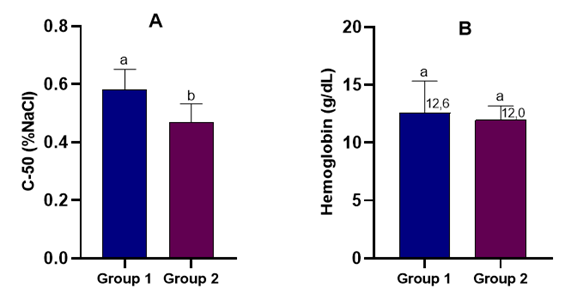
Sheep blood is an important biological reagent for clinical and microbiological laboratories. It is essential to maintain the cellular integrity of its erythrocytes when used in hemolytic reactions of diagnostic protocols. The objective of this study was to determine the relationship between the number of blood draws in rams and erythrocyte osmotic fragility, and its correlation with blood storage time at (2-8) °C, with its thermal robustness for 16 h at laboratory temperature (22-25) °C, and with the welfare and behavior of the rams. The experiments revealed that erythrocyte osmotic fragility is inversely related to the number of blood draws. Hemoglobin concentration remained within the normal range for up to six blood draws, and indicators of animal welfare and behavior did not change. Erythrocytes maintained their osmotic integrity for 42 days of storage at (2-8) °C and for up to 16 h at (22-25) °C. This work has demonstrated, for the first time, the resistance of sheep blood to hemolysis after repeated blood draws from the same animal or exposure to suboptimal temperatures, confirming its use as a reliable reagent in routine diagnostic procedures.
Downloads
References
Chacón AV. Evaluation of ram blood as nutritive supplement in culture media: citratated and defibrinated. MediSan. [Internet] [Accessed 4 Sep 2025]. 2021; 25(03). Available in: https://www.medigraphic.com/cgi-bin/new/resumenI.cgi?IDARTICULO=109221
Očenáš P, Baloga M., Valko-Rokytovská M, Ivašková S. Determination of Biochemical and Metabolomic Characteristics of Sheep Blood Serum and Their Application in Clinical Practice. Life [Internet]. 2025; 15(7):1141. Available in: https://doi.org/10.3390/life15071141
Chabannes M, Bordereau P, Martins PV, Dragon-Durey M.A. Sheep Erythrocyte Preparation for Hemolytic Tests Exploring Complement Functional Activities. In: Roumenina, L.T. (eds) The Complement System. [Internet] 2021; Methods in Molecular Biology, vol. 2227. Humana, New York, NY. Available in: https://doi.org/10.1007/978-1-0716-1016-9_6
Thualfakar HHA, Abdul Hussein A, Almahbob TF. Review of Streptococcus pyogenes. Qeios. [Internet] 2023. Available in: https://doi.org/10.32388/BCSYBU.2
Tang SH, Lin HC, Chang JB, Chan YS, Tang HF, Chang FY, et al. Preservation of red blood cell antigenicity in a new storage solution in vitro. Ann. Med. [Internet]. 2023; 55:168–174. Available in: https://doi.org/10.1080/07853890.2022.2157476
D'Alessandro A, Hod EA. Red blood cell storage: from genome to exposome towards personalized transfusion medicine. Transfus. Med. Rev. [Internet]. 2023; 37(4):150750. Available in: https://doi.org/10.1016/j.tmrv.2023.150750
Yoshida T, Prudent M, D'alessandro A. Red blood cell storage lesion: causes and potential clinical consequences. Blood transfusion = Trasfusione del sangue [Internet]. 2019; 17(1):27–52. Available in: https://doi.org/10.2450/2019.0217-18
Arif SH, Yadav N, Rehman S, Mehdi G. Study of Hemolysis During Storage of Blood in the Blood Bank of a Tertiary Health Care Centre. Indian J. Hematol. Blood Transfus. [Internet]. 2017; 33(4):598-602. Available in: https://doi.org/10.1007/s12288-016-0769-5
Igbokwe N. A review of the factors that influence erythrocyte osmotic fragility. Sokoto Journal of Veterinary Sciences. [Internet]. 2019; 16(4):1-23. Available in: https://doi.org/10.4314/SOKJVS.V16I4.1
Salvagno GL, Demonte D, Dima F, Bovo C, Lippi G. Stability of refrigerated whole blood samples for osmotic fragility test. Hematol. Transfus. Cell. Ther. [Internet]. 2020; 42(2):134-138. Available in: https://doi.org/10.1016/j.htct.2019.06.001
Ilić M, Ivković M, Radaković M, Spariosu K, Andrić N, Kovačević M, et al. Association of increased osmotic fragility of red blood cells with common systemic inflammatory diseases in dogs. Pak. Vet. J. [Internet]. 2023; 43(3):463-469. Available in: https://doi.org/10.29261/pakvetj/2023.048
Gerda BA, Skverchinskaya EA, Andreeva AY, Volkova AA, Gambaryan S, Mindukshev IV. A Comparative Analysis of Erythrocyte Osmotic Fragility across Vertebrate Taxa. J. Evol. Biochem. Phys. [Internet]. 2024; 60(4):1363-1384. Available in: https://doi.org/10.1134/S0022093024040094
Reed GB. Preservation of Red Blood Cells for Hemolytic Reactions. J. Infect. Dis. [Internet]. 1929; 45(4):247-254. Available in: https://doi.org/10.1093/infdis/45.4.247
WVU IACUC Guidelines: Blood Collection – Maximum Volumes and Fluid Replacement. IACUC 20-005. [Internet] [Accessed 15 Jan 2025]. 2023; Version 2. Available in: https://animal.research.wvu.edu/files/d/f050dd7d-efcf-4314-9b36-8c3f446a809d/blood-collection-guidelines.pdf
Aldrich KJ, Saunders DK, Sievert LM, Sievert G. Comparison of erythrocyte osmotic fragility among amphibians, reptiles, birds and mammals. Trans. Kans. Acad. [Internet]. 2006; 109(3):149-158. Available in: https://doi.org/10.1660/0022-8443(2006)109[149:COEOFA]2.0.CO;2
Drabkin DL, Austin JH. Spectrophotometric studies: I. Spectrophotometric constants for common hemoglobin derivatives in human, dog, and rabbit blood. JBC [Internet]. 1932; 98(2):719-733. Available in: https://doi.org/10.1016/S0021-9258(18)76122-X
Al-Qarawi AA, Mousa HM. Lipid concentrations in erythrocyte membranes in normal, starved, dehyrated and rehydrated camels (Camelus dromedarius), and in normal ram (Ovis aries) and goats (Capra hircus). J. Arid Environ. [Internet]. 2004; 59(4):675-683. Available in: https://doi.org/10.1016/j.jaridenv.2004.02.004
Shirke VG, Kandalkar YB, Tanpure MU. Assessment of body condition score as an indicator of nutritional status in Sangamneri goats. Int. J. Vet. [Internet] [Accessed 18 June 2025]. 2024; 9:128-130. Available in: https://www.veterinarypaper.com/pdf/2024/vol9issue3/PartB/9-3-26-361.pdf
Marin N, Moragon A, Gil D, Garcia-Garcia F, Bisbal V. Acclimation and Blood Sampling: Effects on Stress Markers in C57Bl/6J Mice. Animals [Internet]. 2023; 13(18):2816. Available in: https://doi.org/10.3390/ani13182816
Granados Zúñiga, J. Fragilidad osmótica de los eritrocitos de carnero en relación con su uso en el laboratorio clínico. Rev. Cost. Cienc. Méd. [Internet] [Accessed 1 July 2025]. 1993; 14:55-59. Available in: https://hdl.handle.net/10669/336
Forchetti O, Maffrand C, Vissio C, Boaglio C, Cufré G. Hipofosfatemia y fragilidad osmótica eritrocitica en cabras. Revista Electrónica de Veterinaria REDVET® [Internet] [Accessed 27 July 2025]. 2006; 7(1). Available in: https://www.redalyc.org/pdf/636/63612648002.pdf
Ferreira SL, Caires AO, Borges TDS, Lima AM, Silva LO, dos Santos WN. Robustness evaluation in analytical methods optimized using experimental designs. Microchem. J. [Internet]. 2017; 131:163-169. Available in: https://doi.org/10.1016/j.microc.2016.12.004
Downloads
Published
How to Cite
Issue
Section
License
Copyright (c) 2025 Luis Miguel Águila-Pérez, Angel Aquino-Perna, Maylin Pérez-Bernal, Adria Fernández-Pérez, Carlos Hernández-Díaz

This work is licensed under a Creative Commons Attribution 4.0 International License.
The authors retain their rights:
a. The authors retain their trademark and patent rights, as well as any process or procedure described in the article.
b. The authors retain the right to share, copy, distribute, execute and publicly communicate the article published in the Revista de Veterinaria y Zootecnia Amazónica (REVZA) (for example, place it in an institutional repository or publish it in a book), with an acknowledgment of its initial publication in the REVZA.
c. Authors retain the right to make a subsequent publication of their work, to use the article or any part of it (for example: a compilation of their works, notes for conferences, thesis, or for a book), provided that they indicate the source of publication (authors of the work, journal, volume, number and date).