Physicochemical, microbiological and sensory characterization of honey from two ecosystems of San Martín, Peru
DOI:
https://doi.org/10.51252/raa.v6i2.1518Keywords:
water activity, sensory analysis, Apis mellifera, diastase index, multifloral honeyAbstract
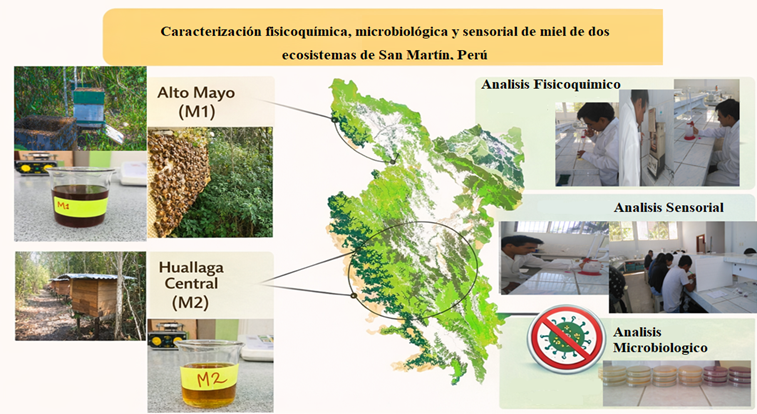
The study aimed to describe the physicochemical, microbiological, and sensory characteristics of honey produced by Apis mellifera L. from two contrasting ecosystems in the San Martín region of Peru: Alto Mayo and Central Huallaga. Representative apiary samples were collected and analyzed using standardized methodologies in accordance with Peruvian Technical Standards and AOAC procedures. The evaluated parameters included pH, moisture content, water activity, soluble solids, density, electrical conductivity, ash content, reducing sugars, diastase activity, hydroxymethylfurfural (HMF) concentration, color, microbiological quality, and sensory attributes assessed through a hedonic scale. The results showed pH values ranging from 3.95 to 4.18, moisture content below 20%, and water activity lower than 0.60, indicating an adequate degree of maturity and product stability. No microbial contamination was detected, while HMF values and diastase activity confirmed the freshness of the honey samples. Sensory evaluation revealed that honey from the Alto Mayo ecosystem achieved higher scores for color, flavor, and overall acceptability, highlighting differences associated with geographical origin and the environmental conditions of each ecosystem.
Downloads
References
AOAC. (2019). Métodos Oficiales de Análisis de la Asociación de Químicos Analíticos Oficiales: Métodos Oficiales de Análisis de AOAC Internacional (21a Edició). AOAC. https://www.aoac.org/wp-content/uploads/2019/08/Front-Matter-List-of-Changes-2.pdf
Belay, A., Solomon, W. K., Bultossa, G., Adgaba, N., & Melaku, S. (2013). Physicochemical properties of the Harenna forest honey, Bale, Ethiopia. Food Chemistry, 141(4), 3386–3392. https://doi.org/10.1016/j.foodchem.2013.06.035
Bruxel, F., Geller, A. M., Felice, A. G., Ströher, J. A., Freitas, A. S. de, Balen, A., Oliveira, M. B. P. P., & Oliveira, W. de C. (2025). Microbial Contamination in Commercial Honey: Insights for Food Safety and Quality Control. Microbiology Research, 16(6), 128. https://doi.org/10.3390/microbiolres16060128
Carrasco, J. C. L. (2015). PLAN NACIONAL APÍCOLA 2015- 2025 IMPULSA COMPETITIVIDAD Y SOSTENIBILIDAD. https://agraria.pe/noticias/plan-nacional-apicola-2015-2025-impulsa-competitividad-y-sos-8180
da Silva, P. M., Gauche, C., Gonzaga, L. V., Costa, A. C. O., & Fett, R. (2016). Honey: Chemical composition, stability and authenticity. Food Chemistry, 196, 309–323. https://doi.org/10.1016/j.foodchem.2015.09.051
Dirección Regional de la Producción de San Martín. (2024). Proyecto apícola: iniciativa trascendental para el desarrollo económico y sostenible de la región. https://www.gob.pe/institucion/regionsanmartin-drp/noticias/1062884-proyecto-apicola-iniciativa-trascendental-para-el-desarrollo-economico-y-sostenible-de-la-region
Escuredo, O., Fernández-González, M., & Seijo María, C. (2012). Differentiation of Blossom Honey and Honeydew Honey from Northwest Spain. Agriculture, 2(1), 25–37. https://doi.org/10.3390/agriculture2010025
FAO. (2001). CODEX STANDARD FOR HONEY CODEX STAN 12-1981. Food and Agriculture Organization. https://share.google/L5ExqxRmLKs3llOCQ
Gobierno Regional San Martín. (2024a). Goresam sensibiliza sobre conservación de flora melífera para el desarrollo de la actividad apícola. https://www.gob.pe/institucion/regionsanmartin/noticias/1020284-goresam-sensibiliza-sobre-conservacion-de-flora-melifera-para-el-desarrollo-de-la-actividad-apicola
Gobierno Regional San Martín. (2024b). San Martín, modelo nacional en desarrollo apícola: más de mil apicultores beneficiados. https://www.gob.pe/institucion/regionsanmartin/noticias/1062301-san-martin-modelo-nacional-en-desarrollo-apicola-mas-de-mil-apicultores-beneficiados
Iglesias, A., Feás, X., Rodrigues, S., Seijas, J. A., Vázquez-Tato, M. P., Dias, L. G., & Estevinho, L. M. (2012). Comprehensive Study of Honey with Protected Denomination of Origin and Contribution to the Enhancement of Legal Specifications. Molecules, 17(7), 8561–8577. https://doi.org/10.3390/molecules17078561
Karabagias, I. K., Badeka, A., Kontakos, S., Karabournioti, S., & Kontominas, M. G. (2014). Characterisation and classification of Greek pine honeys according to their geographical origin based on volatiles, physicochemical parameters and chemometrics. Food Chemistry, 146, 548–557. https://doi.org/10.1016/j.foodchem.2013.09.105
Klein, A.-M., Vaissière, B. E., Cane, J. H., Steffan-Dewenter, I., Cunningham, S. A., Kremen, C., & Tscharntke, T. (2007). Importance of pollinators in changing landscapes for world crops. Proceedings of the Royal Society B: Biological Sciences, 274(1608), 303–313. https://doi.org/10.1098/rspb.2006.3721
Liu, J.-R., Ye, Y.-L., Lin, T.-Y., Wang, Y.-W., & Peng, C.-C. (2013). Effect of floral sources on the antioxidant, antimicrobial, and anti-inflammatory activities of honeys in Taiwan. Food Chemistry, 139(1–4), 938–943. https://doi.org/10.1016/j.foodchem.2013.02.015
Machado De-Melo, A. A., Almeida-Muradian, L. B. de, Sancho, M. T., & Pascual-Maté, A. (2018). Composition and properties of Apis mellifera honey: A review. Journal of Apicultural Research, 57(1), 5–37. https://doi.org/10.1080/00218839.2017.1338444
MIDAGRI. (2021). MIDAGRI: En Perú existen más de 40 mil productores apícolas que trabajan la miel de abeja en 300 mil colmenas a nivel nacional. https://www.gob.pe/institucion/midagri/noticias/492753-midagri-en-peru-existen-mas-de-40-mil-productores-apicolas-que-trabajan-la-miel-de-abeja-en-300-mil-colmenas-a-nivel-nacional
Ministerio del Ambiente. (2020). Informe Nacional sobre el Estado del Ambiente 2014-2019. https://sinia.minam.gob.pe/inea/wp-content/uploads/2024/03/INEA-2014-2019_red_vf.pdf
Oroian, M., & Ropciuc, S. (2017). Honey authentication based on physicochemical parameters and phenolic compounds. Computers and Electronics in Agriculture, 138, 148–156. https://doi.org/10.1016/j.compag.2017.04.020
Potts, S. G., Imperatriz-Fonseca, V., Ngo, H. T., Aizen, M. A., Biesmeijer, J. C., Breeze, T. D., Dicks, L. V., Garibaldi, L. A., Hill, R., Settele, J., & Vanbergen, A. J. (2016). Safeguarding pollinators and their values to human well-being. Nature, 540(7632), 220–229. https://doi.org/10.1038/nature20588
Ramirez Ledesma, A. F., & García Huamán, F. T. (2026). Revisión sistemática: Identificación de flora melífera en apiarios de Perú, 2020-2025. Revistas - Universidad Nacional de Trujillo.
Downloads
Published
How to Cite
Issue
Section
License
Copyright (c) 2026 Juan William Ramirez-Culquicondor, Andy Sanchez-Prada

This work is licensed under a Creative Commons Attribution 4.0 International License.
The authors retain their rights:
a. The authors retain their trademark and patent rights, as well as any process or procedure described in the article.
b. The authors retain the right to share, copy, distribute, execute and publicly communicate the article published in the Revista Agrotecnológica Amazónica (RAA) (for example, place it in an institutional repository or publish it in a book), with an acknowledgment of its initial publication in the RAA.
c. Authors retain the right to make a subsequent publication of their work, to use the article or any part of it (for example: a compilation of their works, notes for conferences, thesis, or for a book), provided that they indicate the source of publication (authors of the work, journal, volume, number and date).