Fermentative capacity of native yeasts isolated from taperiba and masato of the Peruvian Amazon
DOI:
https://doi.org/10.51252/raa.v6i1.1288Keywords:
biomass, bioethanol, kinetics, CO2 productionAbstract
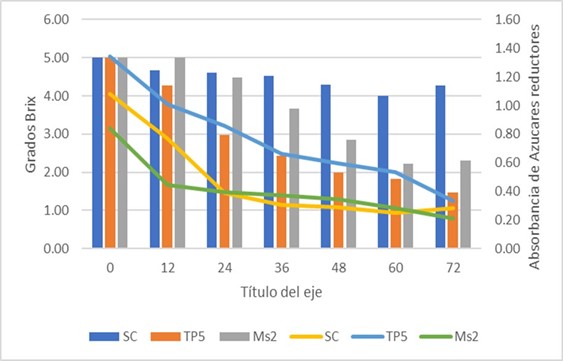
Native yeasts are found on various substrates containing fermentable sugars and are cosmopolitan. They are commonly used in spontaneous fermentations for the preparation of traditional fermented beverages, such as masato, and are also present on most ripe fruits, such as taperibá. This study evaluated the fermentative capacity of native yeasts from masato (Ms2) and taperibá (TP5), using S. cerevisiae (SC) as a control. Data were collected every 12 hours for 72 hours. The parameters evaluated were: Brix degrees, reducing sugars (optical density), CO2 production (ml), and biomass formation (optical density). The results of the kinetic behavior of the evaluated yeasts showed that as time passed, reducing sugars and Brix degrees decreased, while biomass and CO2 production increased. Statistical analysis was performed using SPSS version 27 and the Kruskal-Wallis H test, revealing significant differences. It was concluded that the native yeasts differed from the control.
Downloads
References
Arias Ochoa, A., Barrios Rodríguez, A., Simonsen Cavanzo, E., & Tejeda SantaMaría, S. (2019). Identificación morfológica, fisiológica y molecular de levaduras del género saccharomyces para la elaboración de cerveza. Mente Joven, 8, 55–64.
Burgos Montañez, L. J. (2020). Cuantificación de azúcares reductores del sustrato en residuos de piña con el método del ácido 3,5-dinitrosalicílico. Questionar: Investigación Específica, 7(1), 57–66. https://doi.org/10.29097/23461098.308
Fernádez Collado, C., & Baptista Lucio, P. (2014). Metodología de la Investigación (M. Education (ed.); McGrawHIll). McGrawHIll Education.
Gómez Hernández, F. R. (2023). Evaluación del proceso de propagación y fermentación de dos cepas de levadura Saccharromyces cerevisiae y su influencia en el perfil sensorial del alcohol obtenido en la primera destilación, en DUSA. Agroindustria, Sociedad y Ambiente (A.S.A.), 2(21), 25–43. https://doi.org/http://doi.org/10.5281/zenodo.10389947
González-Leos, A., Del Angel-Del Angel, J. A., González-Castillo, J. L., Rodríguez-Durán, N., & Bustos-Vázquez, G. (2017). Evaluación de levaduras nativas productoras de etanol presentes en el bagazo de caña de azúcar. CienciaUAT, 11(2), 80. https://doi.org/10.29059/cienciauat.v11i2.791
Grijalva-Vallejos, N., Aranda, A., & Matallana, E. (2020). Evaluation of yeasts from Ecuadorian chicha by their performance as starters for alcoholic fermentations in the food industry. International Journal of Food Microbiology, 317, 108462. https://doi.org/10.1016/j.ijfoodmicro.2019.108462
Huerta-Conde, J. A., Schorr-Galindo, S., Figueroa-Hernández, C., Hernández-Estrada, Z. J., Suárez-Quiroz, M. L., & González-Rios, O. (2020). Isolation of autochthonous microorganisms to formulate a defined inoculum for small-scale cocoa fermentation. Revista Mexicana de Ingeniería Química, 20(1), 241–257. https://doi.org/10.24275/rmiq/Bio1869
Lara Utama, G., Sidabutar, F., Felina, H., Wahyudha Wira, D., & Lobo Balia, R. (2019). The utilization of fruit and vegetable wastes for bioethanol production with the inoculation of indigenous yeasts consortium. Bulgarian Journal of Agricultural Science, 25(2), 264–270.
León-Teutli, A. K., Hernández-Iturriaga, M., Miranda-Castilleja, D. E., Aldrete-Tapia, J. A., Soto-Muñoz, L., & Martínez-Peniche, R. Á. (2020). Selection of native yeasts for the production of sparkling ciders from apple varieties established in Querétaro, Mexico. Revista Chapingo Serie Horticultura, 26(1), 29–47. https://doi.org/10.5154/r.rchsh.2019.06.010
Mančić, S., Danilović, B., Malićanin, M., Stamenković Stojanović, S., Nikolić, N., Lazić, M., & Karabegović, I. (2021). Fermentative Potential of Native Yeast Candida famata for Prokupac Grape Must Fermentation. Agriculture, 11(4), 358. https://doi.org/10.3390/agriculture11040358
Martín Sánchez, E. (2020). Oportunidad comercial de bioetanol al mercado peruano. Universidad Militar Nueva Granada.
Miño Valdés, J. E., Martos Actis, M. A., Herrera Garay, J. L., & González Suarez, E. (2015). Fermentación alcohólica con mosto de uva niágara rosada y levaduras de la misma fruta. Centro Azúcar, 42(2).
Miranda-Castilleja, D. E., Ortiz-Barrera, E., Arvizu-Medrano, S. M., Ramiro-Pacheco, J., Aldrete-Tápia, J. A., & Martínez-Peniche, R. Á. (2015). Aislamiento, selección e identificación de levaduras saccharomyces spp. nativas de viñedos en querétaro, méxico. Agrociencia.
Pacheco Canales, Y. R. (2019). Evaluación de la política pública sobre bioetanol como combustible en Perú, 2003-2019. Semestre Económico, 22(53), 127–162. https://doi.org/10.22395/seec.v22n53a6
Poblete, I., Lanino, M., Sepúlveda, B., & Wedeles, A. (2024). Cepa Tamarugal: proceso de vinificación con levaduras nativas y comerciales, Pampa del Tamarugal, desierto de Atacama. Idesia (Arica), 42(1), 71–79. https://doi.org/10.4067/s0718-34292024000100071
Quintana Díaz, A., Villanueva Tarazona, E. E., Alvarado Salinas, P. A., & Llenque Díaz, L. A. (2018). Selección de levaduras nativas productoras de etanol a partir de “chicha de jora” elaborada artesanalmente en el distrito de Santiago de Chuco, La Libertad-Perú. Revista de Investigación Científica (REBIOL), 37(2), 27–35.
Robles Castillo, H., Miranda Chávez, H., & Lora Cahuas, C. (2012). Aislamiento de levaduras productoras de etanol a partir de chicha de jora del Mercado “Mayorista” de Trujillo (Perú). Revista Científca de La Facultad de Ciencias Biológicas.
Romero Isaza, S. P., Suárez Quiroz, M. L., González Ríos, O., Hernández Estrada, Z. J., & Figueroa Hernández, C. Y. (2025). Potencial de las levadurasautóctonas del café comocultivos iniciadores para elproceso de fermentación demasa madreDr. Oscar González RíosDr. Oscar González RíosDra. Mirna L. Suárez QuirozDra. Mirna L. Suárez QuirozM.C. Sara Paola Romero IsazaM.C. Sara Pao. PKP.
Sosa-Aguirre, C. R., Campos-García, J., Mejia-Barajas, J. A., García-Hernández, D., & Santiago-Barajas, C. I. (2024). Fermentación alcohólica de guayaba (Psidium guajava L.) por Kluyveromyces marxianus. Pädi Boletín Científico de Ciencias Básicas e Ingenierías Del ICBI, 12(23), 104–110. https://doi.org/10.29057/icbi.v12i23.12017
Urtubia, A., Franco, W., De Lecco, C. C., Benavides, S., & Durán, A. (2023). Impacto de levaduras autóctonas no Saccharomyces en la reducción de etanol y perfil químico del vino chileno Sauvignon blanc. BIO Web of Conferences, 56, 02018. https://doi.org/10.1051/bioconf/20235602018
Vera Macaya, D. L. (2020). Levaduras autóctonas y su potencial biotecnológico. Repositorio Bibliográfico Biocultural.
Downloads
Published
How to Cite
Issue
Section
License
Copyright (c) 2026 Jhon Aldo Manuel Arce-Herrera, Anita Ruth Mendiola-Céspedes, Yoni Meni Rodriguez-Espejo

This work is licensed under a Creative Commons Attribution 4.0 International License.
The authors retain their rights:
a. The authors retain their trademark and patent rights, as well as any process or procedure described in the article.
b. The authors retain the right to share, copy, distribute, execute and publicly communicate the article published in the Revista Agrotecnológica Amazónica (RAA) (for example, place it in an institutional repository or publish it in a book), with an acknowledgment of its initial publication in the RAA.
c. Authors retain the right to make a subsequent publication of their work, to use the article or any part of it (for example: a compilation of their works, notes for conferences, thesis, or for a book), provided that they indicate the source of publication (authors of the work, journal, volume, number and date).