Ipconazole-induced oxidative stress-associated hepatotoxicity in rats
DOI:
https://doi.org/10.51252/revza.v6i1.1584Keywords:
liver damage, drug, agricultural chemicals, rodentsAbstract
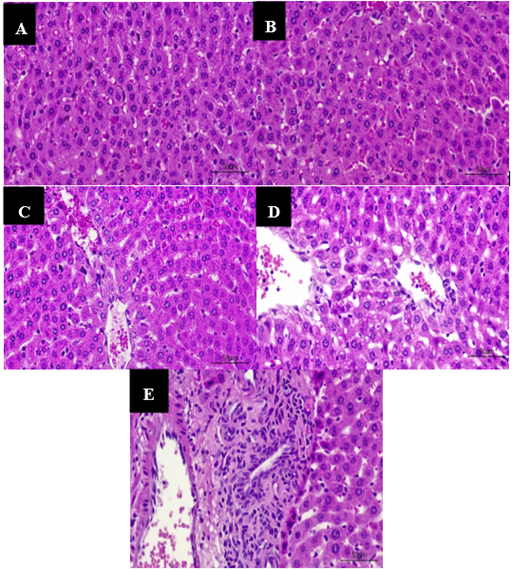
Ipconazole has fungicidal activity. Indiscriminate use or occupational exposure to agricultural chemicals can cause adverse effects on human health. This study investigated liver damage in Wistar rats treated with ipconazole. The rats were randomly assigned to four groups of three specimens each. The first group received a single subcutaneous dose of ipconazole (20 mg/kg) to induce acute liver toxicity in female albino rats. The second, third, and fourth groups were treated intraperitoneally with a single dose of ipconazole (10 mg/kg, 5 mg/kg, and 1 mg/kg, respectively). The fifth group served as a control and was treated only with the vehicle (5% Tween-80 solution in saline). Serum marker enzymes of liver dysfunction, a lipid peroxidation assay (malondialdehyde, MDA), and a histopathological study of the liver were evaluated. It is concluded that ipconazole produces oxidative and structural liver damage upon acute exposure.
Downloads
References
Fang L., Liao X., Jia B., Shi L., Kang L., Zhou L., Kong W. Recent progress in immunosensors for pesticides. 2020; 164. Available from: https://doi.org/10.1016/j.bios.2020.112255
World Health Organization, United Nations Environment Programme. Public health impact of pesticides used in agriculture. Geneva: World Health Organization; 1990. Available from: https://iris.who.int/handle/10665/39772
Kaur R., Mavi GK, Raghav S., Khan I. Pesticides Classification and its Impact on Environment. Int. J. Curr. Microbiol. Appl. Sci. 2019; 8 (3):1889–1897. Available from: https://doi.org/10.20546/ijcmas.2019.803.224
Schwarzbacherová V, Šiviková K, Drážovská M, Dianovský J. Evaluation of DNA damage and cytotoxicity induced by triazole fungicide in cultured bovine lymphocytes. Caryologia. 2015;68(3):233-238. Available from: https://doi.org/10.1080/00087114.2015.1032613
Zhou J, Zhang J, Li F, Liu J. Triazole fungicide tebuconazole disrupts human placental trophoblast cell functions. J Hazard Mater. 2016;308:294-302. Available from: https://doi.org/10.1016/j.jhazmat.2016.01.055
Hodgson, E., Roe. R. M., Mailman, R. B., Chambers, J.E. Dictionary of Toxicology. London: Academic Press- Elsevier; 2015. Available from: https://doi.org/10.1016/C2013-0-12692-X
Andrew D, Sharon A. Hepatotoxicity. En; Hodgson E, editor. A Textbook of Modern Toxicology. 4th. ed. Hobokin: John Wiley & Sons, Inc, 2010. p. 277-303.
Amin A, Hamza AA. Oxidative stress mediates drug-induced hepatotoxicity in rats: a possible role of DNA fragmentation. Toxicology. 2005 Mar 30;208(3):367-75. Available from: https://doi.org/10.1016/j.tox.2004.11.039
Stokes WS. Reducing Unrelieved Pain and Distress in La-boratory Animals Using Humane Endpoints. ILAR Journal. 2000;41(2):59–61. Available from: https://doi.org/10.1093/ilar.41.2.59
Organización para la Cooperación y el Desarrollo Económicos (OCDE). Guía OCDE 407: Toxicidad Oral de Dosis Repetida durante 28 Días en Roedores. Available from: https://www.oecd.org/en/publications/test-no-407-repeated-dose-28-day-oral-toxicity-study-in-rodents_9789264070684-en.html
Mossa AT, Refaie AA, Ramadan A, Bouajila J. Amelioration of prallethrin-induced oxidative stress and hepatotoxicity in rat by the administration of Origanum majorana essential oil. Biomed Res Int. 2013; 2013:859085. Available from: https://doi.org/10.1155/2013/859085
National Research Council (US) Committee for the Update of the Guide for the Care and Use of Laboratory Animals. Guide for the Care and Use of Laboratory Animals. 8th edi-tion. Washington (DC): National Academies Press (US); 2011. Available from: Available from: https://www.ncbi.nlm.nih.gov/books/NBK54050/
Wallace AD, Meyer SA. Hepatotoxicity. En: Smart RC, Hodgson E, edithors. Molecular and Biochemical Toxicology. 4th ed. Hoboken: John Wiley & Sons, Inc.; 2008. p. 671- 92.
Villaorduña C, Mendoza-Carlos M, Chuyma M, Avilés J, Avalos-Diaz A, Lozano-Reategui R, et al. Ipconazole Induces Oxidative Stress, Cell Death, and Proinflammation in SH-SY5Y Cells. Toxics. 2023;11(7):566. Available from: https://doi.org/10.3390/toxics11070566
Ruiz-Yance I, Siguas J, Bardales B, Robles-Castañeda I, Cordova K, Ypushima A, et al. Potential Involvement of Oxidative Stress, Apoptosis and Proinflammation in Ipconazole-Induced Cytotoxicity in Human Endothelial-like Cells. Toxics. 2023;11(10):839. Available from: https://doi.org/10.3390/toxics11100839
Downloads
Published
How to Cite
Issue
Section
License
Copyright (c) 2026 Zuly Kely Zambrano-Inga, Luis Alberto Inostroza-Ruíz

This work is licensed under a Creative Commons Attribution 4.0 International License.
The authors retain their rights:
a. The authors retain their trademark and patent rights, as well as any process or procedure described in the article.
b. The authors retain the right to share, copy, distribute, execute and publicly communicate the article published in the Revista de Veterinaria y Zootecnia Amazónica (REVZA) (for example, place it in an institutional repository or publish it in a book), with an acknowledgment of its initial publication in the REVZA.
c. Authors retain the right to make a subsequent publication of their work, to use the article or any part of it (for example: a compilation of their works, notes for conferences, thesis, or for a book), provided that they indicate the source of publication (authors of the work, journal, volume, number and date).