Profitability and Productive Performance of Gamitana (Colossoma macropomum) Under Commercial Diets During the Fattening Phase
DOI:
https://doi.org/10.51252/raa.v6i1.961Keywords:
amazonian aquaculture, body growth, diet formulation, fattening, proximate analysisAbstract
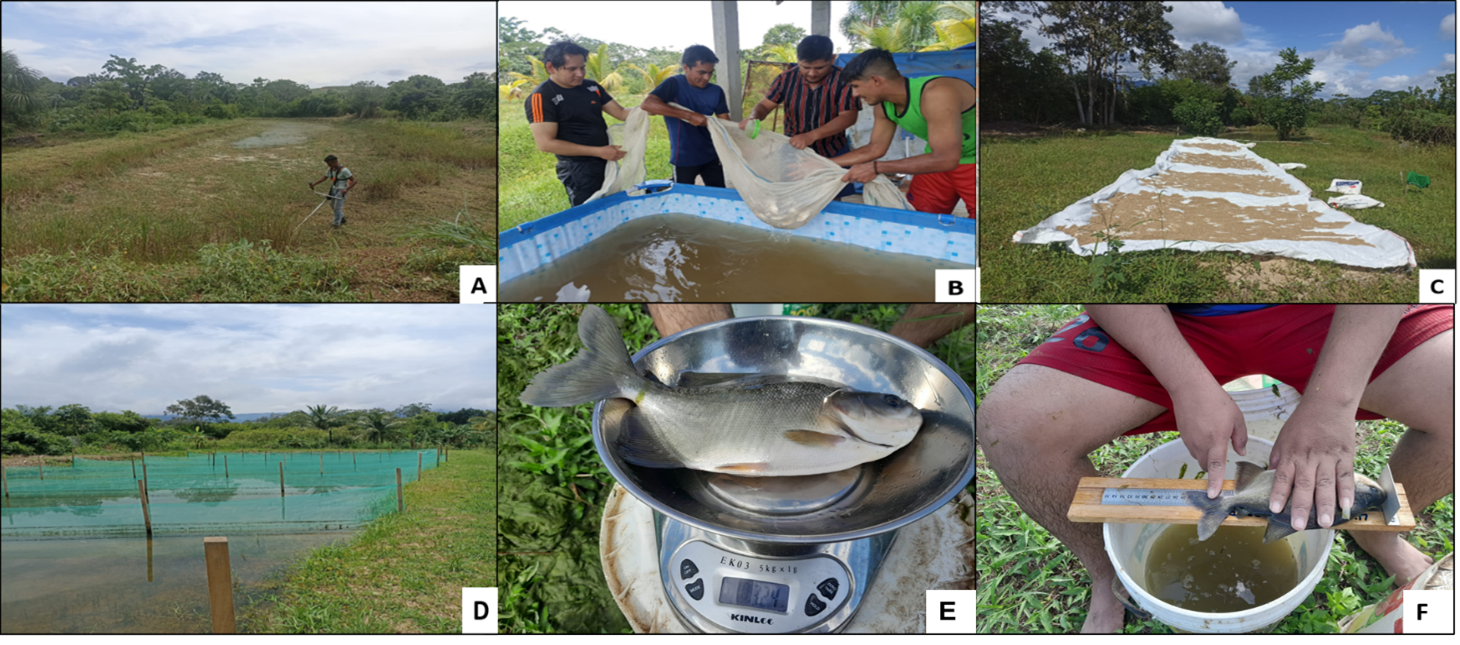
This study evaluated the effect of four commercial diets (D1: Piscis, D2: Aquatech, D3: Aquapro, and D4: formulated diet) on the zootechnical performance and profitability of gamitana (Colossoma macropomum) during the fattening phase in rustic ponds in Bajo Mayo, San Martín, Peru. A total of 1260 juveniles were distributed in 12 compartments of 100 m² under a Randomized Complete Block Design with three replications per treatment. The diets were characterized through proximate analysis, and fish weight and length were recorded over 120 days. Physicochemical water parameters were monitored weekly. Results showed that although all diets promoted adequate growth, diet D1 (Piscis) led to the highest final average weight and length (415.9 g and 30.3 cm, respectively), with no statistically significant differences among treatments by day 120. It was concluded that all diets are suitable for gamitana fattening, with Piscis showing the best performance trend, while the formulated diet offered a cost-effective local alternative.
Downloads
References
Alvarado Sánchez, C. A. (2021). Efecto de harina de pescado pretratada con papaya y piña en el crecimiento de alevines de gamitana Colossoma macropomum (Cuvier, 1816) [Universidad Nacional Federico Villarreal]. https://hdl.handle.net/20.500.13084/4668
Amaringo Cortegano, C. A., Wong B., D. M., Villanueva C., C. A., Germany G., L. L., & Rondón E., J. A. (2025). Validación en estanques de tierra excavados de una ración vegetal de terminación suplementada con harina de Schizochytrium sp. para la producción de Colossoma macropomum rica en DHA. Revista de Investigaciones Veterinarias Del Perú, 36(1), e28040. https://doi.org/10.15381/rivep.v36i1.28040
AOAC. (2000). Official Methods of Analysis (17th Editi). The Association of Official Analytical Chemists.
Arenales Lopez, R. E. (2015). Efecto de tres densidades de crianza en la fase de Engorde de la gamitana (colossoma macropomun) sobre Los índices biométricos en estanques seminaturales En pucallpa - 2014 [Universidad Nacional Intercultural de la Amazonía]. https://hdl.handle.net/20.500.14646/78
Ascón, G., Guerra, H., & Iberico, L. (2003). Policultivo de gamitana (Colossoma macropomum) más boquichico (Prochilodus nigricans) durante 24 meses, en tres fases consecutivas de cultivo.
FAO. (2024). En: Pesca y acuicultura. https://www.fao.org/fishery/es/countrysector/pe/es
Fukushima, M., Alva, R., Castillo, G., Calderón, C., Shimokawa, L., & Fukushima, J. (2016). Adaptation of new technologies for operation of a demonstrative module for tilapia culture in La Libertad. Scientia Agropecuaria, 7(3), 321–331. https://doi.org/10.17268/sci.agropecu.2016.03.21
Gálvez Sánchez, W. (2020). Efecto de la inclusión de harina de subproductos avícolas en el crecimiento y composición química del músculo de gamitana (Colossoma macropomum, Cuvier, 1818) [Universidad Nacional Federico Villarreal]. https://hdl.handle.net/20.500.13084/4193
Gomes, L. de C., Chagas, E. C., Martins-Junior, H., Roubach, R., Ono, E. A., & de Paula Lourenço, J. N. (2006). Cage culture of tambaqui (Colossoma macropomum) in a central Amazon floodplain lake. Aquaculture, 253(1–4), 374–384. https://doi.org/10.1016/j.aquaculture.2005.08.020
Gonzáles Del Águila, L. L. (2012). Influencia de cuatro dietas balanceadas para peces ornamentales en el crecimiento, utilización de alimento, sobrevivencia y calidad de agua de juveniles de Apistogramma eunotos (Perciformes, Cichlidae) [Universidad Nacional de la Amazonía Peruana]. http://repositorio.unapiquitos.edu.pe/handle/20.500.12737/2336
Guélac Gómez, J., Sánchez Calle, J. E., & Valles-Coral, M. A. (2023). Impacto del uso de herramientas tecnológicas en la producción acuícola. Enfoque UTE, 14(2), 66–76. https://doi.org/10.29019/enfoqueute.894
Gutiérrez A., F. W., Contreras S., G., & Zaldívar R., J. (2012). Efecto de varios niveles de energía digestible y proteína en la dieta sobre el crecimiento de gamitana (Colossoma macropomum) CUVIER 1818. Revista de Investigaciones Veterinarias Del Perú, 20(2), 178–186. https://doi.org/10.15381/rivep.v20i2.604
Gutiérrez, F. W., Quispe, M., Valenzuela, L., Contreras, G., & Zaldívar, J. (2010). Utilización de la proteína dietaría por alevinos de la gamitana, Colossoma macropomum, alimentados con dietas isocalóricas. Revista Peruana de Biología, 17(2), 219–223. https://doi.org/10.15381/rpb.v17i2.31
He, Z., Tian, X., Li, J., Guo, J., Cheng, X., & Wang, D. (2024). Effects of Dietary Protein and Lipid Levels on the Growth Performance and Serum Biochemical Indices of Juvenile Furong Crucian Carp. Fishes, 9(11), 466. https://doi.org/10.3390/fishes9110466
Kim, K.-D., Lim, S. G., Kang, Y. J., Kim, K.-W., & Son, M. H. (2012). Effects of Dietary Protein and Lipid Levels on Growth and Body Composition of Juvenile Far Eastern Catfish Silurus asotus. Asian-Australasian Journal of Animal Sciences, 25(3), 369–374. https://doi.org/10.5713/ajas.2011.11089
López, P., & Anzoátegui, D. (2012). Crecimiento del hibrido Cachamoto (Colossoma Macropomum x Piaractus Brachypomus) en un sistema de recirculación de agua. Zootecnia Tropical, 30(4). https://ve.scielo.org/scielo.php?script=sci_arttext&pid=S0798-72692012000400006
Mariano Astocondor, M. G., Tapia Ugaz, L. del R., Montoya Terreros, H., & Mayta Huatuco, E. M. (2022). Inclusión dietaría de la microalga Chlorella peruviana en el crecimiento de alevines de Colossoma macropomum. Revista Del Museo de Historia Natural. Arnaldoa, 29(3), 451–460. https://dialnet.unirioja.es/servlet/articulo?codigo=9475318
Marlo Montenegro, J. (2019). Influencia de sustitución de harina de pescado por torta de sacha inchi (Plukenetia volubilis) sobre los parámetros de crecimiento, composición bromatológica y características sensoriales de tilapia (Oreochromis niloticus) durante la fase de engorde [Universidad Nacional de San Martin - Tarapoto]. http://hdl.handle.net/11458/3467
Medeiros, P. A., Santos, R. B., Freitas, T. M., Uribe, L., Claudiano, G., & Affonso, E. G. (2024). Dietary plant-based protein improves the growth performance and health status of Colossoma macropomum. https://doi.org/10.21203/rs.3.rs-4595842/v1
Mendoza, L. C. (2020). Evaluación del cultivo intensivo sostenible de bocachico Prochilodus magdalenae con tecnología biofloc [Universidad de Córdoba]. https://repositorio.unicordoba.edu.co/server/api/core/bitstreams/964788b6-2ae7-4316-942a-b21ad59284f6/content
Oliva, M., Medina, M., Uriarte, W., & Alvis, R. (2021). Policultivo de paco (Piaractus brachypomus) y gamitana (Colossoma macropomum) a diferentes densidades en la fase de engorde utilizando estanques circulares en Alto Saposoa - San Martín. Revista de Investigación de Agroproducción Sustentable, 5(3), 48–54. https://doi.org/10.25127/aps.20213.818
Santos, R. B., Izel‐Silva, J., Fugimura, M. M. S., Suita, S. M., Ono, E. A., & Affonso, E. G. (2021). Growth performance and health of juvenile tambaqui, Colossoma macropomum , in a biofloc system at different stocking densities. Aquaculture Research, 52(8), 3549–3559. https://doi.org/10.1111/are.15196
Zárate M., I., Sánchez P., C., Palomino C., H., & Smith D., C. (2018). Caracterización de la crianza de trucha arcoíris (Oncorhynchus mykiss) en la provincia de Chincheros, Apurímac, Perú. Revista de Investigaciones Veterinarias Del Perú, 29(4), 1310–1314. https://doi.org/10.15381/rivep.v29i4.15196
Downloads
Published
How to Cite
Issue
Section
License
Copyright (c) 2026 Jorge Luis Correa-Tapia, Gilberto Ubaldo Ascón-Dionicio

This work is licensed under a Creative Commons Attribution 4.0 International License.
The authors retain their rights:
a. The authors retain their trademark and patent rights, as well as any process or procedure described in the article.
b. The authors retain the right to share, copy, distribute, execute and publicly communicate the article published in the Revista Agrotecnológica Amazónica (RAA) (for example, place it in an institutional repository or publish it in a book), with an acknowledgment of its initial publication in the RAA.
c. Authors retain the right to make a subsequent publication of their work, to use the article or any part of it (for example: a compilation of their works, notes for conferences, thesis, or for a book), provided that they indicate the source of publication (authors of the work, journal, volume, number and date).