Trichoderma spp. as a biocontrol strategy to reduce the incidence of frosty pod rot in cocoa plantations
DOI:
https://doi.org/10.51252/raa.v6i1.1287Keywords:
biological control, incidence, pruning, CCN-51Abstract
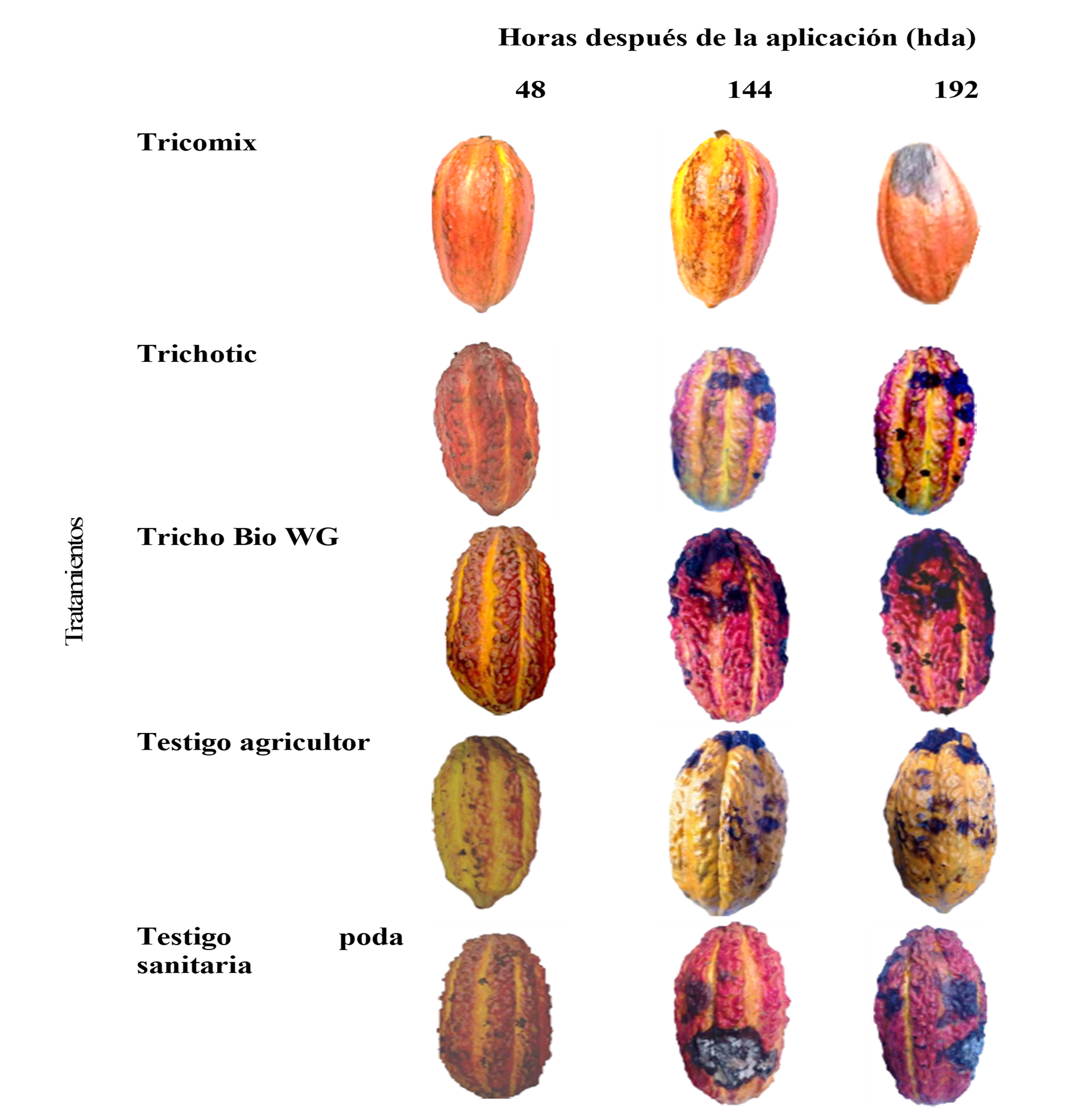
Cocoa (Theobroma cacao L.) is a crop of great economic importance in Ecuador, with an average yield of 0.75 t ha⁻¹. However, its production is affected by fungal diseases, particularly frosty pod rot, caused by Moniliophthora roreri, which can cause yield losses of up to 76% in endemic areas. This study evaluated the efficacy of commercial products based on Trichoderma spp. (Trichotic, Tricho Bio WG, and Tricomix) as biological control agents against M. roreri under field conditions, using a randomized complete block design in Los Ríos, Ecuador. Significant differences were recorded in the number and size of lesions, as well as in the area under the disease progress curve of lesion size (ABCDEtl), with Tricomix being the most effective treatment, followed by Trichotic and Tricho Bio WG. Biological control with Tricomix reduced disease incidence by 49% and 66% compared to sanitary pruning and conventional management, respectively. The efficacy is associated with the action mechanisms of Trichoderma spp., including mycoparasitism, antibiosis, competition, and induced resistance. In conclusion, Trichoderma spp. represents a sustainable and effective alternative for the integrated management of frosty pod rot in cocoa, contributing to improved crop productivity and sustainability.
Downloads
References
Avilés, D., Espinoza, F., Villao, L., Alvarez, J., Sosa, D., Santos-Ordóñez, E., & Galarza, L. (2023). Application of microencapsulated Trichoderma spp. against Moniliophthora roreri during the vegetative development of cocoa. Scientia Agropecuaria, 14(4), 539–547. https://doi.org/10.17268/sci.agropecu.2023.045
Bailey, B. A., Evans, H. C., Phillips‐Mora, W., Ali, S. S., & Meinhardt, L. W. (2018). Moniliophthora roreri , causal agent of cacao frosty pod rot. Molecular Plant Pathology, 19(7), 1580–1594. https://doi.org/10.1111/mpp.12648
Bunbury-Blanchette, A. L., & Walker, A. K. (2019). Trichoderma species show biocontrol potential in dual culture and greenhouse bioassays against Fusarium basal rot of onion. Biological Control, 130, 127–135. https://doi.org/10.1016/j.biocontrol.2018.11.007
Di Rienzo, J. A., Balzarini, M., Gonzalez, L., Casanoves, F., & Tablada, M. (2011). Software Estadístico InfoStat (2024 ver.). https://www.infostat.com.ar/
Díaz-Valderrama, J. R., Leiva-Espinoza, S. T., & Aime, M. C. (2020). The History of Cacao and Its Diseases in the Americas. Phytopathology®, 110(10), 1604–1619. https://doi.org/10.1094/PHYTO-05-20-0178-RVW
Evans, H. C. (2016). Frosty Pod Rot (Moniliophthora roreri). In Cacao Diseases (pp. 63–96). Springer International Publishing. https://doi.org/10.1007/978-3-319-24789-2_3
John Seng, J. S. (2014). Use of Trichoderma fungi in spray solutions to reduce Moniliophthora roreri infection of Theobroma cacao fruits in northeastern Costa Rica. Revista de Biología Tropical, 62(3), 899. https://doi.org/10.15517/rbt.v62i3.14059
Kumar, M., & Ashraf, S. (2017). Role of Trichoderma spp. as a Biocontrol Agent of Fungal Plant Pathogens. In Probiotics and Plant Health (pp. 497–506). Springer Singapore. https://doi.org/10.1007/978-981-10-3473-2_23
Leiva, S., Oliva, M., Hernández, E., Chuquibala, B., Rubio, K., García, F., & Torres de la Cruz, M. (2020). Assessment of the Potential of Trichoderma spp. Strains Native to Bagua (Amazonas, Peru) in the Biocontrol of Frosty Pod Rot (Moniliophthora roreri). Agronomy, 10(9), 1376. https://doi.org/10.3390/agronomy10091376
Leiva, S., Rubio, K., Díaz-Valderrama, J. R., Granda-Santos, M., & Mattos, L. (2022). Phylogenetic Affinity in the Potential Antagonism of Trichoderma spp. against Moniliophthora roreri. Agronomy, 12(9), 2052. https://doi.org/10.3390/agronomy12092052
Marelli, J.-P., Guest, D. I., Bailey, B. A., Evans, H. C., Brown, J. K., Junaid, M., Barreto, R. W., Lisboa, D. O., & Puig, A. S. (2019). Chocolate Under Threat from Old and New Cacao Diseases. Phytopathology®, 109(8), 1331–1343. https://doi.org/10.1094/PHYTO-12-18-0477-RVW
Ploetz, R. (2016). The Impact of Diseases on Cacao Production: A Global Overview. In Cacao Diseases (pp. 33–59). Springer International Publishing. https://doi.org/10.1007/978-3-319-24789-2_2
Reyes-Figueroa, O., Ortiz-García, C. F., Torres-de la Cruz, M., Lagunes-Espinoza, L. del C., & Valdovinos-Ponce, G. (2016). Especies de Trichoderma del agroecosistema cacao con potencial de biocontrol sobre Moniliophthora roreri. Revista Chapingo Serie Ciencias Forestales y Del Ambiente, 22(2), 149–163. https://doi.org/10.5154/r.rchscfa.2015.08.036
RStudio. (2021). RStudio: Integrated Development Environment for R. RStudio, PBC, Boston, MA. http://www.rstudio.com/
Sarwan, J., Sahani, S., Nair, M. V., Bhargav, S., Kumar, S., Singh, R., Mittal, K., Jaglan, P., Uddin, N., & Bose, K. J. C. (2024). Multiple factors influencing Theobroma cacao and their impact on the chocolate market worldwide. In L. C. García, N. R. Maddela, F. Z. Gavilanes, & C. Aguilar Duarte (Eds.), Sustainable Cacao Cultivation in Latin America. Routledge. https://doi.org/https://doi.org/10.4324/9781003381761
SIPA-MAGP. (2024). Información Productiva Territorial. https://sipa.agricultura.gob.ec/index.php/sipa-estadisticas/tablero-dinamico/cifras-agroproductivas
Solís Hidalgo, Z. K., & Suárez Capello, C. (2004). Uso de Trichoderma spp para control del complejo Moniliasis Escoba de Bruja del cacao en Ecuador. INIAP. http://repositorio.iniap.gob.ec/handle/41000/3368
Tyśkiewicz, R., Nowak, A., Ozimek, E., & Jaroszuk-Ściseł, J. (2022). Trichoderma: The Current Status of Its Application in Agriculture for the Biocontrol of Fungal Phytopathogens and Stimulation of Plant Growth. International Journal of Molecular Sciences, 23(4), 2329. https://doi.org/10.3390/ijms23042329
Varas Carvajal, I. A., Macías Holguín, C. J., Mendoza Thompson, J. U., Cárdenas Briones, D. K., & Bravo Díaz, L. F. (2024). Biocontrol de Moniliophthora roreri con Trichoderma harzianum y Bacillus subtilis en cacao CCN-51. Código Científico Revista de Investigación, 5(E4), 77–92. https://doi.org/10.55813/gaea/ccri/v5/nE4/462
You, J., Zhang, J., Wu, M., Yang, L., Chen, W., & Li, G. (2016). Multiple criteria-based screening of Trichoderma isolates for biological control of Botrytis cinerea on tomato. Biological Control, 101, 31–38. https://doi.org/10.1016/j.biocontrol.2016.06.006
Downloads
Published
How to Cite
Issue
Section
License
Copyright (c) 2026 Karen Beltran-Carguacundo, Eduardo Rodríguez-Maldonado, Katheryne Santamaría-Poveda, Andrea Román-Ramos

This work is licensed under a Creative Commons Attribution 4.0 International License.
The authors retain their rights:
a. The authors retain their trademark and patent rights, as well as any process or procedure described in the article.
b. The authors retain the right to share, copy, distribute, execute and publicly communicate the article published in the Revista Agrotecnológica Amazónica (RAA) (for example, place it in an institutional repository or publish it in a book), with an acknowledgment of its initial publication in the RAA.
c. Authors retain the right to make a subsequent publication of their work, to use the article or any part of it (for example: a compilation of their works, notes for conferences, thesis, or for a book), provided that they indicate the source of publication (authors of the work, journal, volume, number and date).