Arquitectura cloud-based de gemelos digitales para el diseño óptimo de cadenas de suministro de gran escala
DOI:
https://doi.org/10.51252/rcsi.v6i2.1682Palabras clave:
Azure Digital Twins, cadena de suministro, diseño de red, gemelo digital, PSO, MILP, pythonResumen
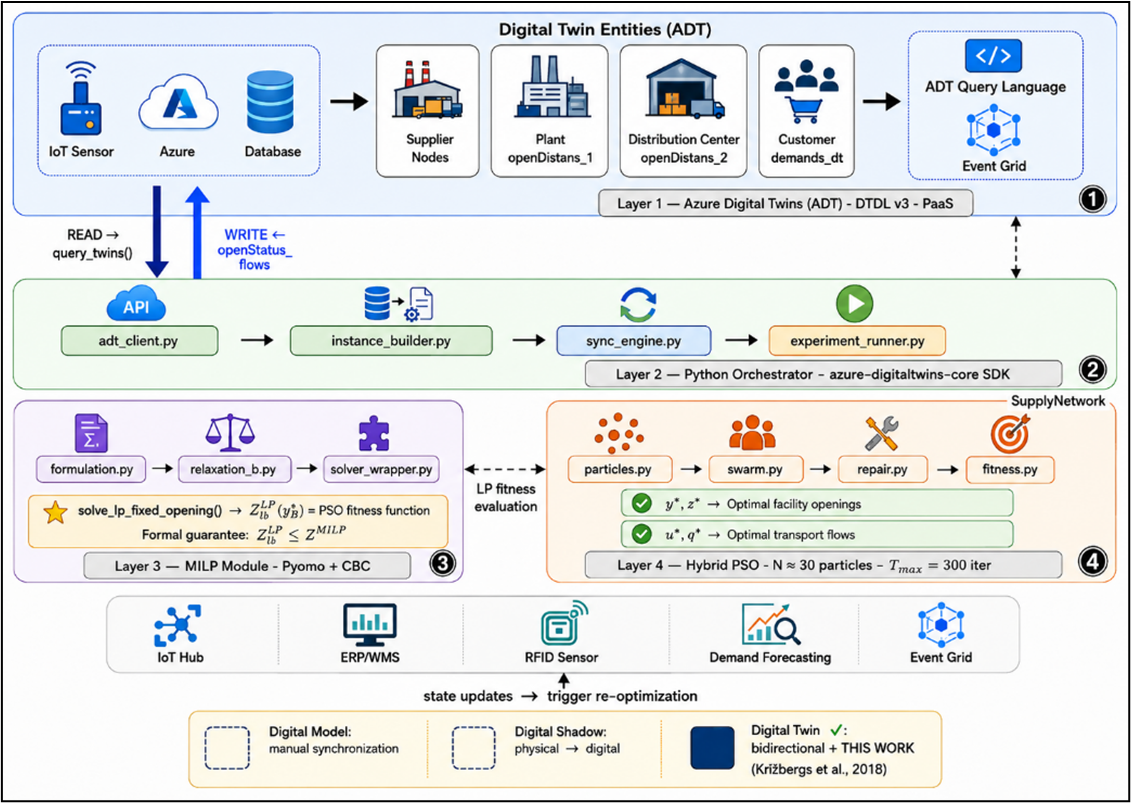
El diseño de redes de suministro de gran escala es un problema MILP NP-duro que requiere representación dinámica y optimización eficiente en contextos industriales. Este estudio propuso, implementó y validó una arquitectura cloud-based de cuatro capas que integra Microsoft Azure Digital Twins (ADT), un modelo MILP multi-escalón, un PSO híbrido y un motor de integración en Python con sincronización bidireccional. La principal contribución algorítmica consistió en emplear la relajación lineal del MILP como función de aptitud del PSO, proporcionando una cota inferior formal del problema original. Se ejecutaron 74 corridas experimentales con un operador de reparación por capacidad, alcanzando una tasa de infactibilidad nula. Las instancias evaluadas, en escalas S, M y XL y con cinco niveles de complejidad, evidenciaron una relación inversa entre la brecha de integralidad y la calidad de la solución PSO. Asimismo, las instancias de baja complejidad combinatoria lograron una consistencia superior al 90% en las decisiones de apertura, preservando el estado decisional del gemelo digital. El marco propuesto integra arquitectura cloud-based, optimización MILP y PSO híbrido para cadenas de suministro con validación experimental.
Descargas
Citas
Avella, P., Calamita, A., & Palagi, L. (2023). A computational study of off-the-shelf MINLP solvers on a benchmark set of congested capacitated facility location problems. ArXiv. https://doi.org/10.48550/arXiv.2303.04216
Dominguez Martinez, V., Parody De La Cruz, J. D., Guerra Manjarrez, J. F., & Rodriguez Velandia, D. A. (2026). Digital twins in healthcare (2018–2024): A scientometric analysis with emphasis on cardiology and perspectives for Colombia. En M. Zuluaga (Ed.), Scientometric Perspectives on Biomedical Research: Applications Across Oncology, Infectious Diseases, Bioinformatics, and Medical Technologies (Vol. 1, pp. 33-50). Contemporary Biomedical Research. Pro-Metrics. https://doi.org/10.47909/978-9916-9331-7-6.5
Farahani, R. Z., Rezapour, S., Drezner, T., & Fallah, S. (2014). Competitive supply chain network design: An overview of classifications, models, solution techniques and applications. Omega, 45, 92–118. https://doi.org/10.1016/j.omega.2013.08.006
Geoffrion, A. M., & Graves, G. W. (1974). Multicommodity Distribution System Design by Benders Decomposition. Management Science, 20(5), 822–844. https://doi.org/10.1287/mnsc.20.5.822
Grieves, M. (2014). Digital Twin: Manufacturing Excellence through Virtual Factory Replication.
Grieves, M., & Vickers, J. (2017). Digital Twin: Mitigating Unpredictable, Undesirable Emergent Behavior in Complex Systems. In F.-J. Kahlen, S. Flumerfelt, & A. Alves (Eds.), Transdisciplinary Perspectives on Complex Systems: New Findings and Approaches (pp. 85–113). Springer International Publishing. https://doi.org/10.1007/978-3-319-38756-7_4
Guo, D., & Mantravadi, S. (2025). The role of digital twins in lean supply chain management: review and research directions. International Journal of Production Research, 63(5), 1851–1872. https://doi.org/10.1080/00207543.2024.2372655
Hart, W. E., Watson, J.-P., & Woodruff, D. L. (2011). Pyomo: Modeling and solving mathematical programs in Python. Mathematical Programming Computation, 3(3), 219–260. https://doi.org/10.1007/s12532-011-0026-8
Ivanov, D., & Dolgui, A. (2019). The impact of digital technology and Industry 4.0 on the ripple effect and supply chain risk analytics. International Journal of Production Research, 57(3), 829–846. https://doi.org/10.1080/00207543.2018.1488086
Ivanov, D., & Dolgui, A. (2021). A digital supply chain twin for managing the disruption risks and resilience in the era of Industry 4.0. Production Planning & Control, 32(9), 775–788. https://doi.org/10.1080/09537287.2020.1768450
Kennedy, J., & Eberhart, R. (1995). Particle swarm optimization. In Proceedings of ICNN’95 - International Conference on Neural Networks (Vol. 4, pp. 1942–1948). IEEE. https://doi.org/10.1109/ICNN.1995.488968
Kennedy, J., & Eberhart, R. C. (1997). A discrete binary version of the particle swarm algorithm. In 1997 IEEE International Conference on Systems, Man, and Cybernetics: Computational Cybernetics and Simulation (Vol. 5, pp. 4104–4108). IEEE. https://doi.org/10.1109/ICSMC.1997.637339
Kritzinger, W., Karner, M., Traar, G., Henjes, J., & Sihn, W. (2018). Digital Twin in manufacturing: A categorical literature review and classification. IFAC-PapersOnLine, 51(11), 1016–1022. https://doi.org/10.1016/j.ifacol.2018.08.474
Lim, K. Y. H., Zheng, P., & Chen, C.-H. (2020). A state-of-the-art survey of Digital Twin: techniques, engineering product lifecycle management and business innovation perspectives. Journal of Intelligent Manufacturing, 31(6), 1313–1337. https://doi.org/10.1007/s10845-019-01512-w
Longo, F., Mirabelli, G., Padovano, A., & Solina, V. (2023). The Digital Supply Chain Twin paradigm for enhancing resilience and sustainability against COVID-like crises. Procedia Computer Science, 217, 1940–1947. https://doi.org/10.1016/j.procs.2022.12.394
Marmolejo-Saucedo, J. A. (2020). Design and Development of Digital Twins: A Case Study in Supply Chains. Mobile Networks and Applications, 25(6), 2141–2160. https://doi.org/10.1007/s11036-020-01557-9
Marmolejo-Saucedo, J. A. (2022). Digital Twin Framework for Large-Scale Optimization Problems in Supply Chains: A Case of Packing Problem. Mobile Networks and Applications, 27(5), 2198–2214. https://doi.org/10.1007/s11036-021-01856-9
Melo, M. T., Nickel, S., & Saldanha-da-Gama, F. (2009). Facility location and supply chain management - A review. European Journal of Operational Research, 196(2), 401–412. https://doi.org/10.1016/j.ejor.2008.05.007
Microsoft. (2023). Digital Twins Definition Language (DTDL), Version 3. In Azure Open Digital Twins. https://azure.github.io/opendigitaltwins-dtdl/DTDL/v3/DTDL.v3.html
Microsoft. (2025a). Azure Digital Twins Core client library for Python (azure-digitaltwins-core). In Python Package Index (PyPI) (1.3.0). Python Software Foundation. https://pypi.org/project/azure-digitaltwins-core/
Microsoft. (2025b). What is an ontology in Azure Digital Twins? In Microsoft Learn. https://learn.microsoft.com/en-us/azure/digital-twins/concepts-ontologies
Microsoft. (2025c). What is Azure Digital Twins? In Microsoft Learn. https://learn.microsoft.com/en-us/azure/digital-twins/overview
Milenkovic, M. (2022). Internet of Things: System Reference Architecture. ArXiv. https://doi.org/10.48550/arXiv.2204.01872
Noel, M. M., & Jannett, T. C. (2004). Simulation of a new hybrid particle swarm optimization algorithm. In Proceedings of the Thirty-Sixth Southeastern Symposium on System Theory (pp. 150–153). IEEE. https://doi.org/10.1109/SSST.2004.1295638
Pérez-Baquero, R.-S., Murgas Gutierrez, J. P., Arzuaga Gomez, A. C., & Suarez Ravelo, C. D. (2026). Decision technologies in control engineering: A scientometric review of LQR control for inverted pendulum systems (2006–2025). DecisionTech Review, 6, 1–14. https://doi.org/10.47909/dtr.36
Shi, Y., & Eberhart, R. C. (1998). A modified particle swarm optimizer. In 1998 IEEE International Conference on Evolutionary Computation Proceedings; IEEE World Congress on Computational Intelligence (pp. 69–73). IEEE. https://doi.org/10.1109/ICEC.1998.699146
Simchi-Levi, D., Kaminsky, P., & Simchi-Levi, E. (2008). Designing and Managing the Supply Chain: Concepts, Strategies, and Case Studies (3rd ed.). McGraw-Hill/Irwin.
Somma, A., Amalfitano, D., De Benedictis, A., & Pelliccione, P. (2025). TwinArch: A digital twin reference architecture. Journal of Systems and Software, 112613. https://doi.org/10.1016/j.jss.2025.112613
Tao, F., Zhang, H., Liu, A., & Nee, A. Y. C. (2019). Digital Twin in Industry: State-of-the-Art. IEEE Transactions on Industrial Informatics, 15(4), 2405–2415. https://doi.org/10.1109/TII.2018.2873186
Tirkolaee, E. B., Goli, A., Faridnia, A., Soltani, M., & Weber, G.-W. (2020). Multi-objective optimization for the reliable pollution-routing problem with cross-dock selection using Pareto-based algorithms. Journal of Cleaner Production, 276, 122927. https://doi.org/10.1016/j.jclepro.2020.122927
Wasi, A. T., Anik, M. A., Rahman, A., Hoque, M. I., Islam, M. D. S., & Ahsan, M. M. (2025). A Theoretical Framework for Graph-based Digital Twins for Supply Chain Management and Optimization. ArXiv. https://doi.org/10.48550/arXiv.2504.03692
Descargas
Publicado
Cómo citar
Número
Sección
Licencia
Derechos de autor 2026 José Antonio Marmolejo-Saucedo, Román Rodríguez-Aguilar, Abraham Mendoza

Esta obra está bajo una licencia internacional Creative Commons Atribución 4.0.
Los autores retienen sus derechos:
a. Los autores retienen sus derechos de marca y patente, y tambien sobre cualquier proceso o procedimiento descrito en el artículo.
b. Los autores retienen el derecho de compartir, copiar, distribuir, ejecutar y comunicar públicamente el articulo publicado en la Revista Científica de Sistemas e Informática (RCSI) (por ejemplo, colocarlo en un repositorio institucional o publicarlo en un libro), con un reconocimiento de su publicación inicial en la RCSI.
c. Los autores retienen el derecho a hacer una posterior publicación de su trabajo, de utilizar el artículo o cualquier parte de aquel (por ejemplo: una compilación de sus trabajos, notas para conferencias, tesis, o para un libro), siempre que indiquen la fuente de publicación (autores del trabajo, revista, volumen, número y fecha).