Cloud-based architecture of digital twins applied to the optimal design of large-scale supply chains
DOI:
https://doi.org/10.51252/rcsi.v6i2.1682Keywords:
Azure Digital Twins, supply chain, network design, digital twin, PSO, MILP, pythonAbstract
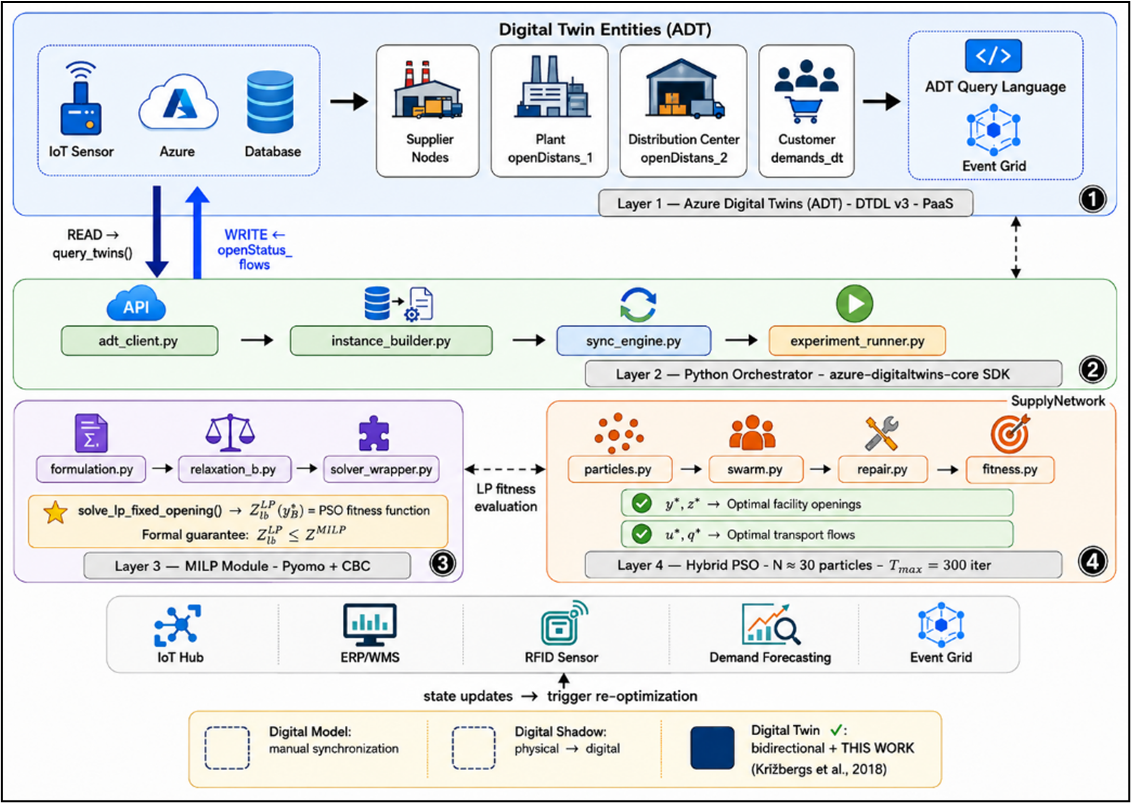
The design of large-scale supply networks is an NP-hard MILP problem that requires dynamic representation and efficient optimization in industrial contexts. This study proposed, implemented, and validated a four-layer cloud-based architecture that integrates Microsoft Azure Digital Twins (ADT), a multi-echelon MILP model, a hybrid PSO, and a Python-based integration engine with bidirectional synchronization. The main algorithmic contribution consisted of using the linear relaxation of the MILP as the PSO fitness function, providing a formal lower bound for the original problem. A total of 74 experimental runs were conducted using a capacity repair operator, achieving a zero-infeasibility rate. The evaluated instances, across S, M, and XL scales and five complexity levels, showed an inverse relationship between the integrality gap and the quality of the PSO solution. Likewise, instances with low combinatorial complexity achieved over 90% consistency in opening decisions, preserving the decision state of the digital twin. The proposed framework integrates cloud-based architecture, MILP optimization, and hybrid PSO for supply chains with experimental validation.
Downloads
References
Avella, P., Calamita, A., & Palagi, L. (2023). A computational study of off-the-shelf MINLP solvers on a benchmark set of congested capacitated facility location problems. ArXiv. https://doi.org/10.48550/arXiv.2303.04216
Dominguez Martinez, V., Parody De La Cruz, J. D., Guerra Manjarrez, J. F., & Rodriguez Velandia, D. A. (2026). Digital twins in healthcare (2018–2024): A scientometric analysis with emphasis on cardiology and perspectives for Colombia. En M. Zuluaga (Ed.), Scientometric Perspectives on Biomedical Research: Applications Across Oncology, Infectious Diseases, Bioinformatics, and Medical Technologies (Vol. 1, pp. 33-50). Contemporary Biomedical Research. Pro-Metrics. https://doi.org/10.47909/978-9916-9331-7-6.5
Farahani, R. Z., Rezapour, S., Drezner, T., & Fallah, S. (2014). Competitive supply chain network design: An overview of classifications, models, solution techniques and applications. Omega, 45, 92–118. https://doi.org/10.1016/j.omega.2013.08.006
Geoffrion, A. M., & Graves, G. W. (1974). Multicommodity Distribution System Design by Benders Decomposition. Management Science, 20(5), 822–844. https://doi.org/10.1287/mnsc.20.5.822
Grieves, M. (2014). Digital Twin: Manufacturing Excellence through Virtual Factory Replication.
Grieves, M., & Vickers, J. (2017). Digital Twin: Mitigating Unpredictable, Undesirable Emergent Behavior in Complex Systems. In F.-J. Kahlen, S. Flumerfelt, & A. Alves (Eds.), Transdisciplinary Perspectives on Complex Systems: New Findings and Approaches (pp. 85–113). Springer International Publishing. https://doi.org/10.1007/978-3-319-38756-7_4
Guo, D., & Mantravadi, S. (2025). The role of digital twins in lean supply chain management: review and research directions. International Journal of Production Research, 63(5), 1851–1872. https://doi.org/10.1080/00207543.2024.2372655
Hart, W. E., Watson, J.-P., & Woodruff, D. L. (2011). Pyomo: Modeling and solving mathematical programs in Python. Mathematical Programming Computation, 3(3), 219–260. https://doi.org/10.1007/s12532-011-0026-8
Ivanov, D., & Dolgui, A. (2019). The impact of digital technology and Industry 4.0 on the ripple effect and supply chain risk analytics. International Journal of Production Research, 57(3), 829–846. https://doi.org/10.1080/00207543.2018.1488086
Ivanov, D., & Dolgui, A. (2021). A digital supply chain twin for managing the disruption risks and resilience in the era of Industry 4.0. Production Planning & Control, 32(9), 775–788. https://doi.org/10.1080/09537287.2020.1768450
Kennedy, J., & Eberhart, R. (1995). Particle swarm optimization. In Proceedings of ICNN’95 - International Conference on Neural Networks (Vol. 4, pp. 1942–1948). IEEE. https://doi.org/10.1109/ICNN.1995.488968
Kennedy, J., & Eberhart, R. C. (1997). A discrete binary version of the particle swarm algorithm. In 1997 IEEE International Conference on Systems, Man, and Cybernetics: Computational Cybernetics and Simulation (Vol. 5, pp. 4104–4108). IEEE. https://doi.org/10.1109/ICSMC.1997.637339
Kritzinger, W., Karner, M., Traar, G., Henjes, J., & Sihn, W. (2018). Digital Twin in manufacturing: A categorical literature review and classification. IFAC-PapersOnLine, 51(11), 1016–1022. https://doi.org/10.1016/j.ifacol.2018.08.474
Lim, K. Y. H., Zheng, P., & Chen, C.-H. (2020). A state-of-the-art survey of Digital Twin: techniques, engineering product lifecycle management and business innovation perspectives. Journal of Intelligent Manufacturing, 31(6), 1313–1337. https://doi.org/10.1007/s10845-019-01512-w
Longo, F., Mirabelli, G., Padovano, A., & Solina, V. (2023). The Digital Supply Chain Twin paradigm for enhancing resilience and sustainability against COVID-like crises. Procedia Computer Science, 217, 1940–1947. https://doi.org/10.1016/j.procs.2022.12.394
Marmolejo-Saucedo, J. A. (2020). Design and Development of Digital Twins: A Case Study in Supply Chains. Mobile Networks and Applications, 25(6), 2141–2160. https://doi.org/10.1007/s11036-020-01557-9
Marmolejo-Saucedo, J. A. (2022). Digital Twin Framework for Large-Scale Optimization Problems in Supply Chains: A Case of Packing Problem. Mobile Networks and Applications, 27(5), 2198–2214. https://doi.org/10.1007/s11036-021-01856-9
Melo, M. T., Nickel, S., & Saldanha-da-Gama, F. (2009). Facility location and supply chain management - A review. European Journal of Operational Research, 196(2), 401–412. https://doi.org/10.1016/j.ejor.2008.05.007
Microsoft. (2023). Digital Twins Definition Language (DTDL), Version 3. In Azure Open Digital Twins. https://azure.github.io/opendigitaltwins-dtdl/DTDL/v3/DTDL.v3.html
Microsoft. (2025a). Azure Digital Twins Core client library for Python (azure-digitaltwins-core). In Python Package Index (PyPI) (1.3.0). Python Software Foundation. https://pypi.org/project/azure-digitaltwins-core/
Microsoft. (2025b). What is an ontology in Azure Digital Twins? In Microsoft Learn. https://learn.microsoft.com/en-us/azure/digital-twins/concepts-ontologies
Microsoft. (2025c). What is Azure Digital Twins? In Microsoft Learn. https://learn.microsoft.com/en-us/azure/digital-twins/overview
Milenkovic, M. (2022). Internet of Things: System Reference Architecture. ArXiv. https://doi.org/10.48550/arXiv.2204.01872
Noel, M. M., & Jannett, T. C. (2004). Simulation of a new hybrid particle swarm optimization algorithm. In Proceedings of the Thirty-Sixth Southeastern Symposium on System Theory (pp. 150–153). IEEE. https://doi.org/10.1109/SSST.2004.1295638
Pérez-Baquero, R.-S., Murgas Gutierrez, J. P., Arzuaga Gomez, A. C., & Suarez Ravelo, C. D. (2026). Decision technologies in control engineering: A scientometric review of LQR control for inverted pendulum systems (2006–2025). DecisionTech Review, 6, 1–14. https://doi.org/10.47909/dtr.36
Shi, Y., & Eberhart, R. C. (1998). A modified particle swarm optimizer. In 1998 IEEE International Conference on Evolutionary Computation Proceedings; IEEE World Congress on Computational Intelligence (pp. 69–73). IEEE. https://doi.org/10.1109/ICEC.1998.699146
Simchi-Levi, D., Kaminsky, P., & Simchi-Levi, E. (2008). Designing and Managing the Supply Chain: Concepts, Strategies, and Case Studies (3rd ed.). McGraw-Hill/Irwin.
Somma, A., Amalfitano, D., De Benedictis, A., & Pelliccione, P. (2025). TwinArch: A digital twin reference architecture. Journal of Systems and Software, 112613. https://doi.org/10.1016/j.jss.2025.112613
Tao, F., Zhang, H., Liu, A., & Nee, A. Y. C. (2019). Digital Twin in Industry: State-of-the-Art. IEEE Transactions on Industrial Informatics, 15(4), 2405–2415. https://doi.org/10.1109/TII.2018.2873186
Tirkolaee, E. B., Goli, A., Faridnia, A., Soltani, M., & Weber, G.-W. (2020). Multi-objective optimization for the reliable pollution-routing problem with cross-dock selection using Pareto-based algorithms. Journal of Cleaner Production, 276, 122927. https://doi.org/10.1016/j.jclepro.2020.122927
Wasi, A. T., Anik, M. A., Rahman, A., Hoque, M. I., Islam, M. D. S., & Ahsan, M. M. (2025). A Theoretical Framework for Graph-based Digital Twins for Supply Chain Management and Optimization. ArXiv. https://doi.org/10.48550/arXiv.2504.03692
Downloads
Published
How to Cite
Issue
Section
License
Copyright (c) 2026 José Antonio Marmolejo-Saucedo, Román Rodríguez-Aguilar, Abraham Mendoza

This work is licensed under a Creative Commons Attribution 4.0 International License.
The authors retain their rights:
a. The authors retain their trademark and patent rights, as well as any process or procedure described in the article.
b. The authors retain the right to share, copy, distribute, execute and publicly communicate the article published in the Revista Científica de Sistemas e Informática (RCSI) (for example, place it in an institutional repository or publish it in a book), with an acknowledgment of its initial publication in the RCSI.
c. Authors retain the right to make a subsequent publication of their work, to use the article or any part of it (for example: a compilation of their works, notes for conferences, thesis, or for a book), provided that they indicate the source of publication (authors of the work, journal, volume, number and date).