Spatial configuration of amazon deforestation: An analysis of market and land occupation spillovers in the San Martin region
DOI:
https://doi.org/10.51252/race.v5i2.1700Keywords:
spatial autocorrelation, cocoa, land-use change, agricultural frontier, Spatial Durbin ModelAbstract
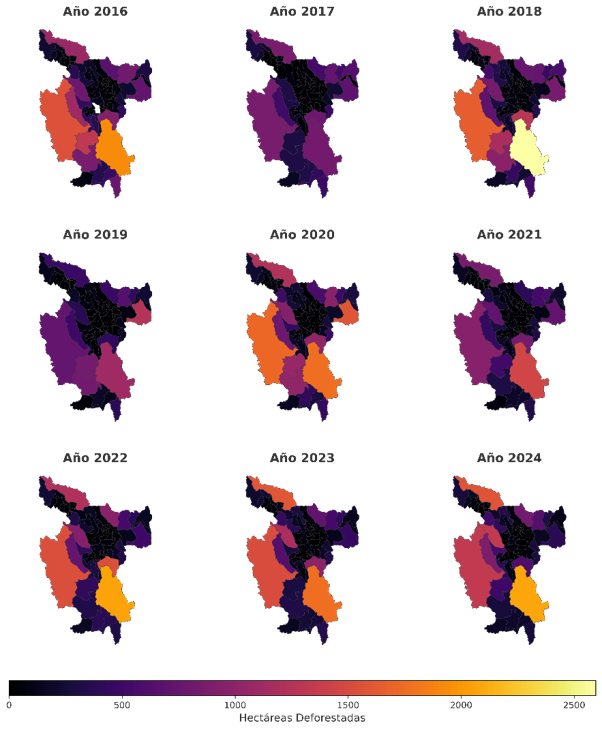
The boom in the cacao market is significantly altering the way land is utilized in our Amazon. Far from being the subject of rigorous analysis, current literature has overlooked this in many quantitative studies. Therefore, this study sought to analyze the influence of commercial variables associated with the cacao market on deforestation, focusing on the San Martín region, and to identify the existence of spillover effects. This was achieved by estimating a Spatial Durbin Model (SDM) using a Queen contiguity matrix, calculating the Global Moran's I, and contrasting its estimators with the traditional Ordinary Least Squares (OLS) method. It was concluded that there is a positive and significant spatial autocorrelation for forest loss, driven by externalities that expanded the agricultural frontier. Furthermore, it was determined that the most highly capitalized districts were the primary drivers of this expansion, and that it has now become a geographically interconnected phenomenon driven by economic incentives, demonstrating that local conservation policies proved ineffective by omitting spatial contagion.
Downloads
References
Aguirre, J., Guerrero, E., & Campana, Y. (2021). How effective are protected natural areas when roads are present? An analysis of the Peruvian case. Environmental Economics and Policy Studies, 23, 831-859. https://doi.org/10.1007/s10018-021-00304-y
Akolo, I. R. (2022). Perbandingan Matriks Pembobot Rook Dan Queencontiguity Dalam Analisis Spatial Autoregressive Model (SAR) Dan Spatial Error Model (SEM). Jambura Journal of Probability and Statistics, 3(1), 11-18. https://doi.org/10.34312/jjps.v3i1.13582
Baumann, M., Gasparri, I., Buchadas, A., Oeser, J., Meyfroidt, P., Levers, C., Romero‐Muñoz, A., De Waroux, Y. L. P., Müller, D., & Kuemmerle, T. (2022). Frontier metrics for a process-based understanding of deforestation dynamics. Environmental Research Letters, 17(9), 095010. https://doi.org/10.1088/1748-9326/ac8b9a
Boillat, S., Ceddia, M. G., & Bottazzi, P. (2022). The role of protected areas and land tenure regimes on forest loss in Bolivia: Accounting for spatial spillovers. Global Environmental Change, 76, 102571. https://doi.org/10.1016/j.gloenvcha.2022.102571
Borda, A., Morales, O., Teegen, H., Rees, G. H., & Gonzalez-Perez, M. A. (2021). Addressing Sustainable Rural Development with Shared Value: A Peruvian Model from the Cacao Industry. Sustainability, 13(14), 8028. https://doi.org/10.3390/su13148028
Chen, X., Wang, H., Zhu, X., & Zhang, X. (2025). Spatial-temporal characteristics of agricultural economic resilience and spatial spillover effects of driving factors: evidence from provincial panel data in China. Frontiers in Environmental Science, 13, 1437018. https://doi.org/10.3389/fenvs.2025.1437018
Cruz, M., Pradel, W., Juarez, H., Hualla, V., & Suarez, V. (2023). Deforestation Dynamics in Peru. A Comprehensive Review of Land Use, Food Systems, and Socio-Economic Drivers. Centro Internacional de la Papa. https://doi.org/10.4160/cip.2023.12.007
González-González, A., Villegas, J., Clerici, N., & Salazar, J. (2021). Spatial-temporal dynamics of deforestation and its drivers indicate need for locally-adapted environmental governance in Colombia. Ecological Indicators, 126, 107695. https://doi.org/10.1016/j.ecolind.2021.107695
Griffith, D. A., & Paelinck, J. H. P. (2018). The Spatial Weights Matrix and ESF. In: Morphisms for Quantitative Spatial Analysis. Advanced Studies in Theoretical and Applied Econometrics, 51, 49-60. https://doi.org/10.1007/978-3-319-72553-6_5
Hänggli, A., Levy, S., Pascual, D. A., Bovolo, I., Brandão, J., Rueda, X., & Garrett, R. (2023). A systematic comparison of deforestation drivers and policy effectiveness across the Amazon biome. Environmental Research Letters, 18(7), 073001. https://doi.org/10.1088/1748-9326/acd408
Higuchi, A., Coq-Huelva, D., Vasco, C., Alfalla-Luque, R., & Maehara, R. (2022). An evidence-based relationship between technical assistance and productivity in cocoa from Tocache, Peru. Revista de Economia e Sociologia Rural, 61(1). https://doi.org/10.1590/1806-9479.2021.253614
Huanca-Ccompe, F. R., Carrión-Sánchez, H. M., Chambilla, L. Q., Alcázar-Alay, S., & Pumacahua-Ramos, A. (2026). Theobroma spp. Mucilage as a Valuable Natural Ingredient: Composition, Potential for Food Innovation, and Future Perspectives. Foods, 15(2), 185. https://doi.org/10.3390/foods15020185
Isnan, S., Abdullah, A. F. B., Shariff, A. R. M., Ishak, I., Ismail, S. N. S., & Appanan, M. R. (2025). Moran's I and Geary's C: investigation of the effects of spatial weight matrices for assessing the distribution of infectious diseases. Geospatial health, 20(1). https://doi.org/10.4081/gh.2025.1277
Kongor, J. E., Owusu, M., & Oduro-Yeboah, C. (2024). Cocoa production in the 2020s: challenges and solutions. CABI Agriculture and Bioscience, 5, 102. https://doi.org/10.1186/s43170-024-00310-6
La Rosa Salazar, M. A. (2022). Agricultura y Deforestación en la Amazonía Peruana: Una Revisión Bibliométrica. Natura@economía, 7(2), 117-130. http://dx.doi.org/10.21704/ne.v7i2.2140
Ledesma Goyzueta, L. (2025). Análisis de la asociación entre la pobreza y la pérdida de bosques a nivel distrital en el Perú: Aplicación del Modelo Autorregresivo Espacial con Perturbaciones Autorregresivas Espaciales (SARAR). Ecología Aplicada, 24(1), 89-101. https://doi.org/10.21704/rea.v24i1.2280
Li, F., Feng, S., Lu, H., Qu, F., & D’haese, M. (2021). How do non-farm employment and agricultural mechanization impact on large-scale farming? A spatial panel data analysis from Jiangsu Province, China. Land Use Policy, 107, 105517. https://doi.org/10.1016/j.landusepol.2021.105517
Móstiga, M., Armenteras, D., Vayreda, J., & Retana, J. (2025) Decoding the drivers and effects of deforestation in Peru: a national and regional analysis. Environment, Development and Sustainability, 27, 17395–17415. https://doi.org/10.1007/s10668-024-04638-x
Ngouhouo-Poufoun, J., Chaupain-Guillot, S., Ndiaye, Y., Sonwa, D. J., Yana Njabo, K., Delacote, P. (2024) Cocoa, livelihoods, and deforestation within the Tridom landscape in the Congo Basin: A spatial analysis. PLoS ONE, 19(6), e0302598. https://doi.org/10.1371/journal.pone.0302598
Octaviani Hasibuan, D., Pau Teku, H., Drostela Putri, M. F., Setyawan, Y., & Dwi Bekti, R. (2023). Application of Geographically Weighted Regression Method on the Human Development Index of Central Java Province. Enthusiastic: International Journal of Applied Statistics and Data Science, 3(2), 189-201. https://doi.org/10.20885/enthusiastic.vol3.iss2.art6
Paredes, M., & Pastor, A. (2023). Illicit crops in the frontier margins: Amazonian indigenous livelihoods and the expansion of coca in Peru. The Journal of Peasant Studies, 51(4), 960 - 981. https://doi.org/10.1080/03066150.2023.2225413
Ravikumar, A., & Lock, W. (2025). Between conservation and commodities: Does Peruvian tropical forest conservation challenge or reinforce extractivism? Environment and Planning E: Nature and Space, 8(5), 1626-1649. https://doi.org/10.1177/25148486251356196
Shao, J., Zhang, L., & Cai, C. (2024). Dynamic evolution and spatial spillover effect of agricultural green development on eight economic regions in China. Heliyon, 10(12), e33188. https://doi.org/10.1016/j.heliyon.2024.e33188
Shilpa, K. S., Minimol, J. S., Mohanan, S., Nair, R. S., Pulickal, R. T., Joseph, J., Ahlawat, Y., & Muhie, S. H. (2026). Fermentation and chemical composition as determinants of genetic and biochemical variation in cocoa (Theobroma cacao L.) bean colour. Scientific Reports, 16, 14492. https://doi.org/10.1038/s41598-026-45348-w
Sims, M. J., Stanimirova, R., Raichuk, A., Neumann, M., Richter, J., Follett, F., MacCarthy, J., Lister, K., Randle, C., Sloat, L. L., Esipova, E., Jupiter, J., Stanton, C., Morris, D., Slay, C. M., Purves, D., & Harris, N. (2025). Global drivers of forest loss at 1 km resolution. Environmental Research Letters, 20(7), 074027. https://doi.org/10.1088/1748-9326/add606
Suryowati, K., Bekti, R. D., & Faradila, A. (2018). A Comparison of Weights Matrices on Computation of Dengue Spatial Autocorrelation. IOP Conference Series: Materials Science and Engineering, 335. https://doi.org/10.1088/1757-899x/335/1/012052
Tafur Anzualdo, V. I., Esenarro, D., Guillen, R., & Reyna, S. (2022). Deforestation in Peru and strategic plan for its reduce Amazonian forests. 3C Tecnología. Glosas de innovación aplicadas a la pyme, Edición Especial, (febrero 2022), 97-111. https://doi.org/10.17993/3ctecno.2022.specialissue9.97-111
Urgilez-Clavijo, A., Rivas-Tabares, D., Gobin, A., Alfonso, A. M. T., & De La Riva Fernández, J. R. (2025). Understanding local connectivity and complexity in the skeleton of deforestation. Scientific Reports, 15, 18192. https://doi.org/10.1038/s41598-025-02932-w
Downloads
Published
How to Cite
Issue
Section
License
Copyright (c) 2026 Renzo Aarón Rojas-Chipana

This work is licensed under a Creative Commons Attribution 4.0 International License.