Early glaucoma detection using hybrid models based on deep learning in fundus images
DOI:
https://doi.org/10.51252/rcsi.v6i2.1642Keywords:
retinal image analysis, multiclass classification, automated diagnosis, transfer learning, computer visionAbstract
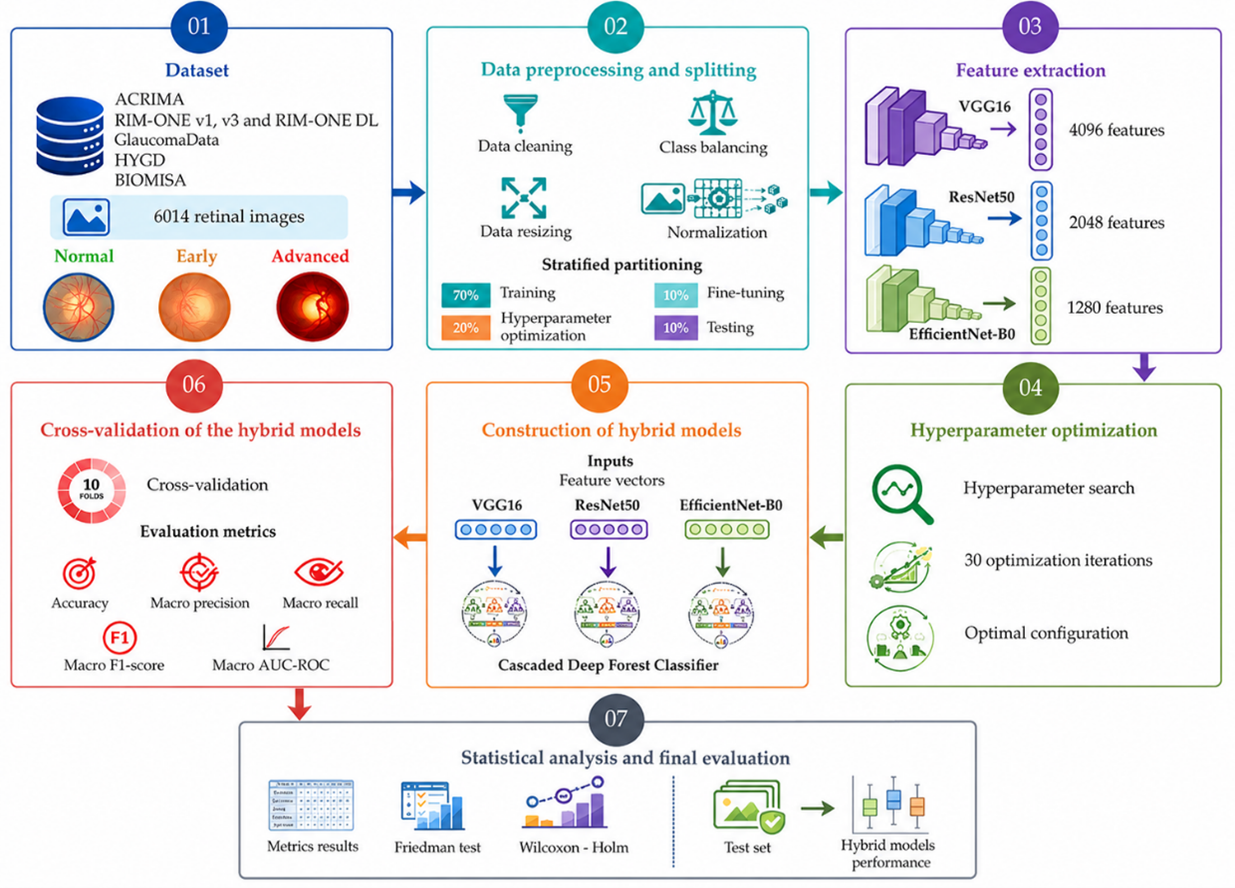
Glaucoma is one of the leading causes of irreversible blindness, making early detection essential to prevent vision loss. This study aimed to develop and evaluate hybrid deep learning models for multiclass glaucoma classification using fundus images. A total of 6,014 retinal images from public databases were used, after undergoing cleaning, balancing, and stratified splitting. The VGG16, ResNet50, and EfficientNet-B0 architectures were employed as feature extractors combined with Cascaded Deep Forest. Evaluation included stratified 10-fold cross-validation and an independent test set. VGG16 + CDF achieved the best performance, with an average accuracy of 0.9320, greater stability, and better generalization. Statistical tests confirmed significant differences among the models, demonstrating that the proposed hybrid approach is a robust alternative for automated glaucoma classification.
Downloads
References
Abramovich, O., Pizem, H., Fhima, J., Berkowitz, E., Gofrit, B., Baskin, M., Meisel, M., Eijgen, J. Van, Blumenthal, E., & Behar, J. (2026). Hillel Yaffe Glaucoma Dataset (HYGD): A Gold-Standard Annotated Fundus Dataset for Glaucoma Detection. PhysioNet. https://doi.org/https://doi.org/10.13026/m92s-0z95
Akiba, T., Sano, S., Yanase, T., Ohta, T., & Koyama, M. (2019). Optuna: A Next-generation Hyperparameter Optimization Framework. Proceedings of the 25th ACM SIGKDD International Conference on Knowledge Discovery & Data Mining, 2623–2631. https://doi.org/10.1145/3292500.3330701
Aljohani, A., & Aburasain, R. Y. (2024). A hybrid framework for glaucoma detection through federated machine learning and deep learning models. BMC Medical Informatics and Decision Making, 24(1), 115. https://doi.org/10.1186/s12911-024-02518-y
Arévalo-Hernández, C. O., Arévalo-Gardini, E., Arévalo-López, L. A., Tuesta-Hidalgo, O., Romero-Vela, D. S., & Ruiz-Camus, C. E. (2023). Predicción de la fertilidad del suelo mediante aprendizaje automático en la provincia de Alto Amazonas, Perú. Revista Peruana de Investigación Agropecuaria, 3(2), e63. https://doi.org/10.56926/repia.v3i2.63
Breiman, L. (2001). Random Forests. Machine Learning, 45(1), 5–32. https://doi.org/10.1023/A:1010933404324
Chaurasia, A. K., Liu, G.-S., Greatbatch, C. J., Gharahkhani, P., Craig, J. E., Mackey, D. A., MacGregor, S., & Hewitt, A. W. (2025). A generalised computer vision model for improved glaucoma screening using fundus images. Eye, 39(1), 109–117. https://doi.org/10.1038/s41433-024-03388-4
Chiang, Y.-Y., Chen, C.-L., & Chen, Y.-H. (2024). Deep Learning Evaluation of Glaucoma Detection Using Fundus Photographs in Highly Myopic Populations. Biomedicines, 12(7), 1394. https://doi.org/10.3390/biomedicines12071394
Demšar, J. (2006). Statistical Comparisons of Classifiers over Multiple Data Sets. JMLR. https://www.jmlr.org/papers/v7/demsar06a.html
Fumero Batista, F. J., Diaz-Aleman, T., Sigut, J., Alayon, S., Arnay, R., & Angel-Pereira, D. (2020). RIM-ONE DL: A Unified Retinal Image Database for Assessing Glaucoma Using Deep Learning. Image Analysis & Stereology, 39(3), 161–167. https://doi.org/10.5566/ias.2346
Geurts, P., Ernst, D., & Wehenkel, L. (2006). Extremely randomized trees. Machine Learning, 63(1), 3–42. https://doi.org/10.1007/s10994-006-6226-1
Govindharaj, I., Santhakumar, D., Pugazharasi, K., Ravichandran, S., Vijaya Prabhu, R., & Raja, J. (2025). Enhancing glaucoma diagnosis: Generative adversarial networks in synthesized imagery and classification with pretrained MobileNetV2. MethodsX, 14, 103116. https://doi.org/10.1016/j.mex.2024.103116
Ha, A., & Park, K. H. (2019). Optical Coherence Tomography for the Diagnosis and Monitoring of Glaucoma. Asia-Pacific Journal of Ophthalmology. https://doi.org/10.22608/APO.201902
Hassan, T., Akram, M. U., Masood, M. F., & Yasin, U. (2018). BIOMISA Retinal Image Database for Macular and Ocular Syndromes (pp. 695–705). https://doi.org/10.1007/978-3-319-93000-8_79
He, K., Zhang, X., Ren, S., & Sun, J. (2016). Deep Residual Learning for Image Recognition. 2016 IEEE Conference on Computer Vision and Pattern Recognition (CVPR), 770–778. https://doi.org/10.1109/CVPR.2016.90
Hicks, S. A., Strümke, I., Thambawita, V., Hammou, M., Riegler, M. A., Halvorsen, P., & Parasa, S. (2022). On evaluation metrics for medical applications of artificial intelligence. Scientific Reports, 12(1), 5979. https://doi.org/10.1038/s41598-022-09954-8
Hwang, E. E., Chen, D., Han, Y., Jia, L., & Shan, J. (2025). Utilization of Image-Based Deep Learning in Multimodal Glaucoma Detection Neural Network from a Primary Patient Cohort. Ophthalmology Science, 5(3), 100703. https://doi.org/10.1016/j.xops.2025.100703
Ilesanmi, A. E., Ilesanmi, T., & Gbotoso, G. A. (2023). A systematic review of retinal fundus image segmentation and classification methods using convolutional neural networks. Healthcare Analytics, 4, 100261. https://doi.org/10.1016/j.health.2023.100261
Ling, X. C., Chen, H. S.-L., Yeh, P.-H., Cheng, Y.-C., Huang, C.-Y., Shen, S.-C., & Lee, Y.-S. (2025). Deep Learning in Glaucoma Detection and Progression Prediction: A Systematic Review and Meta-Analysis. Biomedicines, 13(2), 420. https://doi.org/10.3390/biomedicines13020420
Meethal, N. S. K., Sisodia, V. P. S., George, R., & Khanna, R. C. (2024). Barriers and Potential Solutions to Glaucoma Screening in the Developing World: A Review. Journal of Glaucoma, 33(8S), S33–S38. https://doi.org/10.1097/IJG.0000000000002404
Ministerio de Salud. (2021). Minsa: Más del 50 % de los pacientes que tiene glaucoma no sabe que lo padece. Ministerio de Salud. https://www.gob.pe/institucion/minsa/noticias/346283-minsa-mas-del-50-de-los-pacientes-que-tiene-glaucoma-no-sabe-que-lo-padece?utm_source
Owusu-Adjei, M., Ben Hayfron-Acquah, J., Frimpong, T., & Abdul-Salaam, G. (2023). Imbalanced class distribution and performance evaluation metrics: A systematic review of prediction accuracy for determining model performance in healthcare systems. PLOS Digital Health, 2(11), e0000290. https://doi.org/10.1371/journal.pdig.0000290
Realini, T., McMillan, B., Gross, R. L., Devience, E., & Balasubramani, G. K. (2021). Assessing the Reliability of Intraocular Pressure Measurements Using Rebound Tonometry. Journal of Glaucoma, 30(8), 629–633. https://doi.org/10.1097/IJG.0000000000001892
Roboflow. (2026). GlaucomaData Computer Vision Model. Universe Roboflow. https://universe.roboflow.com/classification-8wwxf/glaucomadata/dataset/1
Saha, S., Vignarajan, J., & Frost, S. (2023). A fast and fully automated system for glaucoma detection using color fundus photographs. Scientific Reports, 13(1), 18408. https://doi.org/10.1038/s41598-023-44473-0
Schuster, A. K., Erb, C., Hoffmann, E. M., Dietlein, T., & Pfeiffer, N. (2020). The Diagnosis and Treatment of Glaucoma. Deutsches Ärzteblatt International. https://doi.org/10.3238/arztebl.2020.0225
Sharma, P., Takahashi, N., Ninomiya, T., Sato, M., Miya, T., Tsuda, S., & Nakazawa, T. (2025). A hybrid multi model artificial intelligence approach for glaucoma screening using fundus images. Npj Digital Medicine, 8(1), 130. https://doi.org/10.1038/s41746-025-01473-w
Shi, D., Zhang, W., Yang, J., Huang, S., Chen, X., Xu, P., Jin, K., Lin, S., Wei, J., Yusufu, M., Liu, S., Zhang, Q., Ge, Z., Xu, X., & He, M. (2025). A multimodal visual–language foundation model for computational ophthalmology. Npj Digital Medicine, 8(1), 381. https://doi.org/10.1038/s41746-025-01772-2
Shoukat, A., Akbar, S., Hassan, S. A., Iqbal, S., Mehmood, A., & Ilyas, Q. M. (2023). Automatic Diagnosis of Glaucoma from Retinal Images Using Deep Learning Approach. Diagnostics, 13(10), 1738. https://doi.org/10.3390/diagnostics13101738
Sidhu, Z., & Mansoori, T. (2024). Artificial intelligence in glaucoma detection using color fundus photographs. Indian Journal of Ophthalmology, 72(3), 408–411. https://doi.org/10.4103/IJO.IJO_613_23
Simonyan, K., & Zisserman, A. (2014). Very Deep Convolutional Networks for Large-Scale Image Recognition. Computer Vision and Pattern Recognition, 1. https://doi.org/https://doi.org/10.48550/arXiv.1409.1556
Świerczyński, H., Pukacki, J., Szczęsny, S., Mazurek, C., & Wasilewicz, R. (2025). Application of machine learning techniques in GlaucomAI system for glaucoma diagnosis and collaborative research support. Scientific Reports, 15(1), 7940. https://doi.org/10.1038/s41598-025-89893-2
Tan, M., & Le, Q. (2019). EfficientNet: Rethinking Model Scaling for Convolutional Neural Networks. Proceedings of the 36th International Conference on Machine Learning, PMLR. https://proceedings.mlr.press/v97/tan19a.html
Tham, Y.-C., Li, X., Wong, T. Y., Quigley, H. A., Aung, T., & Cheng, C.-Y. (2014). Global Prevalence of Glaucoma and Projections of Glaucoma Burden through 2040. Ophthalmology, 121(11), 2081–2090. https://doi.org/10.1016/j.ophtha.2014.05.013
Zhou, Z.-H., & Feng, J. (2019). Deep forest. National Science Review, 6(1), 74–86. https://doi.org/10.1093/nsr/nwy108
Downloads
Published
How to Cite
Issue
Section
License
Copyright (c) 2026 Leandro Enrique Ramírez-Cenepo , John Antony Ruiz-Cueva , Jhosep Sánchez-Flores , Kelvin Lleins Rojas-Córdova, Monica Gabriela Leveau-Paredes , Augusto Ricardo Llontop-Reategui

This work is licensed under a Creative Commons Attribution 4.0 International License.
The authors retain their rights:
a. The authors retain their trademark and patent rights, as well as any process or procedure described in the article.
b. The authors retain the right to share, copy, distribute, execute and publicly communicate the article published in the Revista Científica de Sistemas e Informática (RCSI) (for example, place it in an institutional repository or publish it in a book), with an acknowledgment of its initial publication in the RCSI.
c. Authors retain the right to make a subsequent publication of their work, to use the article or any part of it (for example: a compilation of their works, notes for conferences, thesis, or for a book), provided that they indicate the source of publication (authors of the work, journal, volume, number and date).