IoT System for Water-Quality Monitoring in Intensive Tilapia Culture Using Biofloc
DOI:
https://doi.org/10.51252/rcsi.v6i2.1610Keywords:
biofloc, internet of things, remote monitoring, sensors, smart aquacultureAbstract
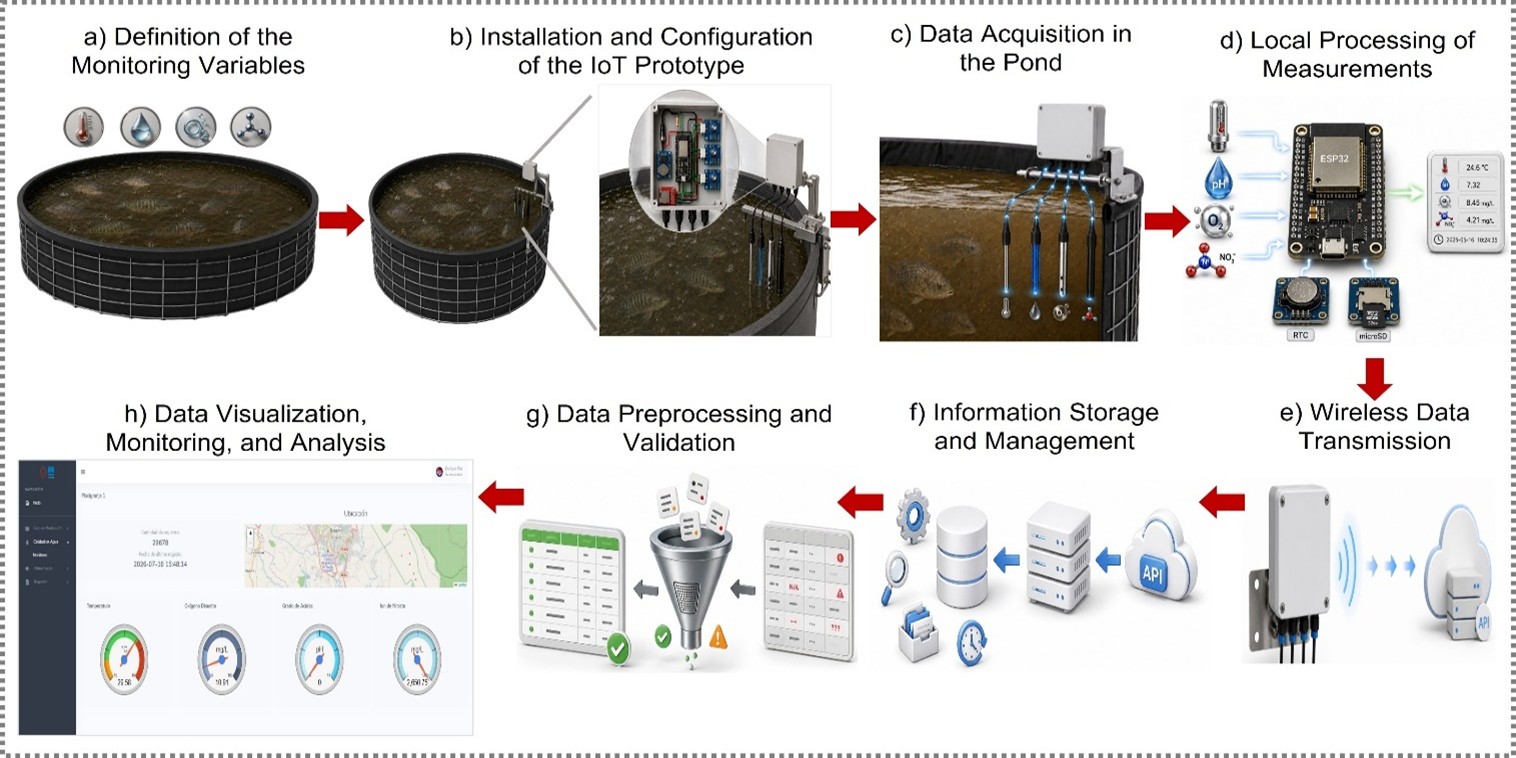
An IoT-based monitoring system was designed and deployed to measure, in real time, key water-quality parameters in intensive tilapia culture using biofloc at Ahuashiyacu Fisheries Station (San Martín, Peru). The prototype integrated temperature, pH, dissolved oxygen and nitrate sensors connected to a microcontroller with wireless transmission to a web dashboard. During validation (Nov 2024–Sep 2025), temperature remained mostly within 24–27 °C and dissolved oxygen within 4–12 mg/L; an outlier pH value due to calibration and a nitrate peak near the critical threshold were detected and triggered corrective actions. The system provided traceability, reduced observation time and supported decision-making, while being replicable and suitable for field conditions. We conclude the solution enhances operational surveillance and preventive management via configurable alerts.
Downloads
References
Acopa, N. J. L., et al. (2023). Evaluación de parámetros para la calidad del agua en el cultivo de tilapia. Revista IPSUMTEC, 6(5), 52–59. https://doi.org/10.61117/ipsumtec.v6i5.212.
Almendaris, R. H. M., Caiche, J. E., & Salcedo, M. (2025). Prototipo de IoT para monitorear los parámetros del agua de un cultivo acuícola. ITI: Revista de Investigación, Tecnología e Innovación, 9(1). https://revistas.ug.edu.ec/index.php/iti/es/article/view/2539
Amín, O. C. F., Rojas, P. A., & Navarrete, C. (2023). Diseño de un sistema de monitoreo de calidad de agua basado en Arduino y LoRa. Revista Facultad de Ciencias Básicas – UMNG. https://revistas.umng.edu.co/index.php/rfcb/article/view/7395
Bado, M., Carneiro, J., & Guerra, I. (2024). Impacto de la tecnología biofloc en el reciclaje de nutrientes, el bienestar animal y la sostenibilidad del ecosistema. Revista Investigaciones Agropecuarias, 7(1), 88–98. https://doi.org/10.48204/j.ia.v7n1.a6548
Bossier, P., & Ekasari, J. (2017). Biofloc technology application in aquaculture to support SDGs. Microbial Biotechnology, 10(5), 1012–1016. https://doi.org/10.1111/1751-7915.12836
Carbajal-Hernández, J. J., Sánchez-Fernández, L. P., Gamboa-Rodríguez, R., & Carrasco-Ochoa, J. A. (2017). Modelo basado en redes neuronales artificiales para la evaluación de la calidad del agua en sistemas de cultivo extensivo de camarón. Tecnología y Ciencias del Agua, 8(5), 71–86. https://revistatyca.org.mx/index.php/tyca/article/view/1369
Delgado-Santillán, L. Y., Trigoso, M., Mamani, G. C., Mendoza, L., & De La Cruz, R. (2025). Calidad de agua y parámetros productivos del cultivo de tilapia en estanque de tierra. AgroScience Research, 3(1), 27–38. https://doi.org/10.17268/agrosci.2025.003
Encinas, C., Ruiz, E., Cortez, J., & Espinoza, A. (2017). Design and implementation of a distributed IoT system for the monitoring of water quality in aquaculture. 2017 Wireless Telecommunications Symposium (WTS), 1–7. https://doi.org/10.1109/WTS.2017.7943540
Estrada-Godínez, J. A., Salgado-Velázquez, M., & Martínez-García, G. (2023). Desempeño productivo de hembras de tilapia en biofloc. Revista Colombiana de Ciencias Pecuarias. (SciELO).
FAO. (2020). El estado mundial de la pesca y la acuicultura 2020: La sostenibilidad en acción. Organización de las Naciones Unidas para la Alimentación y la Agricultura. https://doi.org/10.4060/ca9229es
Gálvez-Cantero, L., et al. (2022). El biofloc en la acuicultura. Revista de Salud Animal (SciELO Cuba).
García-Castro, J., & Ascón-Dionisio, G. (2022). Sistema automatizado de monitoreo de parámetros físico-químicos en alevines de gamitana. Revista Agrotecnológica Amazónica, 2(1), e240. https://doi.org/10.51252/raa.v2i1.240
Garza-Martínez, M. Á., et al. (2021). Aptitud territorial para cultivo de tilapia y aplicación de BFT. Tecnología y Ciencias del Agua (SciELO México).
González-Reyes, E., Romero-Rosales, S., & Pérez-Romero, J. (2024). Biofloc en el tratamiento de aguas residuales del cultivo de peces. Abanico Veterinario.
Hernández-Martínez, I. Y., Salazar-Sánchez, M. R., & Pereira-Flores, L. F. (2025). Comparación de la eficiencia productiva de tilapia roja en biofloc y raceways. BISTUA, 23(1). https://doi.org/10.24054/bistua.v23i1.2936
Ingle de la Mora, G., et al. (2003). Evaluación de parámetros de calidad del agua en recirculación para tilapia y trucha. Hidrobiológica (SciELO México). (De contexto histórico).
Khanjani, M. H., & Sharifinia, M. (2022). Recent progress towards the application of biofloc technology in tilapia aquaculture. Aquaculture, 554, 738021. https://doi.org/10.1016/j.aquaculture.2022.738021
Landines, M. A. (2025). Tecnología biofloc en la acuicultura: Estado de avance y perspectivas. Orinoquia, 27(1), e826. https://doi.org/10.22579/20112629.826
Lee, C., Kim, S., Lim, S.-J., & Lee, K.-J. (2017). Supplemental effects of biofloc powder on growth performance, innate immunity, and disease resistance of Litopenaeus vannamei. Fisheries and Aquatic Sciences, 20, 15. https://doi.org/10.1186/s41240-017-0059-7
Lino Villarán, A. E. (2022). Sistema de monitoreo para granjas acuícolas de la selva del Perú basado en IoT. Interfases, 16, 140–167. https://doi.org/10.26439/interfases2022.n016.6026
Landines, M. A. (2025). Tecnología biofloc en la acuicultura: estado de avance, desarrollo y aplicación. Orinoquia, 27(1). https://doi.org/10.22579/20112629.826
Medrano, K., Menjívar, R., & Vásquez, D. (2025). Tecnologías IoT para el monitoreo de la calidad del agua en acuicultura: revisión. EPISTEMUS (EPSIR).
Moreno, A. H. G., et al. (2024). Sistema de monitoreo IoT para calidad de agua de riego. Prospectiva Universitaria en Ingeniería y Tecnología, 20(1), 31–39. https://doi.org/10.26490/uncp.prospectivauniversitaria.2023.20.1972
Pérez-Somarriba, E. B., Hernández, F., & Molina, V. (2024). Uso de agua residual del cultivo de tilapia en riego agrícola. REBICAMCLI (UNAN-León).
Piamba-Mamián, T. M., Zambrano, L. E., Montaño-Rúales, L. A., & Rojas-Gonzales, F. A. (2021). Implementación de un sistema de monitoreo IoT aplicado a una piscicultura de trucha. Informador Técnico, 85(1), 3–19. https://doi.org/10.23850/22565035.2937
Quintero-Sánchez, Y. D., Sánchez-Portillo, S., Bracho-Colina, E. C., Salazar-Sánchez, M. R., Pereira-Flores, L. F., & Hernández-Martínez, I. Y. (2024). Evaluación de la producción de tilapia roja criados con tecnología biofloc. Revista EIA, 21(42). https://doi.org/10.24050/reia.v21i42.1761
Van Doan, H., Hoseinifar, S. H., Ringø, E., Esteban, M. Á., Dadar, M., Dawood, M. A. O., ... & Faggio, C. (2020). Host-associated probiotics: A key factor in sustainable aquaculture. Reviews in Fisheries Science & Aquaculture, 28(1), 16–42. https://doi.org/10.1080/23308249.2019.1643288
Verdegem, M. C. J., Bosma, R. H., & Verreth, J. A. J. (2006). Reducing water use for animal production through aquaculture. Water Resources Development, 22(1), 101–113. https://doi.org/10.1080/07900620500405544
Villaseñor-Reyes, G., Nájera-Alemán, P., Acosta-Pérez, V.-J., Rabling-Olivera, J., González-Vázquez, J., Ubilla-Paredes, K.-P., Bell-Palacios, I.-S., Gómez-de-Anda, F.-R., & Zepeda-Velázquez, A.-P. (2026). Correlación de la calidad del agua y la comunidad parasitaria en Cyprinus carpio var. koi en Pachuca de Soto, Hidalgo, México. Revista Peruana De Investigación Agropecuaria, 5(1), e145. https://doi.org/10.56926/repia.v5i1.145
Wang, C., Chuprom, J., Wang, Y., & Fu, L. (2020). Beneficial bacteria for aquaculture: Nutrition, bacteriostasis and immunoregulation. Journal of Applied Microbiology, 128(1), 28–40. https://doi.org/10.1111/jam.14383
Zafra Trelles, A. M., Díaz, M., Luján, L., Dávila, F., & Vela, K. (2022). Alimento vivo producido por el biofloc en la crianza de Oreochromis aureus. Arnaldoa, 29(2), 257–266. https://doi.org/10.22497/arnaldoa.292.29104
Zhou, W., Huang, Y., Li, D., Liu, X., & Duan, Q. (2022). Modelling and controlling dissolved oxygen in recirculating aquaculture systems based on mechanism analysis and an adaptive PID controller. Computers and Electronics in Agriculture, 192, 106583. https://doi.org/10.1016/j.compag.2021.106583
Zhu, X., Li, D., He, D., et al. (2010). Remote wireless system for water quality online monitoring. Computers and Electronics in Agriculture, 71, S3–S9. https://doi.org/10.1016/j.compag.2009.10.004
Downloads
Published
How to Cite
Issue
Section
License
Copyright (c) 2026 Juan Carlos García-Castro, Marco Armando Gálvez-Diaz, Juan Orlando Riascos-Armas, Edwin Augusto Hernández-Torres, Alberto Alva-Arévalo, Rubén Eusebio Acosta-Jacinto, Milton Rios-Julcapoma

This work is licensed under a Creative Commons Attribution 4.0 International License.
The authors retain their rights:
a. The authors retain their trademark and patent rights, as well as any process or procedure described in the article.
b. The authors retain the right to share, copy, distribute, execute and publicly communicate the article published in the Revista Científica de Sistemas e Informática (RCSI) (for example, place it in an institutional repository or publish it in a book), with an acknowledgment of its initial publication in the RCSI.
c. Authors retain the right to make a subsequent publication of their work, to use the article or any part of it (for example: a compilation of their works, notes for conferences, thesis, or for a book), provided that they indicate the source of publication (authors of the work, journal, volume, number and date).