Efecto de espectros de luz visible sobre la producción de Ganoderma lucidum en sustrato de pulpa de Café
DOI:
https://doi.org/10.51252/reacae.v5i2.1566Palabras clave:
bioconversión, espectro lumínico, fructificación, pulpa de café, residuos agroindustrialesResumen
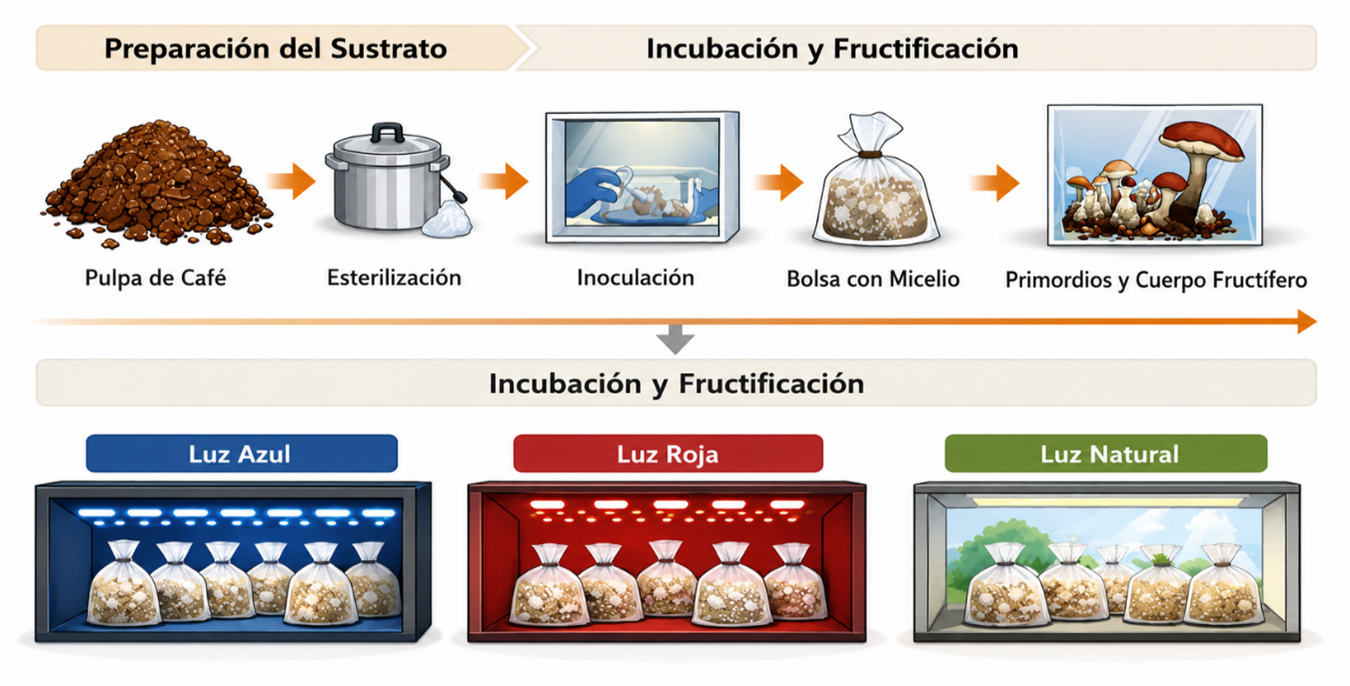
Ganoderma lucidum es un hongo de interés medicinal y nutracéutico cuyo desarrollo puede verse influenciado por las condiciones de iluminación durante el cultivo. El objetivo fue evaluar el efecto de distintos espectros de luz visible sobre la producción de G. lucidum en sustrato de pulpa de café. Se implementó un diseño con tres tratamientos (luz azul, luz roja y luz natural), conteniendo ocho bolsas de 500 g de sustrato por tratamiento y dispuestas en una cámara de crecimiento por condición lumínica, evaluando días de aparición de primordios, número de primordios y diámetro del cuerpo fructífero. La colonización micelial se completó en 17 días bajo oscuridad. Se detectaron diferencias significativas entre tratamientos: La luz roja y la azul redujeron el tiempo de aparición de primordios (18,12 y 19,25 días, respectivamente) frente a la luz natural (35,13 días); la luz roja indujo mayor número de primordios, mientras que la luz azul promovió el mayor diámetro de cuerpos fructíferos (5,2 cm), con diferencia estadística respecto a los demás tratamientos. Se concluyó que los espectros lumínicos influyen significativamente sobre la fructificación de G. lucidum, siendo la luz azul la condición más favorable para el desarrollo del cuerpo fructífero en sustratos de pulpa de café.
Descargas
Citas
Adeyi, A., Adedoyin, S., Adeyi, O., James, S., & Adenipekun, C. (2021). Ganoderma lucidum ethanol extract abrogates metabolic syndrome in rats: In vivo evaluation of hypoglycemic, hypolipidemic, hypotensive and antioxidant properties. Obesity Medicine, 22(September 2020), 112. https://doi.org/10.1016/j.obmed.2021.100320
Bijalwan, A., Bahuguna, K., Vasishth, A., Singh, A., Chaudhary, S., Dongariyal, A., Kumar, T., Kaushik, S., Javed, M., Alfarraj, S., Ali Alharbi, S., Skalicky, M., & Brestic, M. (2021). Growth performance of Ganoderma lucidum using billet method in Garhwal Himalaya, India. Saudi Journal of Biological Sciences, 28(5), 2709–2717. https://doi.org/10.1016/j.sjbs.2021.03.030
Di, P., Sun, Z., Cheng, L., Han, M., Yang, L., & Yang, L. (2023). LED Light Irradiations Differentially Affect the Physiological Characteristics, Ginsenoside Content, and Expressions of Ginsenoside Biosynthetic Pathway Genes in Panax ginseng. Agriculture, 13(807). https://doi.org/https://doi.org/10.3390/agriculture13040807
Fang, T., Chen, L., Yao, H., Li, Y., Liu, G., Wu, S., Lan, J., & Chen, X. (2025). Combined Transcriptomic and Metabolomic Analyses of the Response of Ganoderma lucidum to Elevated CO2. Journal of Fungi, 12(5), 1–24. https://doi.org/https://doi.org/10.3390/jof12010005
Haile, M., & Kang, W. H. (2019). The Role of Microbes in Coffee Fermentation and Their Impact on Coffee Quality. Journal of Food Quality, 2019, 1–6. https://doi.org/10.1155/2019/4836709
Hannah, R. (2021). Deforestation and Forest Loss. OurWorldinData.Org. https://ourworldindata.org/deforestation#article-citation
Hyde, K. D. (2022). The numbers of fungi. Fungal Diversity, 114(1), 1. https://doi.org/10.1007/s13225-022-00507-y
Li, J., Xu, C., Jing, Z., Li, X., Li, H., Chen, Y., Shao, Y., Cai, J., Wang, B., Xie, B., & Tao, Y. (2023). Blue light and its receptor white collar complex (FfWCC) regulates mycelial growth and fruiting body development in Flammulina filiformis. Scientia Horticulturae, 309(August 2022). https://doi.org/10.1016/j.scienta.2022.111623
Lu, X., Li, H., Cao, L., Liang, R., He, W., Wei, F., & Guo, X. (2026). A review of Ganoderma lucidum : Cultivation , active ingredients and its application as functional ingredients. Journal of Food Composition and Analysis, 149, 1–14. https://doi.org/10.1016/j.jfca.2025.108822
MIDAGRI. (2024). Perfil productivo regional. Estadistica Agrícola. https://app.powerbi.com/view?r=eyJrIjoiN2U3NTdkYTktOTk5Ny00NjQ5LTg0ZjEtMmIzYzlmZWIwMDhlIiwidCI6IjdmMDg0NjI3LTdmNDAtNDg3OS04OTE3LTk0Yjg2ZmQzNWYzZiJ9
Montoya, S., López, D., & Segura, B. (2018). Influencia de la luz azul sobre la productividad del cultivo sólido de Ganoderma lucidum. Revista Colombiana de Biotecnología, 20(1), 51–58. https://doi.org/10.15446/rev.colomb.biote.v20n1.73674
Monzón-Reyes, L. B., Vera-Puerto, I., Vergara Florez, V., López Méndez, M. C., Álvarez Month, A. E., Meléndez-Armenta, R., & Sandoval Herazo, L. C. (2026). Municipal and coffee wastewater treated by a full-scale Constructed Wetlands using ornamental plants under tropical climate. Ecological Engineering, 222. https://doi.org/https://doi.org/10.1016/j.ecoleng.2025.107809
Mueller, G. M., Schmit, J. P., Leacock, P. R., Buyck, B., Cifuentes, J., Desjardin, D., Halling, R. E., Hjortstam, K., Iturriaga, T., Karl-henrik, L. D., Jean, L., May, T., Minter, D., Rajchenberg, M., Redhead, S. A., Ryvarden, L., Trappe, J. M., Watling, R., & Wu, Q. (2007). Global diversity and distribution of macrofungi. Biodivers Conserv, 16, 37–48. https://doi.org/10.1007/S10531-006-9108-8
Niego, A., Rapior, S., Thongklang, N., Raspé, O., Hyde, K. D., & Mortimer, P. (2023). Reviewing the contributions of macrofungi to forest ecosystem processes and services. Fungal Biology Reviews, 44, 1–17. https://doi.org/10.1016/j.fbr.2022.11.002
Reátegui, R., & Chilet, S. (2022). La planificación ambiental. Fondo ediorial EDUNI.
Rodríguez, N., & Jaramillo, C. (2005). Cultivo de Hongos medicinales en residuos agricolas de la zona cafetera. In Cenicafé (Vol. 28). https://www.cenicafe.org/es/publications/bot028.pdf
Sun, L., Liu, L. P., Wang, Y. Z., Yang, L., Zhang, C., Yue, M. X., Dabbour, M., Mintah, B. K., & Wang, L. (2022). Effect of ultrasonication on the metabolome and transcriptome profile changes in the fermentation of Ganoderma lucidum. Microbiological Research, 254(July 2021), 126916. https://doi.org/10.1016/j.micres.2021.126916
Thamaraiselvi, C., Athira, S. T., Vasanthy, M., Sahayarayan, J., Gnanajothi, K., & Chandrasekaran, R. (2026). Sustainable management of coffee cherry pulping wastewater using biogenically synthesized calcium oxide nanoparticles. Next Materials, 10, 1–10. https://doi.org/https://doi.org/10.1016/j.nxmate.2025.101393
Tisch, D., & Schmoll, M. (2010). Light regulation of metabolic pathways in fungi. Applied Microbiology and Biotechnology, 85(5), 1259–1277. https://doi.org/10.1007/s00253-009-2320-1
Xu, Y., Huang, X., Wang, Z., Zhao, Y., Lv, D., & Xu, J. (2025). Blue Light Receptor WC-2 Regulates Ganoderic Acid Biosynthesis in Ganoderma lingzhi. Fungi, 11, 1–16. https://doi.org/https://doi.org/10.3390/jof11090646
Yu, W., Pei, R., Zhang, Y., Tu, Y., & He, B. (2023). Light regulation of secondary metabolism in fungi. Journal of Biological Engineering, 17(1), 1–13. https://doi.org/10.1186/s13036-023-00374-4
Zhou, X., Su, K., & Zhang, Y. (2012). Applied modern biotechnology for cultivation of Ganoderma and development of their products. Appl Microbiol Biotechnol, 93, 941–963. https://doi.org/10.1007/s00253-011-3780-7
Descargas
Publicado
Cómo citar
Número
Sección
Licencia
Derechos de autor 2026 Magdalena Luiza Carranza-Lozano , Astriht Ruiz-Rios, Luis Freyder Liñan-Escate, Adolfo Parrera-Salazar, Alfredo Iban Diaz-Visitación, Jhony Alexander Borbor-Vargas

Esta obra está bajo una licencia internacional Creative Commons Atribución 4.0.
Los autores retienen sus derechos:
a. Los autores retienen sus derechos de marca y patente, y tambien sobre cualquier proceso o procedimiento descrito en el artículo.
b. Los autores retienen el derecho de compartir, copiar, distribuir, ejecutar y comunicar públicamente el articulo publicado en la Revista Amazónica de Ciencias Ambientales y Ecológicas (REACAE) (por ejemplo, colocarlo en un repositorio institucional o publicarlo en un libro), con un reconocimiento de su publicación inicial en la REACAE.
c. Los autores retienen el derecho a hacer una posterior publicación de su trabajo, de utilizar el artículo o cualquier parte de aquel (por ejemplo: una compilación de sus trabajos, notas para conferencias, tesis, o para un libro), siempre que indiquen la fuente de publicación (autores del trabajo, revista, volumen, número y fecha).