Effect of visible light spectra on the production of Ganoderma lucidum in coffee pulp substrate
DOI:
https://doi.org/10.51252/reacae.v5i2.1566Keywords:
bioconversion, light spectrum, fruiting, coffee pulp, agro-industrial wasteAbstract
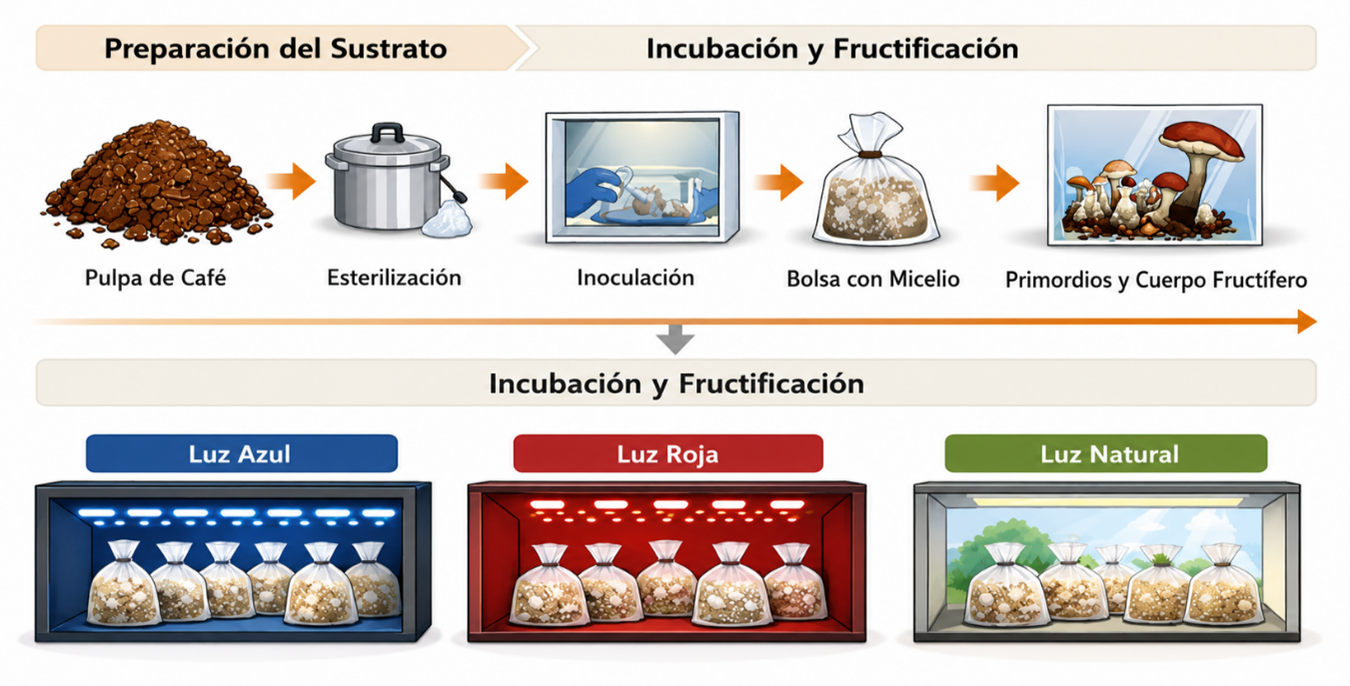
Ganoderma lucidum is a fungus of medicinal and nutraceutical interest whose growth can be influenced by lighting conditions during cultivation. The objective was to evaluate the effect of different visible light spectra on the production of G. lucidum in coffee pulp substrate. An experiment was conducted with three treatments (blue light, red light, and natural light), using eight bags of 500 g of substrate per treatment, arranged in a growth chamber according to the lighting condition. The study evaluated the number of days until primordia appeared, the number of primordia, and the diameter of the fruiting body. Mycelial colonization was completed in 17 days under dark conditions. Significant differences were detected among the treatments: red and blue light reduced the time to primordia emergence (18.12 and 19.25 days, respectively) compared to natural light (35.13 days); red light induced a greater number of primordia, while blue light promoted a larger fruiting body diameter (5.2 cm), with a statistically significant difference compared to the other treatments. It was concluded that light spectra significantly influence the fruiting of G. lucidum, with blue light being the most favorable condition for fruiting body development on coffee pulp substrates.
Downloads
References
Adeyi, A., Adedoyin, S., Adeyi, O., James, S., & Adenipekun, C. (2021). Ganoderma lucidum ethanol extract abrogates metabolic syndrome in rats: In vivo evaluation of hypoglycemic, hypolipidemic, hypotensive and antioxidant properties. Obesity Medicine, 22(September 2020), 112. https://doi.org/10.1016/j.obmed.2021.100320
Bijalwan, A., Bahuguna, K., Vasishth, A., Singh, A., Chaudhary, S., Dongariyal, A., Kumar, T., Kaushik, S., Javed, M., Alfarraj, S., Ali Alharbi, S., Skalicky, M., & Brestic, M. (2021). Growth performance of Ganoderma lucidum using billet method in Garhwal Himalaya, India. Saudi Journal of Biological Sciences, 28(5), 2709–2717. https://doi.org/10.1016/j.sjbs.2021.03.030
Di, P., Sun, Z., Cheng, L., Han, M., Yang, L., & Yang, L. (2023). LED Light Irradiations Differentially Affect the Physiological Characteristics, Ginsenoside Content, and Expressions of Ginsenoside Biosynthetic Pathway Genes in Panax ginseng. Agriculture, 13(807). https://doi.org/https://doi.org/10.3390/agriculture13040807
Fang, T., Chen, L., Yao, H., Li, Y., Liu, G., Wu, S., Lan, J., & Chen, X. (2025). Combined Transcriptomic and Metabolomic Analyses of the Response of Ganoderma lucidum to Elevated CO2. Journal of Fungi, 12(5), 1–24. https://doi.org/https://doi.org/10.3390/jof12010005
Haile, M., & Kang, W. H. (2019). The Role of Microbes in Coffee Fermentation and Their Impact on Coffee Quality. Journal of Food Quality, 2019, 1–6. https://doi.org/10.1155/2019/4836709
Hannah, R. (2021). Deforestation and Forest Loss. OurWorldinData.Org. https://ourworldindata.org/deforestation#article-citation
Hyde, K. D. (2022). The numbers of fungi. Fungal Diversity, 114(1), 1. https://doi.org/10.1007/s13225-022-00507-y
Li, J., Xu, C., Jing, Z., Li, X., Li, H., Chen, Y., Shao, Y., Cai, J., Wang, B., Xie, B., & Tao, Y. (2023). Blue light and its receptor white collar complex (FfWCC) regulates mycelial growth and fruiting body development in Flammulina filiformis. Scientia Horticulturae, 309(August 2022). https://doi.org/10.1016/j.scienta.2022.111623
Lu, X., Li, H., Cao, L., Liang, R., He, W., Wei, F., & Guo, X. (2026). A review of Ganoderma lucidum : Cultivation , active ingredients and its application as functional ingredients. Journal of Food Composition and Analysis, 149, 1–14. https://doi.org/10.1016/j.jfca.2025.108822
MIDAGRI. (2024). Perfil productivo regional. Estadistica Agrícola. https://app.powerbi.com/view?r=eyJrIjoiN2U3NTdkYTktOTk5Ny00NjQ5LTg0ZjEtMmIzYzlmZWIwMDhlIiwidCI6IjdmMDg0NjI3LTdmNDAtNDg3OS04OTE3LTk0Yjg2ZmQzNWYzZiJ9
Montoya, S., López, D., & Segura, B. (2018). Influencia de la luz azul sobre la productividad del cultivo sólido de Ganoderma lucidum. Revista Colombiana de Biotecnología, 20(1), 51–58. https://doi.org/10.15446/rev.colomb.biote.v20n1.73674
Monzón-Reyes, L. B., Vera-Puerto, I., Vergara Florez, V., López Méndez, M. C., Álvarez Month, A. E., Meléndez-Armenta, R., & Sandoval Herazo, L. C. (2026). Municipal and coffee wastewater treated by a full-scale Constructed Wetlands using ornamental plants under tropical climate. Ecological Engineering, 222. https://doi.org/https://doi.org/10.1016/j.ecoleng.2025.107809
Mueller, G. M., Schmit, J. P., Leacock, P. R., Buyck, B., Cifuentes, J., Desjardin, D., Halling, R. E., Hjortstam, K., Iturriaga, T., Karl-henrik, L. D., Jean, L., May, T., Minter, D., Rajchenberg, M., Redhead, S. A., Ryvarden, L., Trappe, J. M., Watling, R., & Wu, Q. (2007). Global diversity and distribution of macrofungi. Biodivers Conserv, 16, 37–48. https://doi.org/10.1007/S10531-006-9108-8
Niego, A., Rapior, S., Thongklang, N., Raspé, O., Hyde, K. D., & Mortimer, P. (2023). Reviewing the contributions of macrofungi to forest ecosystem processes and services. Fungal Biology Reviews, 44, 1–17. https://doi.org/10.1016/j.fbr.2022.11.002
Reátegui, R., & Chilet, S. (2022). La planificación ambiental. Fondo ediorial EDUNI.
Rodríguez, N., & Jaramillo, C. (2005). Cultivo de Hongos medicinales en residuos agricolas de la zona cafetera. In Cenicafé (Vol. 28). https://www.cenicafe.org/es/publications/bot028.pdf
Sun, L., Liu, L. P., Wang, Y. Z., Yang, L., Zhang, C., Yue, M. X., Dabbour, M., Mintah, B. K., & Wang, L. (2022). Effect of ultrasonication on the metabolome and transcriptome profile changes in the fermentation of Ganoderma lucidum. Microbiological Research, 254(July 2021), 126916. https://doi.org/10.1016/j.micres.2021.126916
Thamaraiselvi, C., Athira, S. T., Vasanthy, M., Sahayarayan, J., Gnanajothi, K., & Chandrasekaran, R. (2026). Sustainable management of coffee cherry pulping wastewater using biogenically synthesized calcium oxide nanoparticles. Next Materials, 10, 1–10. https://doi.org/https://doi.org/10.1016/j.nxmate.2025.101393
Tisch, D., & Schmoll, M. (2010). Light regulation of metabolic pathways in fungi. Applied Microbiology and Biotechnology, 85(5), 1259–1277. https://doi.org/10.1007/s00253-009-2320-1
Xu, Y., Huang, X., Wang, Z., Zhao, Y., Lv, D., & Xu, J. (2025). Blue Light Receptor WC-2 Regulates Ganoderic Acid Biosynthesis in Ganoderma lingzhi. Fungi, 11, 1–16. https://doi.org/https://doi.org/10.3390/jof11090646
Yu, W., Pei, R., Zhang, Y., Tu, Y., & He, B. (2023). Light regulation of secondary metabolism in fungi. Journal of Biological Engineering, 17(1), 1–13. https://doi.org/10.1186/s13036-023-00374-4
Zhou, X., Su, K., & Zhang, Y. (2012). Applied modern biotechnology for cultivation of Ganoderma and development of their products. Appl Microbiol Biotechnol, 93, 941–963. https://doi.org/10.1007/s00253-011-3780-7
Downloads
Published
How to Cite
Issue
Section
License
Copyright (c) 2026 Magdalena Luiza Carranza-Lozano , Astriht Ruiz-Rios, Luis Freyder Liñan-Escate, Adolfo Parrera-Salazar, Alfredo Iban Diaz-Visitación, Jhony Alexander Borbor-Vargas

This work is licensed under a Creative Commons Attribution 4.0 International License.
The authors retain their rights:
a. The authors retain their trademark and patent rights, as well as any process or procedure described in the article.
b. The authors retain the right to share, copy, distribute, execute and publicly communicate the article published in the Revista Amazónica de Ciencias Ambientales y Ecológicas (REACAE) (for example, place it in an institutional repository or publish it in a book), with an acknowledgment of its initial publication in the REACAE.
c. Authors retain the right to make a subsequent publication of their work, to use the article or any part of it (for example: a compilation of their works, notes for conferences, thesis, or for a book), provided that they indicate the source of publication (authors of the work, journal, volume, number and date).