Efficiency of Rhynchophorus palmarum (“suri”) larvae in biodegrading sugarcane bagasse
DOI:
https://doi.org/10.51252/reacae.v5i2.1465Keywords:
peruvian Amazon, biodegradation, weevils, ecosystems, waste managementAbstract
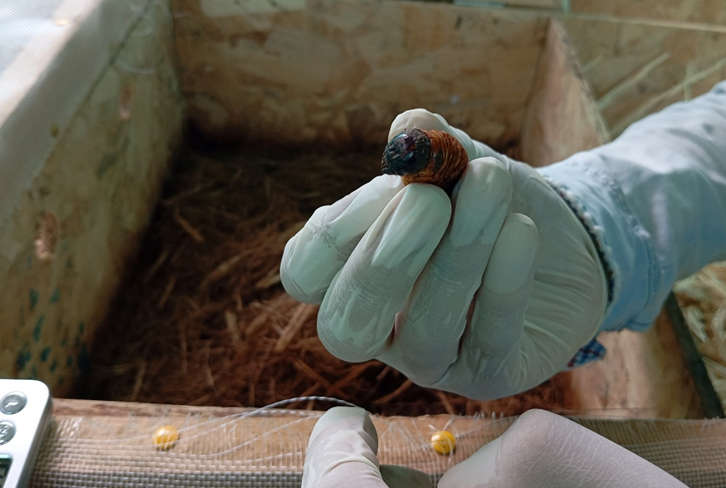
Sugarcane bagasse is an abundant waste product, and its accumulation poses environmental and health risks, making it necessary to explore sustainable and low-cost treatments. The objective was to determine the efficiency of Rhynchophorus palmarum larvae in degrading sugarcane bagasse. An experiment was conducted with a control (T0) and three treatments, T1, T2, and T3, containing 20, 40, and 60 larvae per 500 g and evaluated at 42 days; the percentage of degradation was calculated by mass loss and the effects were analyzed (Kruskal Wallis and Dunn's post hoc). Environmental conditions were homogeneous in all treatments. The average degradation was 3.20% (T0), 42.60% (T1), 54.73% (T2), and 57.67% (T3). the Kruskal–Wallis test indicated significant differences (H=7.82; p=0.049), and Dunn showed that T2 and T3 outperformed the control (T0–T2 p=0.031; T0–T3 p=0.009), with no differences between T1–T2–T3. Mortality was high (68.42% in T1; 67.83% in T2; 72.35% in T3), so T2 (40 larvae/500 g) showed the best conditions in terms of efficiency and survival. Finally, it is concluded that biodegradation with R. palmarum is feasible as a pretreatment for bagasse.
Downloads
References
Aguiar, S., Estrella, M. E., & Uvidia, H. (2022). Residuos agroindustriales : su impacto , manejo y aprovechamiento. AXIOMA, 27, 5–10. https://doi.org/DOI: https://doi.org/10.26621/ra.v1i27.803
Aldana de la Torre, R. C., Aldana de la Torre, J. A., & Mauricio Moya, O. (2011). Manejo de Rhynchophorus palmarum L. (Coleoptera: Curculionidae) en temporada invernal (Instituto Colombiano Agropecuario (ed.)). https://www.ica.gov.co/getattachment/a9d6034a-9dc0-463e-aa49-c974b217a92d/Manejo-de-Rhynchophorus-palmarum-L-en-temporada-i.pdf
Aldana, R. C., Aldana, J., & Moya, O. (2011). Manejo de Rhynchophorus palmarum L. en temporada invernal. In Instituto Colombiano Agropecuario.
Bano, S., Singh, K., Chaudhary, A., & Chandra, R. (2025). Innovative methods for the valorisation of solid wastes from sugar mill and refineries for sustainable development : A review. Cleaner Waste Systems, 10, 1–13. https://doi.org/https://doi.org/10.1016/j.clwas.2025.100230
Bermúdez-Savón, R. C., García-Oduardo, N., Aguilera-Rodríguez, I., & Mendoza Montero, Y. (2024). Biodegradación de residuos lignocelulósicos secundarios por Pleurotus spp. 43(1), 157–172. https://dialnet.unirioja.es/servlet/articulo?codigo=10044987
Cai, L., Gong, X., Ding, H., Li, S., Hao, D., & Yu, K. (2022). Environmental Technology & Innovation Vermicomposting with food processing waste mixtures of soybean meal and sugarcane bagasse. Environmental Technology & Innovation, 28, 1–11. https://doi.org/10.1016/j.eti.2022.102699
Calumby, R., Barros, Y., Barbosa, V. T., Dornelas, C. B., Almeida, L. M., Segura, W. D., Silva, A. T., Alvino, V., & Grillo, L. (2022). Characterization of cultivable intestinal microbiota in Rhynchophorus palmarum Linnaeus (Coleoptera : Curculionidae) and determination of its cellulolytic activity. WILEY, 110(2), 1–18. https://doi.org/10.1002/arch.21881
Debernardi-vazquez, T. D. J., & Aguilar-Rivera, N. (2020). Manejo sostenible de subproductos agroindustriales y estrategias tecnológicas de bioconversión. Revista Colombiana de Investigaciones Agroindustriales, 7(2), 22–31. https://doi.org/https://doi.org/10.23850/24220582.2249
Gaviria, J., & Löhr, B. (2020). Parasitismo de Billaea claripalpis (Diptera: Tachinidae) sobre larvas de Rhynchophorus palmarum (Coleoptera : Dryophthoridae). Avances En Investigación Agropecuaria, 24(2), 67–80.
Hassan, S., Ngo, T., & Ball, A. S. (2024). Valorisation of Sugarcane Bagasse for the Sustainable Production of Polyhydroxyalkanoates. Sustainability, 1–20.
Hoddle, M. S., Antony, B., El-shafie, H. A. F., Chamorro, M. L., Milosavljevi, I., Löhr, B., & Faleiro, J. R. (2024). Taxonomy , Biology , Symbionts , Omics , and Management of Rhynchophorus Palm Weevils (Coleoptera : Curculionidae : Dryophthorinae). Annual Review OfEntomology, 69, 455–479. https://doi.org/https://doi.org/10.1146/annurev-ento-013023-121139
Hoddle, M. S., Hoddle, C. D., & Milosavljevi, I. (2021). Quantification of the Life Time Flight Capabilities of the South American Palm Weevil, Rhynchophorus palmarum (L.) (Coleoptera: Curculionidae). Insects, 12(126). https://doi.org/https://doi.org/10.3390/insects12020126
Landívar, M., Sancho, D., Pico, J., Sarabia, D. A., & Pintado, P. (2021). Aislamiento de microorganismos a partir del fluido digestivo de larvas de Rhynchophorus palmarum (Coleoptera: Curculionidae). Revista Espamciencia, 12(2), 152–157. https://doi.org/https://doi.org/10.51260/revista_espamciencia.v12i2.251
Matsueda, Y., & Antunes, E. (2024). A review of current technologies for the sustainable valorisation of sugarcane bagasse. Journal of Environmental Chemical Engineering, 12, 1–18. https://doi.org/https://doi.org/10.1016/j.jece.2024.114900
Ntunka, M. G., Makhathini, T. P., Khumalo, S. M., Bwapwa, J. K., & Tshibangu, M. M. (2025). Recent Developments in the Valorization of Sugarcane Bagasse Biomass via Integrated Pretreatment and Fermentation Strategies. Fermentation, 11(11), 1–25. https://doi.org/https://doi.org/10.3390/fermentation11110632
Phiri, R., Rangappa, S. M., & Siengchin, S. (2024). Agro-waste for renewable and sustainable green production : A review. Journal of Cleaner Production, 434, 1–13. https://doi.org/10.1016/j.jclepro.2023.139989
Ravish, P., & Chaudhry, S. (2025). Efficacy of a fungal decomposer in accelerating sugarcane trash decomposition and soil nutrient enrichment under semi-controlled conditions. Discover Environment, 3(1), 96. https://doi.org/10.1007/s44274-025-00300-z
Reátegui, R., & Chilet, S. (2022). La planificación ambiental. Fondo ediorial EDUNI.
Velasco-Velasco, J., Gómez-Merino, F. C., Hernández-Cázares, A. S., Salinas-Ruiz, J., & Guerrero-Peña, A. (2017). Residuos orgánicos de la agroindustria azucarera: Retos y oportunidades. Agroproductividad, 10(11), 99–104.
Vidyashri, V., Lewis, H., Narayanasamy, P., Mahesha, G. T., & Bhat, S. (2019). Preparation of chemically treated sugarcane bagasse fiber reinforced epoxy composites and their characterization. Cogent Engineering, 6(1), 1–11. https://doi.org/10.1080/23311916.2019.1708644
Villani, A., Fanelli, F., Mul, G., Moretti, A., & Loi, M. (2025). Shedding light on Pleurotus : An update on taxonomy , properties , and photobiology. Microbiological Research, 295, 1–12. https://doi.org/10.1016/j.micres.2025.128110
Xu, P., Shu, L., Li, Y., Zhou, S., Zhang, G., & Wu, Y. (2023). Pretreatment and composting technology of agricultural organic waste for sustainable agricultural development. Heliyon, 9(5), 1–20. https://doi.org/10.1016/j.heliyon.2023.e16311
Downloads
Published
How to Cite
Issue
Section
License
Copyright (c) 2026 Jesús Martin Flores-Gomez, Luis Eduardo Rodriguez-Pérez, Andi Lozano-Chung, Luis Freyder Liñan-Escate

This work is licensed under a Creative Commons Attribution 4.0 International License.
The authors retain their rights:
a. The authors retain their trademark and patent rights, as well as any process or procedure described in the article.
b. The authors retain the right to share, copy, distribute, execute and publicly communicate the article published in the Revista Amazónica de Ciencias Ambientales y Ecológicas (REACAE) (for example, place it in an institutional repository or publish it in a book), with an acknowledgment of its initial publication in the REACAE.
c. Authors retain the right to make a subsequent publication of their work, to use the article or any part of it (for example: a compilation of their works, notes for conferences, thesis, or for a book), provided that they indicate the source of publication (authors of the work, journal, volume, number and date).