Eficiencia de larvas de Rhynchophorus palmarum (“suri”) para biodegradar bagazo de caña de azúcar
DOI:
https://doi.org/10.51252/reacae.v5i2.1465Palabras clave:
amazonia peruana, biodegradación, curculionidae, ecosistemas, manejo de residuosResumen
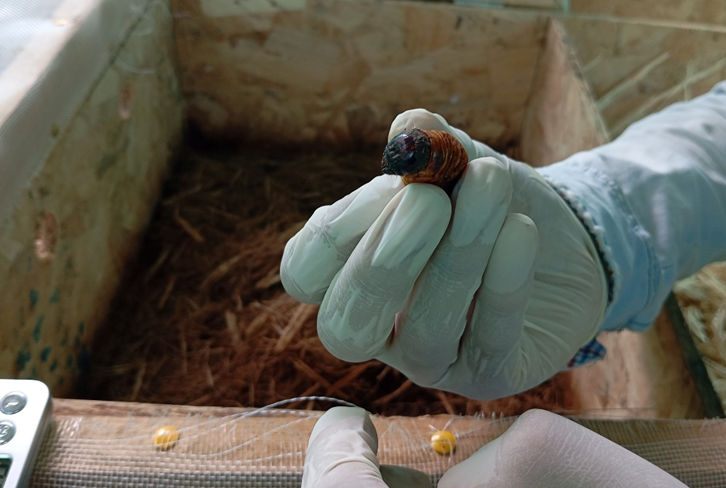
El bagazo de caña de azúcar es un residuo abundante, donde su acumulación plantea riesgos ambientales y sanitarios, razón que resulta necesario explorar tratamientos sostenibles y de bajo costo. El objetivo fue determinar la eficiencia de larvas de Rhynchophorus palmarum para degradar bagazo de caña. Se realizó un experimento con control (T0) y tres tratamientos, T1, T2 y T3, conteniendo 20, 40 y 60 larvas por 500 g y evaluado a 42 días; se calculó el porcentaje de degradación por pérdida de masa y se analizaron efectos (Kruskal Wallis y post hoc de Dunn). Las condiciones ambientales fueron homogéneas en todos los tratamientos. La degradación promedio fue 3,20 % (T0), 42,60 % (T1), 54,73 % (T2) y 57,67 % (T3); la prueba de Kruskal–Wallis indicó diferencias significativas (H=7,82; p=0,049), y Dunn mostró que T2 y T3 superaron al control (T0–T2 p=0,031; T0–T3 p=0,009), sin diferencias entre T1–T2–T3. La mortalidad fue elevada (68,42 % en T1; 67,83 % en T2; 72,35 % en T3), por lo que T2 (40 larvas/500 g) evidencio mejores condiciones entre eficiencia y supervivencia. Finalmente se concluye, que la biodegradación con R. palmarum es factible como pretratamiento del bagazo.
Descargas
Citas
Aguiar, S., Estrella, M. E., & Uvidia, H. (2022). Residuos agroindustriales : su impacto , manejo y aprovechamiento. AXIOMA, 27, 5–10. https://doi.org/DOI: https://doi.org/10.26621/ra.v1i27.803
Aldana de la Torre, R. C., Aldana de la Torre, J. A., & Mauricio Moya, O. (2011). Manejo de Rhynchophorus palmarum L. (Coleoptera: Curculionidae) en temporada invernal (Instituto Colombiano Agropecuario (ed.)). https://www.ica.gov.co/getattachment/a9d6034a-9dc0-463e-aa49-c974b217a92d/Manejo-de-Rhynchophorus-palmarum-L-en-temporada-i.pdf
Aldana, R. C., Aldana, J., & Moya, O. (2011). Manejo de Rhynchophorus palmarum L. en temporada invernal. In Instituto Colombiano Agropecuario.
Bano, S., Singh, K., Chaudhary, A., & Chandra, R. (2025). Innovative methods for the valorisation of solid wastes from sugar mill and refineries for sustainable development : A review. Cleaner Waste Systems, 10, 1–13. https://doi.org/https://doi.org/10.1016/j.clwas.2025.100230
Bermúdez-Savón, R. C., García-Oduardo, N., Aguilera-Rodríguez, I., & Mendoza Montero, Y. (2024). Biodegradación de residuos lignocelulósicos secundarios por Pleurotus spp. 43(1), 157–172. https://dialnet.unirioja.es/servlet/articulo?codigo=10044987
Cai, L., Gong, X., Ding, H., Li, S., Hao, D., & Yu, K. (2022). Environmental Technology & Innovation Vermicomposting with food processing waste mixtures of soybean meal and sugarcane bagasse. Environmental Technology & Innovation, 28, 1–11. https://doi.org/10.1016/j.eti.2022.102699
Calumby, R., Barros, Y., Barbosa, V. T., Dornelas, C. B., Almeida, L. M., Segura, W. D., Silva, A. T., Alvino, V., & Grillo, L. (2022). Characterization of cultivable intestinal microbiota in Rhynchophorus palmarum Linnaeus (Coleoptera : Curculionidae) and determination of its cellulolytic activity. WILEY, 110(2), 1–18. https://doi.org/10.1002/arch.21881
Debernardi-vazquez, T. D. J., & Aguilar-Rivera, N. (2020). Manejo sostenible de subproductos agroindustriales y estrategias tecnológicas de bioconversión. Revista Colombiana de Investigaciones Agroindustriales, 7(2), 22–31. https://doi.org/https://doi.org/10.23850/24220582.2249
Gaviria, J., & Löhr, B. (2020). Parasitismo de Billaea claripalpis (Diptera: Tachinidae) sobre larvas de Rhynchophorus palmarum (Coleoptera : Dryophthoridae). Avances En Investigación Agropecuaria, 24(2), 67–80.
Hassan, S., Ngo, T., & Ball, A. S. (2024). Valorisation of Sugarcane Bagasse for the Sustainable Production of Polyhydroxyalkanoates. Sustainability, 1–20.
Hoddle, M. S., Antony, B., El-shafie, H. A. F., Chamorro, M. L., Milosavljevi, I., Löhr, B., & Faleiro, J. R. (2024). Taxonomy , Biology , Symbionts , Omics , and Management of Rhynchophorus Palm Weevils (Coleoptera : Curculionidae : Dryophthorinae). Annual Review OfEntomology, 69, 455–479. https://doi.org/https://doi.org/10.1146/annurev-ento-013023-121139
Hoddle, M. S., Hoddle, C. D., & Milosavljevi, I. (2021). Quantification of the Life Time Flight Capabilities of the South American Palm Weevil, Rhynchophorus palmarum (L.) (Coleoptera: Curculionidae). Insects, 12(126). https://doi.org/https://doi.org/10.3390/insects12020126
Landívar, M., Sancho, D., Pico, J., Sarabia, D. A., & Pintado, P. (2021). Aislamiento de microorganismos a partir del fluido digestivo de larvas de Rhynchophorus palmarum (Coleoptera: Curculionidae). Revista Espamciencia, 12(2), 152–157. https://doi.org/https://doi.org/10.51260/revista_espamciencia.v12i2.251
Matsueda, Y., & Antunes, E. (2024). A review of current technologies for the sustainable valorisation of sugarcane bagasse. Journal of Environmental Chemical Engineering, 12, 1–18. https://doi.org/https://doi.org/10.1016/j.jece.2024.114900
Ntunka, M. G., Makhathini, T. P., Khumalo, S. M., Bwapwa, J. K., & Tshibangu, M. M. (2025). Recent Developments in the Valorization of Sugarcane Bagasse Biomass via Integrated Pretreatment and Fermentation Strategies. Fermentation, 11(11), 1–25. https://doi.org/https://doi.org/10.3390/fermentation11110632
Phiri, R., Rangappa, S. M., & Siengchin, S. (2024). Agro-waste for renewable and sustainable green production : A review. Journal of Cleaner Production, 434, 1–13. https://doi.org/10.1016/j.jclepro.2023.139989
Ravish, P., & Chaudhry, S. (2025). Efficacy of a fungal decomposer in accelerating sugarcane trash decomposition and soil nutrient enrichment under semi-controlled conditions. Discover Environment, 3(1), 96. https://doi.org/10.1007/s44274-025-00300-z
Reátegui, R., & Chilet, S. (2022). La planificación ambiental. Fondo ediorial EDUNI.
Velasco-Velasco, J., Gómez-Merino, F. C., Hernández-Cázares, A. S., Salinas-Ruiz, J., & Guerrero-Peña, A. (2017). Residuos orgánicos de la agroindustria azucarera: Retos y oportunidades. Agroproductividad, 10(11), 99–104.
Vidyashri, V., Lewis, H., Narayanasamy, P., Mahesha, G. T., & Bhat, S. (2019). Preparation of chemically treated sugarcane bagasse fiber reinforced epoxy composites and their characterization. Cogent Engineering, 6(1), 1–11. https://doi.org/10.1080/23311916.2019.1708644
Villani, A., Fanelli, F., Mul, G., Moretti, A., & Loi, M. (2025). Shedding light on Pleurotus : An update on taxonomy , properties , and photobiology. Microbiological Research, 295, 1–12. https://doi.org/10.1016/j.micres.2025.128110
Xu, P., Shu, L., Li, Y., Zhou, S., Zhang, G., & Wu, Y. (2023). Pretreatment and composting technology of agricultural organic waste for sustainable agricultural development. Heliyon, 9(5), 1–20. https://doi.org/10.1016/j.heliyon.2023.e16311
Descargas
Publicado
Cómo citar
Número
Sección
Licencia
Derechos de autor 2026 Jesús Martin Flores-Gomez, Luis Eduardo Rodriguez-Pérez, Andi Lozano-Chung, Luis Freyder Liñan-Escate

Esta obra está bajo una licencia internacional Creative Commons Atribución 4.0.
Los autores retienen sus derechos:
a. Los autores retienen sus derechos de marca y patente, y tambien sobre cualquier proceso o procedimiento descrito en el artículo.
b. Los autores retienen el derecho de compartir, copiar, distribuir, ejecutar y comunicar públicamente el articulo publicado en la Revista Amazónica de Ciencias Ambientales y Ecológicas (REACAE) (por ejemplo, colocarlo en un repositorio institucional o publicarlo en un libro), con un reconocimiento de su publicación inicial en la REACAE.
c. Los autores retienen el derecho a hacer una posterior publicación de su trabajo, de utilizar el artículo o cualquier parte de aquel (por ejemplo: una compilación de sus trabajos, notas para conferencias, tesis, o para un libro), siempre que indiquen la fuente de publicación (autores del trabajo, revista, volumen, número y fecha).