Influence of the C/N ratio and hydraulic retention time on biogas yield during anaerobic co-digestion
DOI:
https://doi.org/10.51252/reacae.v5i2.1557Keywords:
renewable energy utilization, organic waste management, process optimization, methane production, rural bioenergy systemsAbstract
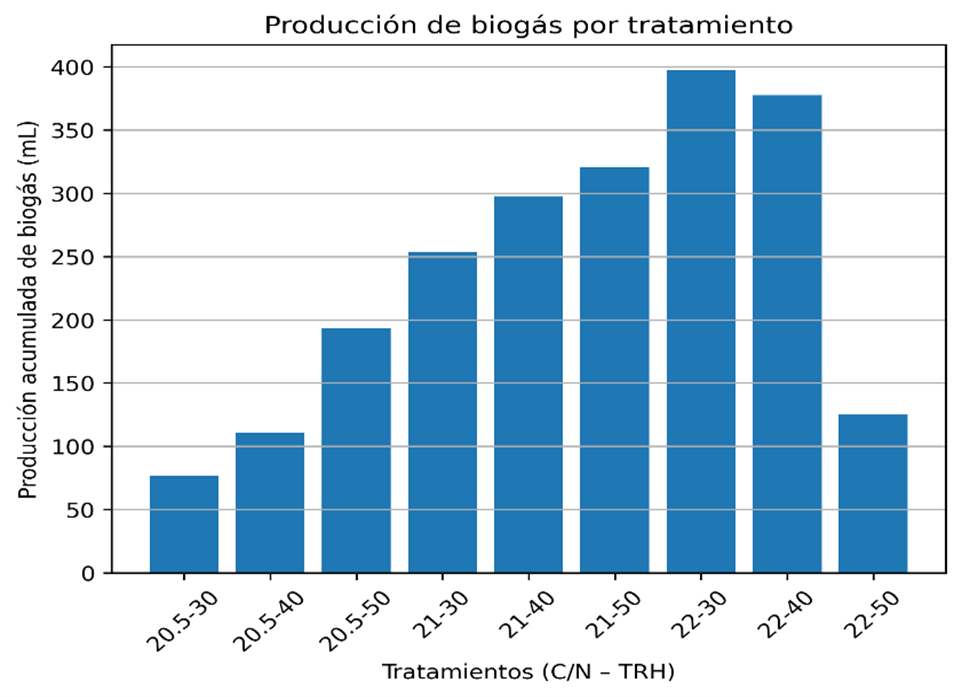
Anaerobic digestion represents a sustainable alternative for organic waste treatment and renewable energy production in the form of biogas. This study evaluated the influence of the carbon-to-nitrogen (C/N) ratio and hydraulic retention time (HRT) on biogas yield obtained through anaerobic co-digestion of pig slurry and vegetable organic waste. The experiment was conducted using a 3 × 3 factorial design with three replicates per treatment, considering three C/N ratios (20.5, 21.0, and 22.0) and three hydraulic retention times (30, 40, and 50 days). The results showed that both the C/N ratio and HRT significantly affected biogas production (p < 0.05), achieving a maximum yield of 397.6 mL under conditions of C/N ratio of 22.0 and HRT of 30 days. It is concluded that the combined optimization of these parameters improves process efficiency and provides technical criteria for the design and operation of anaerobic digestion systems aimed at energy recovery from organic waste in rural contexts.
Downloads
References
Alengebawy, A., Ran, Y., Osman, A. I., Jin, K., Samer, M., & Ai, P. (2024). Anaerobic digestion of agricultural waste for biogas production and sustainable bioenergy recovery: a review. Environmental Chemistry Letters, 22(6), 2641–2668. https://doi.org/10.1007/s10311-024-01789-1
DelaVega-Quintero, J. C., Nuñez-Pérez, J., Lara-Fiallos, M., Barba, P., Burbano-García, J. L., & Espín-Valladares, R. (2025). Advances and Challenges in Anaerobic Digestion for Biogas Production: Policy, Technological, and Microbial Perspectives. Processes, 13(11), 3648. https://doi.org/10.3390/pr13113648
Gonde, L., Wickham, T., Brink, H. G., & Nicol, W. (2023). pH-Based Control of Anaerobic Digestion to Maximise Ammonium Production in Liquid Digestate. Water, 15(3), 417. https://doi.org/10.3390/w15030417
Holm-Nielsen, J. B., Al Seadi, T., & Oleskowicz-Popiel, P. (2009). The future of anaerobic digestion and biogas utilization. Bioresource Technology, 100(22), 5478–5484. https://doi.org/10.1016/j.biortech.2008.12.046
Ibrahim, N. A., Majeed, H. H., Jwaid, T. A., & Silas, K. (2025). Advancements in anaerobic digestion of organic waste for sustainable biogas production. Environmental Science and Pollution Research, 32(30), 17916–17930. https://doi.org/10.1007/s11356-025-36783-9
Islam, M. R., Wang, Q., Guo, Y., Wang, W., Sharmin, S., & Ebere Enyoh, C. (2023). Physico-Chemical Characterization of Food Wastes for Potential Soil Application. Processes, 11(1), 250. https://doi.org/10.3390/pr11010250
Labatut, R. A., Angenent, L. T., & Scott, N. R. (2014). Conventional mesophilic vs. thermophilic anaerobic digestion: A trade-off between performance and stability? Water Research, 53, 249–258. https://doi.org/10.1016/j.watres.2014.01.035
Li, Y., Park, S. Y., & Zhu, J. (2011). Solid-state anaerobic digestion for methane production from organic waste. Renewable and Sustainable Energy Reviews, 15(1), 821–826. https://doi.org/10.1016/j.rser.2010.07.042
Lizcano-Pulido, A. K., Morales-Toscano, A. C., Naranjo-Lourido, W., & Martínez-Baquero, J. E. (2021). Diseño y Simulación de Control de temperatura y pH para el inicio de un biorreactor tipo Batch. Revista Vínculos, 18(2). https://revistas.udistrital.edu.co/index.php/vinculos/article/view/20193
Lu, Y., Huang, G., Zhang, J., Han, T., Tian, P., Li, G., & Li, Y. (2025). Optimization of Anaerobic Co-Digestion Parameters for Vinegar Residue and Cattle Manure via Orthogonal Experimental Design. Fermentation, 11(9), 493. https://doi.org/10.3390/fermentation11090493
Meegoda, J. N., Li, B., Patel, K., & Wang, L. B. (2018). A Review of the Processes, Parameters, and Optimization of Anaerobic Digestion. International Journal of Environmental Research and Public Health, 15(10), 2224. https://doi.org/10.3390/ijerph15102224
Osinergmin. (2024). Informe mensual de energía y minería – Octubre 2024. https://cdn.www.gob.pe/uploads/document/file/7556960/6419676-informe-mensual-de-energia-y-mineria-octubre-2024.pdf
Sathyan, A., Haq, I., Kalamdhad, A. S., & Khwaraikpam, M. (2022). Recent advancements in anaerobic digestion: A Novel approche for waste to energy. In Advanced Organic Waste Management (pp. 233–246). Elsevier. https://doi.org/10.1016/B978-0-323-85792-5.00017-4
Xi, H., Hu, Q., & Qiu, B. (2026). Optimizing operational parameters in MEC system for enhanced methane production and reduced dissolved methane from dairy wastewater. Desalination and Water Treatment, 326, 101753. https://doi.org/10.1016/j.dwt.2026.101753
Yenigün, O., & Demirel, B. (2013). Ammonia inhibition in anaerobic digestion: A review. Process Biochemistry, 48(5–6), 901–911. https://doi.org/10.1016/j.procbio.2013.04.012
Downloads
Published
How to Cite
Issue
Section
License
Copyright (c) 2026 Wanhin Orlando Aguilar-Herrera

This work is licensed under a Creative Commons Attribution 4.0 International License.
The authors retain their rights:
a. The authors retain their trademark and patent rights, as well as any process or procedure described in the article.
b. The authors retain the right to share, copy, distribute, execute and publicly communicate the article published in the Revista Amazónica de Ciencias Ambientales y Ecológicas (REACAE) (for example, place it in an institutional repository or publish it in a book), with an acknowledgment of its initial publication in the REACAE.
c. Authors retain the right to make a subsequent publication of their work, to use the article or any part of it (for example: a compilation of their works, notes for conferences, thesis, or for a book), provided that they indicate the source of publication (authors of the work, journal, volume, number and date).