Aplicación de biocoagulantes en el tratamiento de aguas residuales: Revisión bibliométrica de métodos y resultados
DOI:
https://doi.org/10.51252/reacae.v5i2.1438Palabras clave:
Coagulación, Contaminantes, Floculación, Remoción, Tecnologías SosteniblesResumen
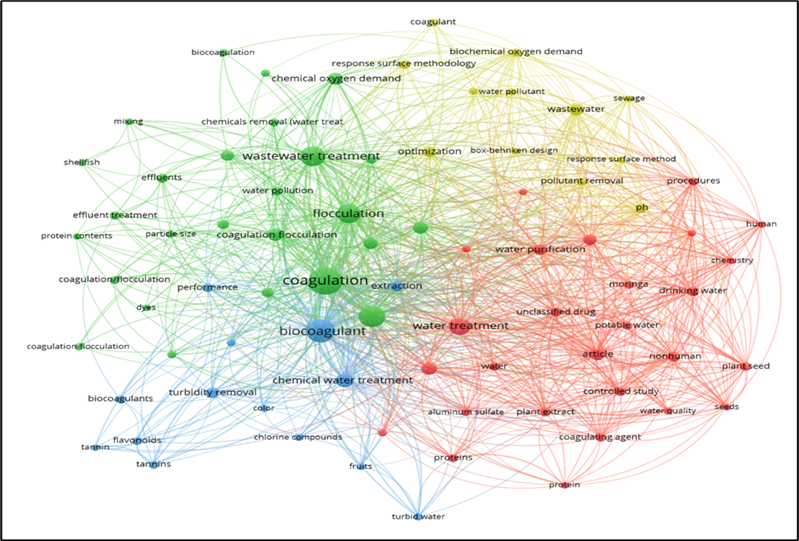
La búsqueda de alternativas sostenibles para el tratamiento de aguas residuales ha impulsado el desarrollo y aplicación de biocoagulantes derivados de fuentes vegetales, animales y microbianas. Estos materiales destacan por su biodegradabilidad, baja toxicidad y potencial para reemplazar coagulantes químicos convencionales. El presente estudio desarrolla una revisión bibliométrica sobre el empleo de biocoagulantes en el tratamiento de aguas residuales, utilizando 140 artículos indexados en Scopus entre 1983 y 2025. El análisis se realizó mediante Bibliometrix y VOSviewer, aplicando un umbral mínimo de cinco ocurrencias para identificar términos relevantes y construir mapas de co-ocurrencia. Se obtuvieron cuatro clústeres temáticos que representan las principales líneas de investigación: a Tratamiento de aguas residuales con biocoagulantes y desempeño del proceso, Potabilización y calidad del agua para consumo humano mediante el uso de biocoagulantes, Coagulantes naturales y alternativas sostenibles, Optimización experimental y metodología. Los resultados muestran un crecimiento sostenido de la producción científica durante la última década, con liderazgo de países asiáticos y africanos. Además, los estudios experimentales evidencian eficiencias superiores al 80 % en la remoción de turbidez, color y materia orgánica. En conjunto, el análisis demuestra que los biocoagulantes representan una alternativa viable y ambientalmente favorable para mejorar la calidad del agua tratada.
Descargas
Citas
Agbakpe, M., Ge, S., Zhang, W., Zhang, X., & Kobylarz, P. (2014). Algae harvesting for biofuel production: Influences of UV irradiation and polyethylenimine (PEI) coating on bacterial biocoagulation. Bioresource Technology, 166, 266–272. https://doi.org/10.1016/j.biortech.2014.05.060
Ahmad, A., Abdullah, S. R. S., Hasan, H. A., Othman, A. R., & Kurniawan, S. B. (2024). Aquaculture wastewater treatment using plant-based coagulants: Evaluating removal efficiency through the coagulation-flocculation process. Results in Chemistry, 7, 101390. https://doi.org/10.1016/j.rechem.2024.101390
Anele, B. C., Okerentugba, P. O., Stanley, H. O., Immanuel, O. M., Ikeh, I. M., Ukanwa, C. C., & Okonko, I. O. (2023). Treatment of abattoir wastewater using Moringa oleifera seed and snail shell in Rivers State, Nigeria. Scientia Africana, 22(2), 287–296. https://doi.org/10.4314/sa.v22i2.25
Belbahloul, M., Zouhri, A., & Anouar, A. (2015). Bioflocculants extraction from Cactaceae and their application in treatment of water and wastewater. Journal of Water Process Engineering, 7, 306–313. https://doi.org/10.1016/j.jwpe.2015.07.002
Bello, A., & Leiviskä, T. (2022). Sustainable tannin-based coagulants synthesized through Mannich reaction using melamine as an amine source for water treatment applications. Industrial Crops and Products, 176, 114336. https://doi.org/10.1016/j.indcrop.2021.114336
Benalia, A., Atime, L., Baatache, O., Khalfaoui, A., Ghomrani, A. F., Derbal, K., Pizzi, A., Panico, A., Bouchareb, E. M., Bouchareb, R., & Amirou, S. (2024). Removal of lead in water by coagulation flocculation process using Cactus-based natural coagulant: optimization and modeling by response surface methodology (RSM). Environmental Monitoring and Assessment, 196(3), 244. https://doi.org/10.1007/s10661-024-12412-9
Birhanu, Y., & Leta, S. (2021). Application of response surface methodology to optimize removal efficiency of water turbidity by low-cost natural coagulant (Odaracha soil) from Saketa District, Ethiopia. Results in Chemistry, 3, 100108. https://doi.org/10.1016/j.rechem.2021.100108
Braga, W. L. M., Roberto, J. A., Vaz, C., Samanamud, G. R. L., Loures, C. C. A., França, A. B., Lofrano, R. C. Z., Naves, L. L. R., José Henrique de Freitas Gomes, J. H., & Naves, F. L. (2018). Extraction and optimization of tannin from the flower of Musa sp. applied to the treatment of iron ore dump. Journal of Environmental Chemical Engineering, 6(4), 4310–4317. https://doi.org/10.1016/j.jece.2018.05.058
Cadena, A. P., Cevallos-Cedeño, R. E., & García Muentes, S. A. (2024). Evaluation of the coagulant property of carica papaya seeds in surface water treatment. Revista Mexicana de Ingeniería Química, 23(3), 1–10. https://doi.org/10.24275/rmiq/IA24301
Chethana, M., Sorokhaibam, L. G., Bhandari, V. M., Raja, S., & Ranade, V. V. (2016). Green Approach to Dye Wastewater Treatment Using Biocoagulants. ACS Sustainable Chemistry & Engineering, 4(5), 2495–2507. https://doi.org/10.1021/acssuschemeng.5b01553
Choy, S. Y., Prasad, K. M. N., Wu, T. Y., Raghunandan, M. E., & Ramanan, R. N. (2014). Utilization of plant-based natural coagulants as future alternatives towards sustainable water clarification. Journal of Environmental Sciences, 26(11), 2178–2189. https://doi.org/10.1016/j.jes.2014.09.024
Dinu, I. A., Mihai, M., & Dragan, E. S. (2010). Comparative study on the formation and flocculation properties of polyelectrolyte complex dispersions based on synthetic and natural polycations. Chemical Engineering Journal, 160(1), 115–121. https://doi.org/10.1016/j.cej.2010.03.018
Dotto, J., Fagundes-Klen, M. R., Veit, M. T., Palácio, S. M., & Bergamasco, R. (2019). Performance of different coagulants in the coagulation/flocculation process of textile wastewater. Journal of Cleaner Production, 208, 656–665. https://doi.org/10.1016/j.jclepro.2018.10.112
Elguera, N. Y. M., Pulcha, S. E. S., Ballon, E. M. M., Castro, M. R. F., Ramos, L. M. M., Tohalino, V. L. A., Sarmiento, P. K. D., Almeida, V. C., & Pacheco, H. G. J. (2024). Evaluation of Biocoagulant “ Opuntia ficus-indica and Chitosan ” to Improve the Removal of Contaminants in Dairy Effluents through Electrocoagulation. Journal of Chemistry, 2024(1). https://doi.org/10.1155/2024/6351954
Fadli, M. I., Bustan, M. D., & Haryati, S. (2024). Reducing Pollutants in Coal Wastewater with Moringa oleifera and Natural Biocoagulants Combination. Ecological Engineering & Environmental Technology, 25(8), 232–244. https://doi.org/10.12912/27197050/189806
Fagundes-Klen, M. R., Gullich, C. T. B., Triques, C. C., Formentini-Schmitt, D. M., Veit, M. T., & Bergamasco, R. (2023). Valorization of the Coagulant Bioactive Compound of the Moringa seed Residue: Treatability of Fish Processing Residuary Waters. Waste and Biomass Valorization, 14(12), 4113–4126. https://doi.org/10.1007/s12649-023-02110-x
Fan, L., Peng, R., Liu, X., Li, Z., Wang, Q., & Peng, S. (2025). Superior performance of a novel chitosan-based flocculant in sludge treatment: Synthesis, chelating mechanism, and engineering application by interconnected porous structure. Journal of Environmental Chemical Engineering, 13(5), 117841. https://doi.org/10.1016/j.jece.2025.117841
Ferasat, Z., Panahi, R., & Mokhtarani, B. (2020). Natural polymer matrix as safe flocculant to remove turbidity from kaolin suspension: Performance and governing mechanism. Journal of Environmental Management, 255, 109939. https://doi.org/10.1016/j.jenvman.2019.109939
Frantz, T. S., Farias, B. S. de, Leite, V. R. M., Kessler, F., Cadaval Jr, T. R. S., & Pinto, L. A. de A. (2020). Preparation of new biocoagulants by shrimp waste and its application in coagulation-flocculation processes. Journal of Cleaner Production, 269, 122397. https://doi.org/10.1016/j.jclepro.2020.122397
Kapse, G., & Samadder, S. R. (2021). Moringa oleifera seed defatted press cake based biocoagulant for the treatment of coal beneficiation plant effluent. Journal of Environmental Management, 296, 113202. https://doi.org/10.1016/j.jenvman.2021.113202
Katayon, S., Noor, M. J. M. M., Asma, M., Ghani, L. A. A., Thamer, A. M., Azni, I., Ahmad, J., Khor, B. C., & Suleyman, A. M. (2006). Effects of storage conditions of Moringa oleifera seeds on its performance in coagulation. Bioresource Technology, 97(13), 1455–1460. https://doi.org/10.1016/j.biortech.2005.07.031
Kolya, H., & Kang, C.-W. (2023). Bio-Based Polymeric Flocculants and Adsorbents for Wastewater Treatment. Sustainability, 15(12), 9844. https://doi.org/10.3390/su15129844
Konkobo, F. A., Savadogo, P. W., Diao, M., Dakuyo, R., & Dicko, M. H. (2023). Evaluation of the effectiveness of some local plant extracts in improving the quality of unsafe water consumed in developing countries. Frontiers in Environmental Science, 11. https://doi.org/10.3389/fenvs.2023.1134984
Koul, B., Bhat, N., Abubakar, M., Mishra, M., Arukha, A. P., & Yadav, D. (2022). Application of Natural Coagulants in Water Treatment: A Sustainable Alternative to Chemicals. Water, 14(22), 3751. https://doi.org/10.3390/w14223751
Kurniawan, S. B., Ahmad, A., Said, N. S. M., Gustinasari, K., Abdullah, S. R. S., & Imron, M. F. (2023). The influence of preparation and pretreatment on the physicochemical properties and performance of plant-based biocoagulants in treating wastewater. Environmental Advances, 14, 100441. https://doi.org/10.1016/j.envadv.2023.100441
Kurniawan, S. B., Haya, A. A., Soedarti, T., Kuncoro, E. P., Sługocki, Ł., Nowakowski, K., Abdul, P. M., & Imron, M. F. (2025). Revealing the potential of extracted Tamarindus indica seed as a biocoagulant for aquaculture wastewater treatment: Effect of solvent type, concentration, dose, and toxicity assessment. Results in Engineering, 27, 105710. https://doi.org/10.1016/j.rineng.2025.105710
López-Maldonado, E. A., Oropeza-Guzman, M. T., Jurado-Baizaval, J. L., & Ochoa-Terán, A. (2014). Coagulation–flocculation mechanisms in wastewater treatment plants through zeta potential measurements. Journal of Hazardous Materials, 279, 1–10. https://doi.org/10.1016/j.jhazmat.2014.06.025
Mutar, Z. H., Al-Baldawi, I. A., & Abdullah, S. R. S. (2025). Sustainable treatment of palm oil mill effluent and repurposing of sludge as a micronutrient resource. Journal of King Saud University – Science, 37, 9862025. https://doi.org/10.25259/JKSUS_986_2025
Namane, P. I., Letshwenyo, M. W., & Yahya, A. (2025). Evaluation of plant-based coagulants for turbidity removal and coagulant dosage prediction using machine learning. Environmental Technology, 46(14), 2570–2585. https://doi.org/10.1080/09593330.2024.2439183
Ndabigengesere, A., & Subba Narasiah, K. (1998). Quality of water treated by coagulation using Moringa oleifera seeds. Water Research, 32(3), 781–791. https://doi.org/10.1016/S0043-1354(97)00295-9
Neffa, M., Taourirte, M., Ouazzani, N., & Hanine, H. (2020). Eco-friendly approach for elimination of olive mill wastewaters (OMW) toxicity using cactus prickly pears juice as a coagulant. Water Practice and Technology, 15(4), 1050–1067. https://doi.org/10.2166/wpt.2020.076
Nzeyimana, B. S., & Mary, A. D. C. (2024). Sustainable sewage water treatment based on natural plant coagulant: Moringa oleifera. Discover Water, 4(1), 15. https://doi.org/10.1007/s43832-024-00069-x
Okolo, B. I., Adeyi, O., Oke, E. O., Agu, C. M., Nnaji, P. C., Akatobi, K. N., & Onukwuli, D. O. (2021). Coagulation kinetic study and optimization using response surface methodology for effective removal of turbidity from paint wastewater using natural coagulants. Scientific African, 14, e00959. https://doi.org/10.1016/j.sciaf.2021.e00959
Okuda, T., Baes, A. U., Nishijima, W., & Okada, M. (2001). Isolation and characterization of coagulant extracted from moringa oleifera seed by salt solution. Water Research, 35(2), 405–410. https://doi.org/10.1016/S0043-1354(00)00290-6
Otálora, M., Wilches-Torres, A., Lara, C., Cifuentes, G., & Gómez Castaño, J. (2022). Use of Opuntia ficus-indica Fruit Peel as a Novel Source of Mucilage with Coagulant Physicochemical/Molecular Characteristics. Polymers, 14(18), 3832. https://doi.org/10.3390/polym14183832
Pacheco, H. G. J., Elguera, N. Y. M., Mamani, M. R. A., Alvarez, N. P. L., & de Cinque Almeida, V. (2023). Treatment of textile wastewater by electrocoagulation process assisted with biocoagulant obtained from the pitahaya peels. Desalination and Water Treatment, 283, 1–10. https://doi.org/10.5004/dwt.2023.29186
Pritchard, M., Craven, T., Mkandawire, T., Edmondson, A. S., & O’Neill, J. G. (2010). A comparison between Moringa oleifera and chemical coagulants in the purification of drinking water – An alternative sustainable solution for developing countries. Physics and Chemistry of the Earth, Parts A/B/C, 35(13–14), 798–805. https://doi.org/10.1016/j.pce.2010.07.014
Pujiastuti, P., Wibowo, Y. M., & Narimo, N. (2022). Moringa Seed Powder Biocoagulant (Moringa oleifera) for Improving Laboratory Wastewater Quality. Molekul, 17(3), 301. https://doi.org/10.20884/1.jm.2022.17.3.5461
Rodrigues, J. R. da S., Santos, R. da S., Matos, R. A., Pires, J. C. M., & Salgado, E. M. (2023). Sustainable Microalgal Harvesting Process Applying Opuntia cochenillifera: Process Parameters Optimization. Applied Sciences, 13(2), 1203. https://doi.org/10.3390/app13021203
Sánchez-Martín, J., Beltrán-Heredia, J., & Solera-Hernández, C. (2010). Surface water and wastewater treatment using a new tannin-based coagulant. Pilot plant trials. Journal of Environmental Management, 91(10), 2051–2058. https://doi.org/10.1016/j.jenvman.2010.05.013
Sané, N., Sivalingam, P., Koželuh, M., Mbengue, M., Stoll, S., Poté, J., & Le Coustumer, P. (2024). Effect of Moringa oleifera seeds on the removal of pathogens and pharmaceutical residues in a domestic wastewater treatment plant by an interdisciplinary approach. Environmental Science and Pollution Research, 31(56), 65123–65136. https://doi.org/10.1007/s11356-024-35362-8
Shah, R. A. R., Abdullah, S. R. S., Hasan, H. A., Othman, A. R., & Ismail, N. ‘Izzati. (2023). Prospective plants as biocoagulant-flocculants for removal of total suspended solids in coffee effluent treatment. Chemical Engineering Research and Design, 198, 282–295. https://doi.org/10.1016/j.cherd.2023.09.002
Shahzadi, F., Haydar, S., & Tabraiz, S. (2024). Optimization of Coagulation to Remove Turbidity from Surface Water Using Novel Nature-Based Plant Coagulant and Response Surface Methodology. Sustainability, 16(7), 2941. https://doi.org/10.3390/su16072941
Tomasi, I. T., Boaventura, R. A. R., & Botelho, C. M. S. (2026). Comparative study of natural and chemical coagulants for continuous-flow treatment of textile wastewater. Chemical Engineering Science, 320, 122476. https://doi.org/10.1016/j.ces.2025.122476
Varala, S., Kumari, A., Buruga, K., Bhargava, S. K., & Parthasarathy, R. (2025). Abating cationic dye in wastewater using natural coagulants. Environmental Progress & Sustainable Energy, 44(1). https://doi.org/10.1002/ep.14523
Varsani, V., Vyas, S. J., & Dudhagara, D. R. (2022). Development of bio-based material from the Moringa oleifera and its bio-coagulation kinetic modeling–A sustainable approach to treat the wastewater. Heliyon, 8(9), e10447. https://doi.org/10.1016/j.heliyon.2022.e10447
Descargas
Publicado
Cómo citar
Número
Sección
Licencia
Derechos de autor 2026 Delmester Chuquimbalqui-Marina, Ivan Chuquimbalqui-Marina, Yrwin Daniel Azabache-Aliaga

Esta obra está bajo una licencia internacional Creative Commons Atribución 4.0.
Los autores retienen sus derechos:
a. Los autores retienen sus derechos de marca y patente, y tambien sobre cualquier proceso o procedimiento descrito en el artículo.
b. Los autores retienen el derecho de compartir, copiar, distribuir, ejecutar y comunicar públicamente el articulo publicado en la Revista Amazónica de Ciencias Ambientales y Ecológicas (REACAE) (por ejemplo, colocarlo en un repositorio institucional o publicarlo en un libro), con un reconocimiento de su publicación inicial en la REACAE.
c. Los autores retienen el derecho a hacer una posterior publicación de su trabajo, de utilizar el artículo o cualquier parte de aquel (por ejemplo: una compilación de sus trabajos, notas para conferencias, tesis, o para un libro), siempre que indiquen la fuente de publicación (autores del trabajo, revista, volumen, número y fecha).